Annexes Constats d'infraction A-35
ANNEXE I

|
1 | ||
|
DES ANNEXES
Section No Règlement
A C-25.1, r. 0.1.1 Règlement sur la forme des constats d'infraction
B C-25.1, r. 0.2.1 Règlement sur la forme des rapports d'infraction
C Règles de la Cour d'appel du Québec en matière criminelle
D C-25.1, r. 1.1 Règles de pratique de la Cour supérieure du Québec en matière pénale
E C-25.1, r. 2 Tarif judiciaire en matière pénale
F C-25.1, r. 0.3 Règlement sur certains frais judiciaires en matière pénale applicables aux personnes âgées de moins de 18 ans
G T-16, r. 8 Règles de pratique du Tribunal de la jeunesse en matière criminelle et pénale - Remplacées
H C-25, r. 1.01.1 Règlement de la Cour du Québec | ||
|
| ||
|
2 Tables des matières | ||
|
Section No Règlement
I C-25, r. 2 Règlement sur les indemnités et les allocations payables aux témoins assignés devant les cours de justice
J C-25.1, r. 0.4 Règlement sur la prise des dépositions des témoins en matière pénale
K C-27, r. 3.1 Règles de procédure du Tribunal du Travail
L C-72.01, r. 0.01 Règlement des cours municipales
| ||
|
A-2 Constats d'infraction Annexes | ||||||
|
au support ou à la sécurité informatique peut différer.
4. Un formulaire de constat d'infraction est un document qui se compose de rubriques, mots-clés et textes préimprimés ou préprogrammés dans le cadre desquels des espaces sont prévus pour l'inscription manuscrite, mécanique ou informatisée des mentions obligatoires et facultatives prévues par la loi ou le présent règlement. Il peut aussi comporter, de façon sous-jacente ou apparente, des codes, marques ou mentions propres au support électronique ou visant à assurer la sécurité de l'information et de la documentation électroniques en matière pénale.
5. Un document-réponse, sur support papier ou sur support électronique, doit être joint au constat du défendeur. Il se compose de rubriques, mots-clés, textes préimprimés ou préprogrammés permettant l'inscription manuscrite, mécanique ou informatisée des mentions obligatoires et facultatives prévues par la loi ou le présent règlement, dont la réponse du défendeur. Tout document sur support papier qui porte la réponse du défendeur peut, conformément au présent règlement, être numérisé et joint électroniquement ou relié électroniquement par référence à un constat d'infraction réalisé sur support électronique.
6. Le constat d'infraction peut être réalisé soit entièrement sur support papier ou sur support électronique, soit en partie au moyen d'un support papier et en partie au moyen d'un support électronique. Il peut aussi être réalisé sur support papier, puis transféré sur sup |
concerning the nature of the form or computer security may differ.
4. A statement of offence form is a document containing headings, key words and pre-printed or pre-programmed texts allowing the optional or compulsory particulars prescribed by an act or this Regulation to be entered by hand, mechanically or by computer. It may also contain computer codes, marks or particulars, either underlying or visible, that are specific to the electronic form or are designed to ensure the security of electronic data and documentation in penal matters.
5. A return document, in paper or in electronic form, shall be attached to the defendant's statement of offence. It shall contain headings, key words and pre-printed or pre-programmed texts allowing the optional or compulsory particulars prescribed by an act or this Regulation, including the defendant's response, to be entered by hand, mechanically or by computer. Any document in paper form bearing the defendant's response may, in accordance with this Regulation, be digitized and electronically attached or referenced to a statement of offence in electronic form.
6. The statement of offence may be generated entirely in paper form or in electronic form, or partly in paper form and partly in electronic form. It may also be drawn up in paper form, then transferred into electronic form by means of | |||||
|
| ||||||
|
| ||||||
|
| ||||||
|
| ||||||
|
Annexes Constats d'infraction A-3 | |||||
|
port électronique, au moyen de la numérisation, et peut alors être matérialisé sur support papier. Ainsi, le constat peut être soit originairement, soit à la suite de sa matérialisation à partir d'un support électronique; le constat peut aussi être sur support électronique soit originairement, soit en raison de sa numérisation à partir d'un support papier.
7. Lorsque le constat d'infraction est originairement réalisé sur support papier, chacun des doubles du constat d'infraction constitue un document original.
8. Lorsque le constat d'infraction est entièrement ou partiellement réalisé sur support électronique, soit originairement ou par transfert sur un tel support au moyen de la numérisation, les données informatiques qui forment et permettent de visualiser ou de matérialiser le formulaire et les mentions qui le composent, en tout ou en partie, sur ce support ont valeur d'original, si le constat répond aux normes prévues au présent règlement et à celles d'un règlement sur la sécurité de l'information et de la documentation électroniques en matière pénale pris en vertu du paragraphe 1.1 de l'article 367 du Code du procédure pénale (chapitre C-25.1). Ces données informatiques conservent leur valeur d'original lors de leur transfert, de leur transmission, de leur consultation, de leur utilisation, jusqu'à leur conservation ou leur archivage sur support électronique ou au moyen d'un tel support, si elles répondent aux normes prévues à ce dernier règlement. Il en est de même des données informatiques qui forment le constat d'infraction |
digitization, and may then be converted into hard copy. Thus a statement of offence may be in paper form, either originally or after conversion from electronic form into hard copy; a statement of offence may also be in electronic form, either originally or after digitization from the paper form.
7. Where the statement of offence is originally produced in paper form, each of the duplicates of the statement of offence constitutes and original document.
8. Where the statement of offence is generated entirely or partly in electronic form, either originally or after its transfer into electronic form by means of digitization, the computer data that make it possible to display the form or convert into hard copy the form and the particulars recorded therein, in whole or in part, have the same force as an original, if the statement meets the standards provided for in this Regulation and in those of a regulation respecting the security of electronic data and documentation in penal matters made pursuant to paragraph 1.1 of article 367 of the Code of Penal Procedure (chapter C-25.1); The computer data have the same force as an original during electronic transfer, transmission, use, storage and archiving in electronic form or by electronic means, if they meet the standards provided for in the Regulation referred to above. This also applies to computer data comprising the digitized statement of offence, whether the form or particulars comprising it were digitized simultaneously or separately. | ||||
|
A-4 Constats d'infraction Annexes | ||||
|
numérisé que le formulaire ou les mentions qui le composent soient numérisés simultanément ou séparément. De même, les données informatiques qui forment et permettent de visualiser ou de matérialiser le document électronique qui porte la réponse du défendeur ont valeur d'original, si le document est réalisé conformément à ces normes.
9. Lorsque le constat d'infraction, réalisé entièrement ou partiellement sur support électronique, est matérialisé sur un formulaire préimprimé ou prépro-grammé, la première matérialisation du constat destiné au défendeur, le constat matérialisé que le poursuivant peut produire en preuve et le constat matérialisé qui est destiné à l'autorité judiciaire ont également valeur d'original. Cependant , lorsqu'il y a matérialisation du constat numérisé ou des mentions numérisées qui le composent, le constat matérialisé que le poursuivant peut produire en preuve et celui qui est destiné à l'autorité judiciaire tiennent lieu d'original sur support papier.
10. Le constat d'infraction sur support papier se compose de feuillets, tandis que le constat ou la partie de constat sur support électronique se compose de données informatiques présentées sur des pages-écran. Le formulaire et les mentions présentés sur les pages-écran d'un constat peuvent être joints électroniquement ou reliés électroniquement par référence. Cependant, les pages-écran du constat ou les sections qu'elles comportent doivent être intelligibles et elles doivent être accessibles sur une surface de visuali |
In the same manner, the computer data that make it possible to display the form bearing the defendant's response or to convert it into hard copy, have the same force as an original, if the document is produced in accordance with these standards.
9. Where a statement of offence, generated entirely or partly in electronic form, is converted into hard copy on a pre-printed or pre-programmed form, the first hard-copy statement of offence intended for the defendant, the hard-copy statement of offence that the prosecutor may adduce as evidence and the hard-copy statement of offence intended for the judicial authority have the same force as an original. Where a digitized statement of offence or the digitized particulars it comprises are converted into hard copy, the hard-copy statement of offence that the prosecutor may adduce as evidence and the hard-copy statement of offence intended for the judicial authority stand in lieu of the original.
10. A statement of offence in paper form is composed of pages, whereas a statement of offence or part thereof in electronic form is composed of computer data displayed on page screens. The form and the particulars displayed on the page screens in a statement of offence may be electronically attached or referenced. However, the page screens in a statement of offence or the sections they contain shall be intelligible and shall be accessible on a | |||
|
Annexes Constats d'infraction A-5 | ||||
|
sation, soit entièrement, soit partiellement, de manière séquentielle ou thématique.
11. Le constat d'infraction ainsi que tout document portant la réponse du défendeur qui sont réalisés entièrement ou partiellement sur support électronique peuvent, soit demeurer sur un tel support et être ainsi utilisé à partir d'une surface de visualisation, soit être matérialisé sur un formulaire de constat d'infraction préimprimé ou préprogrammé ou, en cas de numérisation, sur un feuillet destiné à porter la reconstitution du constat.
12. Lorsque le constat d'infraction comporte plus d'un chef d'accusation contre un même défendeur, l'utilisation d'autant de formulaires, du type de constat d'infraction approprié, qu'il y a de chefs d'accusation est requis pour constituer le constat d'infraction. Les formulaires, sur support papier ou sur support électronique, d'un constat qui comporte plusieurs chefs d'accusation distincts sont reliés entre eux par une désignation commune à l'ensemble du constat et chacun des formulaires qui comporte l'un de ces chefs d'accusation est distingué par une désignation particulière.
13. Lorsqu'une même accusation est porté contre plusieurs défendeurs dans un constat d'infraction, l'utilisation d'autant de formulaires, du type de constat d'infraction approprié, qu'il y a de défendeurs est requise. Les formulaires, sur support papier ou sur support électronique, d'un constat qui comporte plusieurs défendeurs sont reliés entre eux par une désignation commune à l'ensemble du constat et |
display surface, either in whole or in part, sequentially or thematically.
11. The return document or any other document bearing the defendant's response that is entirely or partly electronically-generated may remain in electronic form and be so used on a display surface, or be converted into hard copy on a pre-printed or pre-programmed statement of offence form, or if digitized, on a page for the purposes of reconstituting the statement.
12. Where a statement of offence contains more than one count against a single defendant, the statement of offence shall be constituted by using a separate statement of offence form of the appropriate type for each count. Where a statement of offence contains two or more separate counts, the statement of offence forms, in paper or in electronic form, shall be cross-referenced by a designation that refers to the entire statement, and each form bearing one of those counts shall be distinguished by a specific designation.
13. Where a single charge is brought against two or more defendants in a statement of offence, a separate statement of offence form of the appropriate type shall be used for each defendant. Where a statement of offence names two or more defendants, the statement of offence forms, in paper or in electronic form, shall be cross-referenced by a designation that refers to the entire statement, and each form for an individual | |||
|
A-6 Constats d'infraction Annexes | ||||
|
chacun des formulaires destiné à l'un des défendeurs est distingué par une désignation particulière.
SECTION II CONSTAT D'INFRACTION ORIGINAIREMENT SUR SUPPORT PAPIER
14. Le constat d'infraction originairement réalisé sur support papier se compose d'au moins deux feuillets destinés respectivement au défendeur et à l'autorité judiciaire. Il peut également comporter des feuillets additionnels destinés au poursuivant. Un document-réponse sur feuillets est joint au constat destiné au défendeur. Le constat d'infraction composé de feuillet comportant des inscriptions informatisées est un constat sur support papier assujetti aux normes de la présente section et il doit être signé de façon manuscrite lors de sa délivrance.
15. Le constat d'infraction sur support papier visé au paragraphe 1 du premier alinéa de l'article 23 est réalisé sur des feuillets de 21,5 cm de largeur sur 35,5 cm de hauteur. Les constats d'infraction sur support papier visés aux paragraphes 2 et 3 du premier alinéa de l'article 23 peuvent être de plus petit format, soit d'au moins 10 cm de largeur sur au moins 20 cm de hauteur et d'au plus 21,5 cm de largeur sur 35,5 cm de hauteur. Le constat d'infraction sur support papier visé au paragraphe 4 du premier alinéa de l'article 23 est d'au moins 9 cm de largeur sur au moins 20 cm de hauteur et d'au plus 21,5 cm de largeur sur 35,5 de hauteur. Le papier ou le procédé de reproduction utilisé doit permettre la reproduction exacte, sur le recto de chacun des feuillets |
defendant shall be distinguished by a specific designation.
DIVISION II STATEMENT OF OFFENCE ORIGINALLY IN PAPER FORM
14. A statement of offence originally drawn up in paper form shall contain at least two pages intended respectively for the defendant and the judicial authority. It may also contain additional pages intended for the prosecutor. A return document in a page format shall be attached to the statement of offence intended for the defendant. The statement of offence made up of pages comprising computer data is a statement in paper form subject to the standards of this Division and must be signed by hand when issued.
15. The statement of offence in paper form referred to in subparagraph 1 of the first paragraph of section 23 shall be in a format measuring 21.5 cm wide by 35.5 cm high. The statements of offence in paper form referred to in subparagraphs 2 and 3 of the first paragraph of section 23 may be in a smaller format, but may not be less that 10 cm wide by 20 cm high nor more than 21.5 cm wide by 35.5 cm high. The statement of offence in paper form referred to in subparagraph 4 of the first paragraph of section 23 shall not be less that 9 cm wide by 20 cm high nor more than 21.5 cm wide by 35.5 cm high. The paper or the reproduction process used shall be such that the handwritten, mechanical or computer entries made on the front of the first page can be | |||
|
Annexes Constats d'infraction A-7 | ||||
|
du constat, des inscriptions manuscrites, mécaniques ou informatisées faites sur le recto du premier feuillet. Cependant, les feuillets du constat peuvent être signés un à un. Les rubriques, mots-clés et mentions générales peuvent être préimprimés ou préprogrammés. Le caractère d'imprimerie ou, selon le cas, du caractère d'imprimante ne peut alors être inférieur à six points.
SECTION III CONSTAT D'INFRACTION ORIGINAIREMENT SUR SUPPORT ÉLECTRONIQUE
16. Le constat d'infraction entièrement réalisé sur support électronique se présente sur des pages-écran composés de données informatiques correspondant au recto et au verso d'un feuillet de constat d'infraction. Il en est de même du document-réponse au constat d'infraction, lequel se présente sur des pages-écran composées de données informatiques correspondant au recto et au verso d'un document-réponse sur feuillet joint à un constat d'infraction.
17. Lorsque le constat d'infraction est partiellement réalisé sur support électronique, la partie du constat qui est originairement sur ce support se présente sur des pages-écran. Lorsque seul le recto du constat est réalisé sur support électronique, il peut être matérialisé sur un formulaire de constat dont le recto ou le verso peuvent être soit préimprimés, soit préprogrammés. Le document-réponse du constat partiellement réalisé sur support électronique peut être réalisé sur un formulaire préimprimé ou préprogrammé. |
accurately reproduced on the front of each page in the statement of offence. However, the pages of the statement of offence may be signed one by one. The headings, key words and general particulars may be pre-printed or pre-programmed. The type size of the printer or the printing press, as the case may be, shall be no smaller than 6 point.
DIVISION III STATEMENT OF OFFENCE ORIGINALLY IN ELECTRONIC FORM
16. A statement of offence generated entirely in electronic form is displayed on page screens containing computer data that corresponds to the front and the back of a page in a statement of offence. The same is true of the return document in a statement of offence, which in such case is displayed on page screens containing computer data that correspond to the front and the back of a return document on a page attached to a statement of offence.
17. A part of a statement of offence may be originally generated in electronic form. The part so generated is displayed on page screens. Where only the data corresponding to the front of a statement of offence are generated in electronic form, they may be converted into hard copy on a statement of offence form whose front or back may be either pre-printed or pre-programmed. A return document in the statement of offence that is generated partly in electronic form may be generated on a pre-printed or pre-programmed form. | |||
|
A-8 Constats d'infraction Annexes | ||||
|
SECTION IV CONSTAT D'INFRACTION NUMÉRISÉ
18. Le constat d'infraction destiné à l'autorité judiciaire et qui est originairement réalisé sur support papier peut être numérisé. Le recto et le verso du formulaire ainsi que les mentions qui constituent ce constat peuvent être numérisés, soit simultanément, soit séparément. Dans ce dernier cas, le recto du constat numérisé se présente sur des pages superposées et le verso peut être joint électroniquement ou relié électroniquement par référence. Lorsque le recto du constat est numérisé séparément, le constat peut être matérialisé sur un feuillet destiné à porter la reconstitution du recto du constat et dont le verso peut être préimprimé ou préprogrammé. De même, lorsque les mentions qui composent le recto du constat sont numérisées séparément, le constat peut être matérialisé sur un formulaire préimprimé ou prépro-grammé.
SECTION V CONSTAT D'INFRACTION MATÉRIALISÉ
19. Les constats d'infractions réalisés entièrement ou partiellement sur support électronique ainsi que les constats numérisés peuvent être matérialisés. Le document matérialisé comporte l'attestation de matérialisation prévue au paragraphe 5 de l'article 25. Lorsque le constat est matérialisé, il résulte de la combinaison d'une partie virtuelle et d'une partie matérielle. La partie virtuelle est constituée des mentions et du formulaire préprogrammé qui |
DIVISION IV DIGITIZED STATEMENT OF OFFENCE
18. A statement of offence intended for the judicial authority and originally drawn up in paper form may be digitized. The front and the back of the form as well as the particulars contained in that statement of offence may be digitized either simultaneously or separately. In the latter case, the front of the digitized statement of offence is displayed on superimposed page screens and the back may be electronically attached or referenced to it. Where the front of the statement of offence is digitized separately, the statement of offence may be converted into hard copy on a page that is intended to bear the reconstitution of the front of the statement and whose back may be pre-printed or pre-programmed. Where the particulars contained on the front of the statement of offence are digitized separately, the statement may like-wise be converted into hard copy on a pre-printed or pre-programmed form.
DIVISION V HARD-COPY STATEMENT OF OFFENCE
19. Statements of offence generated entirely or partly in electronic form and digitized statements of offence may be converted into hard copy. In that case, the hard-copy document shall bear an attestation of hard-copy conversion such as provided for in paragraph 5 of section 25. Where a statement of offence is converted into hard copy, it results from the combination of a virtual part and a material part. The virtual part is comprised of | |||
|
Annexes Constats d'infraction A-9 | ||||
|
composent le constat ou la partie du constat réalisé sur support électronique; en cas de numérisation, la partie virtuelle est constituée des mentions et du formulaire numérisés. La partie matérielle est constituée du formulaire du constat sur support papier, lequel peut être préimprimé ou préprogrammé; en cas de numérisation, elle est constituée, soit de la reconstitution sur support papier du formulaire et des mentions numérisés du constat. Il en est de même du document-réponse ou des autres documents additionnels qui portent la réponse du défendeur.
20. Le poursuivant qui désire produire en preuve un constat d'infraction matérialisé peut ne produire que la matérialisation du recto ou des données informatiques des pages-écran correspondantes du constat. Cependant, le poursuivant doit, au besoin, mettre le verso ou les données des pages-écrans correspondantes du constat à la disposition de l'autorité judiciaire, soit sur support papier ou sur support électronique.
21. Le constat d'infraction matérialisé destiné au défendeur est réalisé conformément aux premier et troisième alinéas de l'article 15, qu'il soit matérialisé sur un formulaire de constat préimprimé ou préprogrammé. Le constat matérialisé destiné au poursuivant ou à l'autorité judiciaire peut être réalisés sur des feuillets d'au moins 9 cm de largeur sur au moins 20 cm de hauteur et d'au plus 21,5 cm de largeur sur 35,5 cm de hauteur.
22. Le papier utilisé pour la matérialisation du constat d'infraction destiné |
the particulars and the pre-programmed form contained in the statement of offence or in the part of the statement of offence generated in electronic form; in case of digitization, the virtual part is comprised of the digitized form and particulars. The material part is comprised of the statement of offence form in paper form, which may be pre-printed or pre-programmed; in case of digitization, the material part is comprised of either a pre-printed or pre-programmed form or the reconstitution in paper form of the digitized form and particulars in the statement of offence. The same is true of the return document or the other additional documents bearing the defendant's response.
20. A prosecutor wishing to adduce as evidence a hard-copy statement of offence may submit only the hard-copy of the front of the pages or of the computer data in the corresponding page screens in the statement. However, the prosecutor shall, if need be, make the back of the pages or the data in the corresponding page screens of the statement of offence available to the judicial authority either in paper form or in electronic form.
21. The hard-copy statement of offence intended for the defendant shall be generated in accordance with the first and third paragraphs of section 15, whether it is converted into hard copy on a pre-printed or on a pre-programmed statement of offence form. The hard-copy statement of offence intended for the prosecutor or for the judicial authority may be generated on pages not less than 9 cm wide by 20 cm high nor more than 21.5 cm wide by 35.5 cm high.
22. The paper used to convert into hard copy the statement of offence in | |||
|
A-10 Constats d'infraction Annexes | ||||||
|
au défendeur, de celui destiné à l'autorité judiciaire pour être au dossier du tribunal ou de celui destiné au poursuivant et devant servir de preuve documentaire doit permettre de reconnaître que ce constat est un original, soit par l'emploi d'un papier d'un grain spécial, soit au moyen d'un sceau, d'un sigle, d'un code, d'un numéro, d'une marque ou d'une mention distinctive. La taille du caractère d'imprimante ou, selon le cas, d'imprimerie utilisé pour la matérialisation du constat d'infraction ne peut être inférieure à six points.
CHAPITRE II DISPOSITIONS PARTICULIÈRES
SECTION I TYPES DE CONSTAT D'INFRACTION
23. Les quatre types de constat d'infraction qui peuvent être utilisés pour la poursuite des infractions aux dispositions des lois et des règlements sont les suivants: 1) le constat d'infraction général avec avis permettant la réclamation d'une peine plus forte que la peine minimale; ce constat est applicable à toutes les infractions, à l'exception de celles visées à la section II du chapitre VI du Code de procédure pénale, et permet la réclamation d'une peine plus forte que la peine minimale; il est destiné, soit à être remis lors de la perpétration de l'infraction ou après enquête sommaire, lorsque le poursuivant réclame une peine plus forte que la peine minimale, soit à être signifié après la perpétration d'une infraction, lorsqu'une enquête détaillée ou une vérification particulière quant à l'infraction ou à la peine est requise; un modèle de ce type de constat se trouve à l'annexe I; |
tended for the defendant, the statement of offence intended for the judicial authority to be kept in the court record or the statement of offence intended for the prosecutor to be used as documentary evidence shall be such that the statement can be recognized as an original, either by use of paper of a special grain, or by means of a seal, an acronym, a code, a number, a mark or a distinctive indication. The type size of the printer or the printing press, as the case may be, used to convert the statement of offence into hard copy shall be no smaller than 6 point.
CHAPTER II SPECIAL PROVISIONS
DIVISION I TYPES OF STATEMENTS OF OFFENCE
23. Four types of statement of offence may be used for proceedings in respect of offences against the provisions of statutes and regulations enacted or made in Québec: 1) a general statement of offence with a request for sentence allowing for a greater sentence than the minimum sentence, a model for which appears in Schedule I, applies to all offences, except offences to which Division II of Chapter VI of the Code of Penal Procedure applies, and allows a request for a greater sentence than the minimum sentence; it is intended to be remitted at the time of the offence or following a summary investigation, where the prosecutor requests a greater sentence than the minimum sentence, or to be served after an offence is committed, where a detailed investigation or special inquiry is required in respect of the offence or the sentence; | |||||
|
| ||||||
|
| ||||||
|
Annexes Constats d'infraction A-11 | ||||||||
|
2) le constat d'infraction général avec avis de réclamation de la peine minimale; ce constat est applicable à toutes les infractions, à l'exception de celles visées à la section II du chapitre VI du Code de procédure pénale, et ne permet que la réclamation de la peine minimale; il est destiné, soit à être remis lors de la perpétration de l'infraction, soit à être signifié après enquête sommaire; un modèle de ce type de constat se trouve à l'annexe II; 3) le constat d'infraction délivré pour les infractions relatives au contrôle du transport routier, à la sécurité routière et au stationnement d'un véhicule ou pour les infractions dont une municipalité est chargée de la poursuite, que la section II du chapitre VI du Code de procédure pénale s'applique ou non à ces infractions; ce constat est destiné à être remis lors de la perpétration de l'infraction ou à être signifié après celle-ci, dans les cas où le poursuivant ne réclame que la peine minimale; un modèle de ce type se trouve à l'annexe III; 4) le constat d'infraction délivré pour les infractions relatives au stationnement d'un véhicule, que la section II du chapitre VI du Code de procédure pénale s'applique ou non à ces infractions; ce constat est destiné à être remis lors de la perpétration de l'infraction ou après celle-ci, dans les cas où le poursuivant ne réclame que la peine minimale; un modèle de ce type de constat se trouve à l'annexe IV. Un constat d'infraction matérialisé au sens de la section V du chapitre I du présent règlement comporte une attestation de matérialisation. Un modèle du recto et du verso du type de constat prévu au paragraphe 3) du premier alinéa et portant une telle attestation se trouve à l'annexe V. |
2) a general statement of offence with a request for sentence for the minimum sentence, a model for which appears in Schedule II, applies to all offences, except offences to which Division II of Chapter VI of the Code of Penal Procedure applies, and allows only a request for the minimum sentence; it is intended to be remitted at the time of the offence or to be served following a summary investigation; 3) a statement of offence issued for an offence relating to the control of highway transportation, highway safety or parking violations or for an offence which a municipality is responsible for prosecuting, whether or not Division II of Chapter VI of the Code of Penal Procedure applies to those offences, a model for which appears in Schedule III, is intended to be remitted at the time of the offence or to be served following the offence, in cases where the prosecutor requests the minimum sentence only; and 4) a statement of offence issued for a parking violation, whether or not Division II of Chapter VI of the Code of Penal Procedure applies to the offence, a mo-del for which appears in Schedule IV, is intended to be remitted at the time of the offence or following it, in cases where the prosecutor requests the minimum sentence only. A statement of offence converted into hard copy within the meaning of Division V of Chapter I of this Regulation must include an attestation of hard copy conversion. A model for the front and back of the type of statement of offence provided for in subparagraph 3) of the first paragraph bearing an attestation of hard copy conversion is set out in Schedule V. | |||||||
|
| ||||||||
|
| ||||||||
|
| ||||||||
|
| ||||||||
|
| ||||||||
|
| ||||||||
|
| ||||||||
|
| ||||||||
|
A-12 Constats d'infraction Annexes | ||||||
|
SECTION II CONSTAT D'INFRACTION GÉNÉRAL AVEC AVIS DE RÉCLAMATION D'UNE PEINE PLUS FORTE QUE LA PEINE MINIMALE
24. Le recto des feuillets ou les données des pages-écran correspondantes du constat d'infraction général avec avis permettant la réclamation d'une peine plus forte que la peine minimale comportent les rubriques, mots-clés, textes et espaces permettant d'inscrire toutes les mentions suivantes: 1) le titre «constat d'infraction» et le numéro du constat; 2) le district judiciaire où la poursuite est intentée; 3) lorsque sur support papier, le numéro du dossier du greffe; lorsque sur support électronique, ce numéro peut être inscrit sur un autre document électroniquement joint au constat ou qui y est relié électroniquement par référence; 4) les nom et adresse du poursuivant; l'adresse du poursuivant peut apparaître au verso du constat plutôt qu'au recto; 5) les nom et adresse du défendeur; 6) la description de l'infraction et la peine minimale prévue pour une première infraction à la disposition législative enfreinte; 7) le nom, la qualité et, selon le cas, la signature de la personne qui a délivré le constat d'infraction ou sa signature apposé au moyen d'un procédé électronique ou le code de validation de sa signature ainsi apposée et la date de la délivrance du constat; 8) la date et l'heure de la signification du constat par huissier ou par agent de la paix ou, dans le cas de la signification par la poste, la référence au document qui en indique la date; 9) si le constat est signifié autrement |
DIVISION II GENERAL STATEMENT OF OFFENCE WITH A REQUEST FOR SENTENCE ALLOWING FOR A GREATER SENTENCE THAN THE MINIMUM SENTENCE
24. The front of the pages or the data on the corresponding page screens in the general statement of offence with a request for sentence allowing for a greater sentence than the minimum sentence shall contain the headings, key words, texts and spaces allowing all the following particulars to be entered: 1) the title "Statement of Offence" and the number of the statement of offence; 2) the judicial district in which the proceedings are instituted; 3) if the statement of offence is in paper form, the court office record number; if the statement of offence is in electronic form, that number may be entered in another document electronically attached or referenced to the statement of offence; 4) the prosecutor's name and address; the prosecutor's address may appear on the back of the statement of offence rather than on the front; 5) the defendant's name and address; 6) a description of the offence and the minimum sentence prescribed for a first offence against the legislative provision violated; 7) the name, quality and signature of the issuer of the statement of offence or, as the case may be, his signature affixed electronically or the validation code for his signature so affixed, and the date on which the statement is issued; 8) the date and time of service of the statement of offence by a bailiff or a peace officer or, for service by mail, the reference to the document stating that date; | |||||
|
| ||||||
|
| ||||||
|
Annexes Constats d'infraction A-13 | ||||
|
que par la poste, le nom, la qualité et, selon le cas, la signature de la personne qui a effectué la signification ou sa signature apposée au moyen d'un procédé électronique ou le code de validation de sa signature ainsi apposé; 10) un avis de réclamation indiquant la peine, les frais et, le cas échéant, le montant de la contribution prévu à l'article 8.1 du Code de procédure pénale et, si le poursuivant réclame une peine plus forte que la peine minimale, la peine réclamée et les motifs de cette réclamation; 11) le plaidoyer du défendeur et, en cas de plaidoyer de culpabilité, l'indication de la possibilité de contester la peine plus forte réclamée; 12) la signature du défendeur ou, selon le cas, sa signature apposée au moyen d'un procédé électronique ou le code de validation de sa signature ainsi apposée, la qualité du signataire si le défendeur est une personne morale ainsi que la date de la signature; 13) un avis ou une ordonnance relatifs à l'infraction décrite et prévus par la loi créatrice de l'infraction.
25. Le recto des feuillets ou les données des pages-écran correspondantes du constat d'infraction peuvent comporter en outre les mentions suivantes: 1) le numéro du dossier du poursuivant; 2) la date de naissance du défendeur; 3) le type de pièce ou de fichier et les éléments de la pièce ou du fichier permettant de confirmer l'identité du défendeur; 4) la possibilité d'indiquer une nouvelle adresse; 5) dans la section relative à la matérialisation du constat: a) l'attestation de matérialisation; |
9) if the statement of offence is served other than by mail, the name, quality and signature of the person who served the statement of offence or, as the case may be, his signature affixed electronically or the validation code for his signature so affixed; 10) a request for sentence stating the sentence, the costs and, where applicable, the amount of the contribution provided for in article 8.1 of the Code of Penal Procedure and, where the prosecutor requests a greater sentence than the minimum sentence, the sentence requested and the reasons for the request; 11) the defendant's plea and, in the case of a plea of guilty, mention of the fact that the greater sentence requested may be contested; 12) the defendant's signature or, as the case may be, his signature affixed electronically or the validation code for his signature so affixed, the quality of the signatory if the defendant is a legal person, and the date of the signature; and 13) a notice or an order relating to the offence described and provided for in the statute creating the offence.
25. The front of the pages or the data on the corresponding page screens in the statement of offence may also contain the following particulars: 1) the prosecutor's file number; 2) the defendant's birthdate; 3) the type of document or file and the items in the document or file that make it possible to confirm the defendant's identity; 4) space to indicate a change of address; 5) in the section concerning the conversion of the statement into hard copy; a) an attestation of hard-copy conversion; b) the name and quality of the person | |||
|
A-14 Constats d'infraction Annexes | ||||
|
b) le nom et la qualité de la personne qui atteste la matérialisation ainsi que la date, l'heure et la minute à laquelle la matérialisation a été effectuée; c) la signature de la personne qui atteste la matérialisation ou, selon le cas, sa signature apposée au moyen d'un procédé électronique ou le code de validation de sa signature ainsi apposée; 6) les codes, marques ou mentions informatiques permettant de repérer les documents électroniquement joints au constat ou qui y sont reliés électroniquement par référence; 7) les codes, marques ou mentions informatiques permettant d'assurer la sécurité de l'information que porte le constat.
26. Le constat d'infraction sur support papier destiné au défendeur est composé d'une partie fixe et d'une partie détachable, lorsque le constat est sur support électronique, cette dernière partie peut être transmise électroniquement, visualisée ou matérialisée séparément et elle comporte les mentions prévues aux paragraphes 11) et 12) de l'article 24 ainsi que, le cas échéant, une attestation de matérialisation conforme à celle prévue au paragraphe 5) de l'article 25 et le numéro du constat dont cette partie est matérialisée.
27. Le constat d'infraction sur support papier destiné à l'autorité judiciaire est également composé d'une partie fixe et d'une partie détachable. Lorsque le constat est sur support électronique, cette dernière partie peut être transmise électroniquement, visualisée ou matérialisée séparément et elle comporte les mentions prévues aux paragraphes 10), 11) et 12) de l'article 24 ainsi que, le cas échéant, une attesta- |
attesting to the hard-copy conversion and the date and exact time of conversion; and c) the signature of the person attesting to the hard-copy conversion or, as the case may be, his signature affixed electronically or the validation code for his signature so affixed; 6) the computer codes, marks or particulars making it possible to locate the documents electronically attached or referenced to the statement of offence; and 7) the computer codes, marks or particulars making it possible to ensure the security of the data contained in the statement of offence.
26. The statement of offence in paper form intended for the defendant shall consist of a stub and a detachable portion. Where the statement is in electronic form, the detachable portion may be transmitted electronically, displayed or converted into hard copy separately, and it shall contain the particulars prescribed in paragraphs 11) and 12) of section 24 and, where applicable, an attestation of hard-copy conversion complying with that prescribed in paragraph 5) of section 25 and the number of the statement of offence from which that part was converted.
27. The statement of offence in paper form intended for the judicial authority shall also consist of a stub and a detachable portion. Where the statement is in electronic form, the detachable portion may be transmitted electronically, displayed or converted into hard copy separately, and it shall contain the particulars prescribed in paragraphs 10), 11) and 12) of section 24 and, where applicable, an attestation of hard-copy conversion and | |||
|
Annexes Constats d'infraction A-15 | ||||||
|
tion de matérialisation et le numéro du constat dont cette partie est matérialisée. Toutefois, les mentions sur support papier prévues au paragraphes 11) et 12) de l'article 24 peuvent être remplacées sur la partie détachable par un rapport de signification du constat également détachable. Lorsque sur support électronique, cette partie peut être transmise électroniquement, visualisée ou matérialisée séparément. Dans ce cas, le numéro du constat d'infraction doit être inscrit sur la partie du constat relative à l'avis de réclamation et sur la partie du constat relative au rapport de signification et, le cas échéant, la partie matérialisée du constat comporte une attestation de matérialisation.
28. Le verso des feuillets ou les données des pages-écran correspondantes du constat d'infraction comportent au moins les rubriques, mots-clés, textes et espaces permettant d'inscrire: 1) la définition de l'objet général d'un constat d'infraction; 2) la description des étapes de procédure conséquentes, soit à la transmission ou au défaut de transmission d'un plaidoyer, soit à l'indication de l'intention de contester la peine plus forte réclamée; 3) l'endroit où le défendeur doit faire parvenir le plaidoyer et, en cas de plaidoyer de culpabilité, l'endroit où faire parvenir, soit le montant total d'amende, de frais et, le cas échéant, de contribution réclamé, soit l'indication de l'intention de contester la peine plus forte réclamée; 4) jusqu'à quand le défendeur doit faire parvenir le plaidoyer et, en cas de plaidoyer de culpabilité, jusqu'à quand faire parvenir, soit le montant total d'amende, de frais et, le cas échéant, de |
the number of the statement of offence from which that part was converted. The particulars in paper form prescribed in paragraphs 11 and 12 of section 24 may be replaced in the detachable portion by a statement of offence service report, which shall also be detachable. Where that portion is in electronic form, it may be transmitted electronically, displayed or converted into hard copy separately. In such case, the number of the statement of offence shall be entered in the part of the statement of offence concerning the request for sentence and in the part of the statement of offence concerning the service report and, where applicable, the hard-copy portion of the statement of offence shall contain an attestation of hard-copy conversion.
28. The back of the pages or the data on the corresponding page screens in the statement of offence shall contain at least the headings, key words, texts and spaces allowing the following to be entered: 1) a description of the general purpose of a statement of offence; 2) a description of the procedural steps entailed either by transmitting or failing to transmit a plea or by indicating an intent to contest the greater sentence requested; 3) the place where the defendant must transmit the plea and, in the case of a plea of guilty, the place where he must transmit the total amount of the fine, the costs and, where applicable, the contribution, or the notice of his intent to contest the greater sentence requested; 4) the deadline by which the defendant must transmit the plea and, in the case of a plea of guilty, the deadline by which he must transmit the total amount of the fine, the costs and, where applicable, the contribution, or the notice of his | |||||
|
| ||||||
|
| ||||||
|
| ||||||
|
| ||||||
|
A-16 Constats d'infraction Annexes | ||||||
|
contribution réclamé, soit l'indication de l'intention de contester la peine plus forte réclamée; 5) la manière d'effectuer le paiement du montant total d'amende, de frais et, le cas échéant, de contribution réclamé; 6) l'indication de la possibilité de formuler des demandes préliminaires; 7) le droit de consulter un avocat. Le verso des feuillets ou les données des pages-écran correspondantes du constat doivent faire mention de l'endroit ou du poste téléphonique où le défendeur peut obtenir des renseignements additionnels relatifs au constat d'infraction. Il peut aussi comporter une section permettant d'expliquer la signification de codes ou de sigles et prévoir, selon la nature du paiement requis sur l'avis de réclamation, l'un ou plusieurs des éléments suivants: 1) un encadré permettant l'apposition d'un timbre de caisse attestant la réception d'un paiement; 2) une formule de reçu d'un paiement; 3) un relevé ou une attestation de transaction électronique; 4) la référence au document qui atteste la réception d'un paiement.
SECTION III CONSTAT D'INFRACTION GÉNÉRAL AVEC AVIS DE RÉCLAMATION DE LA PEINE MINIMALE
29. Le recto des feuillets ou les données des pages-écran correspondantes du constat d'infraction général avec avis de réclamation de la peine minimale comportent les rubriques, mots-clés, textes préimprimés ou préprogrammés et espaces permettant d'inscrire les mentions suivantes: |
intent to contest the greater sentence requested; 5) the procedure for payment of the total amount of the fine, the costs and, where applicable, the contribution; 6) mention of the fact that preliminary applications may be made; and 7) the right to counsel. The back of the pages or the data on the corresponding page screens in the statement of offence shall indicate the place or the telephone number at which the defendant may obtain additional information concerning the statement of offence. The back of the pages may also contain a section for explanation of the codes and acronyms and, depending on the type of payment required in the request for sentence, may contain one or more of the following: 1) a box where a cashier's stamp may be affixed attesting that a payment has been received; 2) a payment receipt form; 3) a record or an attestation of an electronic transaction; and 4) the reference to the document attesting to the receipt of a payment.
DIVISION III GENERAL STATEMENT OF OFFENCE WITH A REQUEST FOR THE MINIMUM SENTENCE
29. The front of the pages or the data on the corresponding page screens in the general statement of offence with a request for the minimum sentence shall contain the headings, key words, pre-printed or pre-programmed texts and spaces allowing the following particulars to be entered: | |||||
|
| ||||||
|
| ||||||
|
Annexes Constats d'infraction A-17 | ||||||
|
1) dans l'en-tête: a) le titre «constat d'infraction» et le numéro du constat; b) le district judiciaire où la poursuite est intentée; c) lorsque sur support papier, le numéro du dossier du greffe; lorsque sur support électronique, ce numéro peut être inscrit sur un autre document électroniquement joint au constat ou qui y est relié électroniquement par référence; d) les nom et adresse du poursuivant; l'adresse du poursuivant peut apparaître au verso du constat plutôt qu'au recto; 2) dans la section relative à l'identité du défendeur, ses nom et adresse et les mentions facultatives suivantes: a) l'indication du fait qu'il s'agit d'une personne morale ou physique et, dans ce dernier cas, son sexe; b) sa date de naissance; c) le type de pièce ou de fichier et les éléments de la pièce ou du fichier permettant de confirmer l'identité du défendeur ainsi que la province, le territoire ou l'État d'origine de la pièce ou du fichier; 3) dans la section relative à l'infraction: a) la référence aux dispositions législatives créatrices de l'infraction alléguée avoir été commise; b) la description de l'infraction; c) la date de perpétration de l'infraction; d) l'heure de perpétration de l'infraction, si elle est pertinente à l'accusation; 4) dans la section relative au lieu de perpétration de l'infraction: a) l'endroit où l'infraction aurait été commise; b) le code de localisation de cet endroit, s'il est pertinent à l'accusation; 5) dans la section relative à la peine: a) le montant de la peine minimale, des frais minima prévus par la loi à |
1) in the page header: a) the title "Statement of Offence" and the number of the statement of offence; b) the judicial district in which the proceedings are instituted; c) if the statement of offence is in paper form, the court office record number; if the statement of offence is in electronic form, that number may be entered in another document electronically attached or referenced to the statement of offence; and d) the prosecutor's name and address; the prosecutor's address may appear on the back of the statement of offence rather than on the front; 2) in the section concerning identification of the defendant, his or its name and address and the following optional particulars: a) mention of whether the defendant is a legal or natural person and, in the latter case, whether male or female; b) the defendant's birthdate; and c) the type of document or file and the items in the document or file making it possible to confirm the defendant's identity, and the province or state of origin of the document or file; 3) in the section concerning the offence: a) the reference to the legislative provisions creating the offence alleged to have been committed; b) a description of the offence; c) the date on which the offence was committed; and d) the time at which the offence was committed, if relevant to the charge; 4) in the section concerning the place where the offence was committed: a) the place where the offence is alleged to have been committed; and b) the location code of that place, if relevant to the charge; | |||||
|
| ||||||
|
| ||||||
|
A-18 Constats d'infraction Annexes | |||||
|
l'égard de l'infraction et, le cas échéant, de la contribution; b) le montant total d'amende, de frais et, le cas échéant, de contribution réclamé par le poursuivant; 6) dans la section relative à l'attestation des faits et à la signification du constat d'infraction: a) l'attestation des faits par la personne qui délivre le constat; b) le nom et la qualité de la personne qui atteste les faits et, s'il s'agit d'un agent de la paix, son matricule; c) le fait que cette personne n'a pas effectué la signification du constat; d) le fait que la signification est effectuée lors de la perpétration de l'infraction ou après celle-ci; e) la manière d'effectuer la signification; f) le nom et la qualité de la personne qui effectue la signification ou le fait qu'il s'agit de la même personne que celle qui atteste les faits; g) la date et l'heure de la signification ou la référence au document qui en indique la date et l'heure; h) la signature de la personne qui atteste les faits et de la personne qui effectue la signification ou, selon le cas, leur signature respective apposée au moyen d'un procédé électronique ou le code de validation de leur signature ainsi apposée; dans le cas où l'attestation et la signification sont effectuées par la même personne, l'indication de ce fait et la signature de cette personne pour l'attestation des faits et pour la signification ou, selon le cas, sa signature apposée au moyen d'un procédé électronique ou le code de validation de sa signature ainsi apposée; 7) dans la section relative à la matérialisation du constat, les mentions pré |
5) in the section concerning the sentence: a) the amount of the minimum sentence, the minimum costs prescribed by law for the offence and, where applicable, the contribution; and b) the total amount of the fine, the costs and, where applicable, the contribution requested by the prosecutor; 6) in the section concerning the attestation of the facts and service of the statement of offence: a) the attestation of the facts by the person who issued the statement of offence; b) the name and quality of the person attesting to the facts and, if the person is a peace officer, his number; c) mention of the fact that that person did not serve the statement of offence; d) mention of the fact that service is made at the time the offence was committed of following it; e) how service was made; f) the name and quality of the person serving the statement of offence or mention of the fact that he is the same person as the person attesting to the facts; g) the date and time of service or the reference to the document indicating the date and time of service; and h) the signature of the person attesting to the facts and of the person serving the statement of offence or, as the case may be, their respective signatures affixed electronically or the validation codes for their signatures so affixed; where the attestation and service are made by the same person, mention of that fact and that person's signature for the attestation of the facts and for service or, as the case may be, his signature affixed electronically or the validation code for his signature so affixed; |
| |||
|
Annexes Constats d'infraction A-19 | ||||||
|
vues au paragraphe 5 de l'article 25; 8) les codes, marques ou mentions informatiques permettant de repérer les documents électroniquement joints au constat ou qui y sont reliés électroniquement par référence; 9) les codes, marques ou mentions informatiques permettant d'assurer la sécurité de l'information que porte le constat.
30. Le verso des feuillets ou les données des pages-écran correspondantes du constat d'infraction comportent au moins les rubriques, mots-clés, textes et espaces permettant d'inscrire les mentions prévues à l'article 28, à l'exception de celles relatives à la réclamation d'une peine plus forte que la peine minimale prévues dans les paragraphes 2, 3 et 4 du premier alinéa de cet article.
31. Le recto ou les données des pages-écran correspondantes du document-réponse au constat d'infraction comportent les rubriques, mots-clés, textes préimprimés ou préprogrammés et les espaces nécessaires permettant d'inscrire: 1) le numéro du constat d'infraction; 2) le plaidoyer du défendeur; 3) la signature du défendeur ou, selon le cas, sa signature apposée au moyen d'un procédé électronique ou le code de validation de sa signature ainsi apposée, ainsi que la date de la signature; 4) l'avis de réclamation indiquant la peine et les frais minima prévus par la loi et, le cas échéant, la contribution ainsi que le montant total d'amende, de frais et, le cas échéant, de contribution réclamé; |
7) in the section concerning the conversion of the statement of offence into hard copy, the particulars prescribed in paragraph 5 of section 25; 8) the computer codes, marks or particulars making it possible to locate the documents electronically attached or referenced to the statement of offence; and 9) the computer codes, marks or particulars making it possible to ensure the security of the data contained in the statement of offence.
30. The back of the pages or the data on the corresponding page screens in the statement of offence shall contain at least the headings, key words, texts and spaces allowing the particulars prescribed in section 28 to be entered, except for the particulars concerning the request for a greater sentence than the minimum sentence prescribed in subparagraphs 2, 3 and 4 of the first paragraph of that section.
31. The front of the pages or the data on the corresponding page screens of the return document in the statement of offence shall contain the headings, key words, pre-printed or pre-programmed texts and spaces allowing the following particulars to be entered: 1) the number of the statement of offence; 2) the defendant's plea; 3) the defendant's signature or, as the case may be, his signature affixed electronically or the validation code for his signature so affixed, and the date of the signature; 4) the sentence indicating the minimum sentence and costs prescribed by law and, where applicable, the contribution, and the total amount of the fine, the costs and, where applicable, the contribution; | |||||
|
|
| |||||
|
A-20 Constats d'infraction Annexes | ||||||
|
5) l'endroit où le défendeur doit faire parvenir le plaidoyer et, dans le cas d'un plaidoyer de culpabilité, l'endroit où faire parvenir le montant total d'amende, de frais et, le cas échéant, de contribution réclamé; 6) jusqu'à quand le défendeur doit faire parvenir le plaidoyer et, dans le cas d'un plaidoyer de culpabilité, jusqu'à quand faire parvenir le montant total d'amende, de frais et, le cas échéant, de contribution réclamé; 7) le rappel de la date de signification du constat d'infraction; 8) la somme effectivement payée.
32. Le verso ou les données des pages-écran correspondantes du document-réponse au constat d'infraction peuvent, selon la nature du paiement requis, prévoir l'un ou plusieurs des éléments suivants: 1) un encadré permettant l'apposition d'un timbre de caisse attestant la réception d'un paiement; 2) une formule de reçu d'un paiement; 3) un relevé ou une attestation de transaction électronique; 4) la référence au document attestant la réception d'un paiement.
SECTION IV CONSTAT D'INFRACTION DÉLIVRÉ POUR LES INFRACTIONS RELATIVES AU CONTRÔLE DU TRANSPORT ROUTIER, À LA SÉCURITÉ ROUTIÈRE ET AU STATIONNEMENT D'UN VÉHICULE OU POUR LES INFRACTIONS DONT UNE MUNICIPALITÉ EST CHARGÉE DE LA POURSUITE
33. Abrogé. |
5) the place where the defendant must transmit the plea and, in the case of a plea of guilty, the place where he must transmit the total amount of the fine, the costs and, where applicable, the contribution; 6) the deadline by which the defendant must transmit the plea and, in the case of a plea of guilty, the deadline by which he must transmit the total amount of the fine, the costs and, where applicable, the contribution; 7) the date of service of the statement of offence; and 8) the sum actually paid.
32. The back of the pages or the data on the corresponding page screens of the return document in the statement of offence may, depending on the type of payment required, contain one or more of the following: 1) a box where a cashier's stamp may be affixed attesting to the receipt of a payment; 2) a payment receipt form; 3) a record or an attestation of an electronic transaction; and 4) the reference to the document attesting to the receipt of a payment.
DIVISION IV STATEMENT OF OFFENCE ISSUED FOR AN OFFENCE RELATING TO THE CONTROL OF HIGHWAY TRANSPORTATION, HIGHWAY SAFETY OR PARKING VIOLATIONS OR FOR AN OFFENCE WHICH A MUNICIPALITY IS RESPONSIBLE FOR PROSECUTING
33. Revoked. | |||||
|
|
| |||||
|
Annexes Constats d'infraction A-21 | ||||||
|
34. Le recto des feuillets ou les données des pages-écran correspondantes du constat d'infraction délivré pour les infractions relatives au contrôle du transport routier, à la sécurité routière et au stationnement d'un véhicule ou pour les infractions dont une municipalité est chargée de la poursuite comportent les rubriques, mots-clés, textes et espaces permettant d'inscrire les mentions suivantes: 1) dans l'en-tête: a) le titre «constat d'infraction» et le numéro du constat; b) supprimé; c) le district judiciaire où la poursuite est intentée; d) lorsque sur support papier, le numéro du dossier du greffe; lorsque sur support électronique, ce numéro peut être inscrit sur un autre document électroniquement joint au constat ou qui y est relié électroniquement par référence; e) les nom et adresse du poursuivant; l'adresse du poursuivant peut apparaître au verso du constat plutôt qu'au recto; 2) dans la section relative à l'identité du défendeur, ses nom et adresse ou, s'il s'agit d'une infraction relative au stationnement, l'indication du fait que le propriétaire du véhicule sera identifié comme défendeur, ainsi que les mentions facultatives suivantes: a) son lieu de résidence et, le cas échéant, l'indication qu'il s'agit d'un non-résident ou d'un intermédiaire en service de transport; b) l'indication du fait qu'il s'agit d'une personne morale ou physique et, dans ce dernier cas, son sexe; c) sa date de naissance; d) le type de pièce ou de fichier, les éléments de la pièce ou du fichier permettant de confirmer l'identité du défen |
34. The front of the pages or the data on the corresponding page screens in the statement of offence issued for an offence relating to the control of highway transportation, highway safety or parking violations or for an offence which a municipality is responsible for prosecuting shall contain the headings, key words, texts and spaces allowing the following particulars to be entered: 1) in the page header: a) the title "Statement of Offence" and the number of the statement; b) deleted; c) the judicial district in which the proceedings are instituted; d) if the statement of offence is in paper form, the court office record number; if the statement of offence is in electronic form, that number may be entered in another document electronically attached or referenced to the statement of offence; and e) the prosecutor's name and address; the prosecutor's address may appear on the back of the statement of offence rather than on the front; 2) in the section concerning identification of the defendant, the defendant's name and address or, if the offence is a parking violation, an indication that the vehicle owner is identified as the defendant, and the following optional particulars: a) his place of residence and whether he is a non-resident or a transport services intermediary; b) mention of whether the defendant is a legal or natural person and, in the latter case, whether male or female; c) his birthdate; and d) the type of document or file and the items in the document or file making it possible to confirm the defendant's identity, and the province, territory or state of origin of the document or file; | |||||
|
| ||||||
|
| ||||||
|
|
| |||||
|
|
| |||||
|
A-22 Constats d'infraction Annexes | ||||||
|
deur ainsi que la province, le territoire ou l'État d'origine de la pièce ou du fichier; 3) dans la section relative au véhicule, le numéro d'immatriculation ou, le cas échéant, le numéro de certificat d'immatriculation temporaire, et les mentions facultatives suivantes: a) l'année d'expiration de cette immatriculation ou la date d'expiration du droit de circuler et la province, le territoire ou l'État d'origine de l'immatriculation; b) la marque, le modèle et l'année du véhicule, son nombre d'essieux déclarés et sa masse nette déclarée; 4) dans la section relative à l'infraction: a) la référence aux dispositions législatives créatrices de l'infraction alléguée avoir été commise; b) la description de l'infraction; c) la date et, si elle est pertinente, l'heure de perpétration de l'infraction; d) les précisions quant à la vitesse constatée, à la masse constatée et à la masse permise du véhicule à la dimension constatée et à la dimension permise, à la zone de circulation, au mode d'interception du véhicule ainsi que, le cas échéant, l'indication du fait que l'infraction aurait été commise durant une période de dégel; e) à titre indicatif, les points d'inaptitude correspondant à l'infraction alléguée; 5) dans la section relative au lieu de perpétration de l'infraction: a) l'endroit où l'infraction aurait été commise; b) les précisions quant à la position du véhicule par rapport à cet endroit; 6) dans la section relative au conducteur, son nom, s'il ne s'agit pas du défendeur identifié dans la section visée au paragraphe 2 ainsi que les mentions facultatives suivantes: a) sa date de naissance; b) le type de pièce ou de fichier, les éléments de la pièce ou du fichier per |
3) in the section concerning the vehicle, the registration number or, where applicable, the temporary registration number, and the following optional particulars: a) the year of expiry of the registration or the expiry date of the right to travel and the province or state that issued the registration; and b) the make, model and year of the vehicle, its declared number of axles and its declared net weight; 4) in the section concerning the offence: a) the reference to the legislative provisions creating the offence alleged to have been committed; b) a description of the offence; c) the date on which the offence was committed and, if relevant, the time at which it was committed; d) specification of the recorded speed, recorded weight and authorized weight recorded size and allowed size, speed zone, the means of interception and, where applicable, mention of the fact that the offence is alleged to have been committed during a thaw period; and e) for information purposes, the demerit points corresponding to the alleged offence; 5) in the section concerning the place where the offence was committed: a) the place where the offence is alleged to have been committed; and b) specification of the vehicle's position in relation to that place; 6) in the section concerning the driver, his name, if he is not the defendant identified in the section referred to in paragraph 2, and the following optional particulars: a) his birthdate; b) the type of document or file, the items in the document or file making it | |||||
|
|
| |||||
|
Annexes Constats d'infraction A-23 | ||||||
|
mettant de confirmer l'identité du conducteur ainsi que la province, le territoire ou l'État d'origine de la pièce ou du fichier; c) le nom de l'exploitant de qui relève le conducteur; d) l'indication du fait que le conducteur est l'exploitant du véhicule; e) la référence à la Loi concernant les propriétaires et exploitants de véhicules lourds (1998, c. 40) afin de permettre l'identification des infractions qui sont considérées aux fins de l'application de cette loi; 7) dans la section relative à la peine: a) la peine et les frais minima prévus par la loi et, le cas échéant, le montant de la contribution; b) le montant total d'amende, de frais et, le cas échéant, de contribution réclamé par le poursuivant; c) les autres réclamations permises par la loi; 8) dans la section relative à l'attestation des faits et à la signification du constat d'infraction ou dans des sections distinctes s'y rapportant: a) l'attestation des faits par l'agent de la paix ou, selon le cas, la personne chargée de l'application de la loi qui constate l'infraction ou délivre le constat; b) le cas échéant, l'attestation par l'agent de la paix qui délivre le constat, que les faits constitutifs de l'infraction sont constatés en partie par lui et en partie par un autre agent de la paix; c) le nom et la qualité de la personne qui atteste les faits et, s'il s'agit d'un agent de la paix, son matricule; d) l'attestation que la signification est effectuée lors de la perpétration de l'infraction ou après celle-ci ou le fait qu'il n'y a pas remise du double du constat; e) la manière dont la signification est effectuée; |
possible to confirm the driver's identity and the province, territory or state of origin of the document or file; and c) the name of the operator employing the driver; d) mention of whether the driver is the vehicle operator; e) the reference to the Act respecting owners and operators of heavy vehicles (1998, c. 40) for the identification of penalty that must be considered for the application of this act; 7) in the section concerning the sentence: a) the minimum fine and costs prescribed by law and, where applicable, the amount of the contribution; b) the total amount of the fine, the costs and, where applicable, the contribution requested by the prosecutor; and c) other requests allowed by law; 8) in the section concerning the attestation of the facts and the service of the statement of offence, or in separate sections relating to the attestation and service: a) an attestation of the facts by the peace officer or, as the case may be, the person entrusted with the enforcement of the Act who witnessed the offence or issued the statement of offence; b) if applicable, an attestation by the peace officer who issued the statement of offence that the facts constituting the offence were witnessed in part by that peace officer and in part by another peace officer; c) the name and capacity of the person attesting to the facts and badge number if the person is a police officer; d) an attestation that the statement of offence was served at the time of the offence or subsequent to the commission of the offence, or mention of the fact that the duplicate of the statement of offence was not delivered; | |||||
|
| ||||||
|
| ||||||
|
A-24 Constats d'infraction Annexes | ||||||
|
f) le nom et la qualité de la personne qui effectue la signification ou le fait qu'il s'agit de la même personne que celle qui atteste les faits; g) la date et l'heure de la signification ou la référence au document qui en indique la date et l'heure; h) la signature de la personne qui atteste les faits et de la personne qui effectue la signification ou, selon le cas, leur signature respective apposée au moyen d'un procédé électronique ou le code de validation de leur signature ainsi apposée ; dans le cas où l'attestation et la signification sont effectuées par la même personne, l'indication de ce fait et la signature de cette personne pour l'attestation des faits et pour la signification ou, selon le cas, sa signature apposée au moyen d'un procédé électronique ou le code de validation de sa signature ainsi apposée; 8.1) dans une section relative aux mises en garde adressées au défendeur et suivant immédiatement celle visée au paragraphe 8), l'encadré suivant, dont les inscriptions doivent être en caractères gras majuscules et dont la taille d'impression ne peut être inférieure à 9 points:
IMPORTANT
VEUILLEZ LIRE LA MISE EN GARDE N° 1 AU VERSO. TOUTEFOIS, LISEZ PLUTÔT LA MISE EN GARDE N° 2 AU VERSO SI VOUS ÊTES ÂGÉ DE MOINS DE 18 ANS OU SI LA CASE QUI SUIT EST COCHÉE .
Cette section sert à la personne qui délivre le constat à indiquer au défendeur le régime d'instruction par défaut qui s'applique à lui; |
e) the manner in which service was made; f) the name and capacity of the person who served the statement of offence or mention of the fact that the person who attested to the facts also served the statement of offence; g) the date and time of service or a reference to the document showing the date and time of service; and h) the signature of the person attesting to the facts and of the person serving the statement of offence or, as the case may be, their respective signatures in electronic form or their electronic signature validation codes; if the same person attests to the facts and serves the statement of offence, an indication to that effect and the person's signature for the attestation of the facts and the service or, as the case may be, the person's signature in electronic form or the person's electronic signature validation code; 8.1) in a section concerning warnings to the defendant, immediately after the section referred to in paragraph 8), the following boxed text in bold capital letters, in nine-point print or larger:
IMPORTANT
PLEASE READ WARNING NO.1 ON THE BACK. HOWEVER, IF YOU ARE UNDER 18 YEARS OF AGE OR IF THIS BOX IS CHECKED PLEASE READ WARNING NO.2 ON THE BACK
This section is used by the issuer of the statement of offence to notify the defendant of the default proceedings that apply. | |||||
|
| ||||||
|
| ||||||
|
| ||||||
|
| ||||||
|
Annexes Constats d'infraction A-25 | ||||||
|
9) dans la section relative à la matérialisation du constat, les mentions prévues au paragraphe 5) de l'article 25; 10) les mentions informatiques prévues aux paragraphes 6) et 7) de l'article 25.
35. Le verso des feuillets ou les données des pagesécran correspondantes du constat d'infraction comportent au moins les rubriques, mots-clés, textes et espaces permettant l'inscription des mentions suivantes: 1) la définition de l'objet général d'un constat d'infraction; 2) la description des étapes de procédure conséquentes à la transmission ou au défaut de transmission d'un plaidoyer; 3) l'endroit où le défendeur doit faire parvenir le plaidoyer et, en cas de plaidoyer de culpabilité, l'endroit où faire parvenir le montant total d'amende, de frais et, le cas échéant, de contribution réclamé; 4) le délai dans lequel le défendeur doit faire parvenir le plaidoyer et, en cas de plaidoyer de culpabilité, jusqu'à quand faire parvenir le montant total d'amende, de frais et, le cas échéant, de contribution réclamé; 5) la manière d'effectuer le paiement du montant total d'amende, de frais et, le cas échéant, de contribution réclamé; 6) l'inscription, sous une rubrique relative au défaut de transmission d'un plaidoyer, en caractères gras majuscules dont la taille d'impression ne peut être inférieure à 9 points, de ce qui suit:
|
9) in the section concerning the conversion of the statement of offence into hard copy, the particulars prescribed in paragraph 5) of section 25; and 10) the computer particulars prescribed in paragraphs 6) and 7) of section 25.
35. The back of the pages in the statement of offence form, or the data on the corresponding page screens, must contain at least the headings, keywords, texts and spaces allowing the following to be entered: 1) a description of the general purpose of a statement of offence; 2) a description of the procedure that follows the entering of a plea or a failure to enter a plea; 3) the address to which the defendant must send the plea and, if the defendant enters a plea of guilty, the address to which the total amount of the fine, costs and, if applicable, contribution, must be sent; 4) the time within which the defendant must enter a plea and the time within which the total amount of the fine, costs and, if applicable, contribution, must be paid if the defendant enters a plea of guilty; 5) the procedure for payment of the total amount of the fine, costs and, if applicable, contribution; 6) the following warnings, under a heading on the failure to enter a plea, in bold capital letters, in ninepoint print or larger: | |||||
|
|
| |||||
|
A-26 Constats d'infraction Annexes | ||||||||
|
|
| |||||||
|
DÉFAUT DE TRANSMISSION D'UN PLAIDOYER ET DU MONTANT D'AMENDE ET DE FRAIS RÉCLAMÉ
MISE EN GARDE N° 1 AU DÉFENDEUR
SI VOUS NE TRANSMETTEZ PAS DE PLAIDOYER OU NE VERSEZ PAS LA TOTALITÉ OU UNE PARTIE DU MONTANT DE L'AMENDE ET DES FRAIS RÉCLAMÉ DANS LES 30 JOURS QUI SUIVENT LA DATE DE SIGNIFICATION DU CONSTAT INDIQUÉE DANS LA PARTIE SIGNIFICATION DU CONSTAT, VOUS SEREZ RÉPUTÉ NE PAS CONTESTER LA POURSUITE ET POURREZ ÊTRE DÉCLARÉ COUPABLE PAR DÉFAUT, EN VOTRE ABSENCE, SANS AVOIR L'OCCASION DE VOUS FAIRE ENTENDRE.
MISE EN GARDE N° 2 AU DÉFENDEUR
SI VOUS NE TRANSMETTEZ PAS DE PLAIDOYER, NI LA TOTALITÉ DU MONTANT D'AMENDE ET DE FRAIS RÉCLAMÉ DANS LES 30 JOURS QUI SUIVENT LA DATE DE SIGNIFICATION DU CONSTAT INDIQUÉE DANS LA PARTIE SIGNIFICATION DU CONSTAT OU SUR LE DOCUMENT DE RÉFÉRENCE IDENTIFIÉ DANS CETTE MÊME PARTIE, VOUS SEREZ RÉPUTÉ AVOIR TRANSMIS UN PLAIDOYER DE NON-CULPABILITÉ. LA POURSUITE SERA ALORS INSTRUITE PAR DÉFAUT, EN VOTRE ABSENCE, ET LE JUGEMENT RENDU SANS AUTRE AVIS.
SI VOUS ÊTES CONDAMNÉ PAR DÉFAUT, DES FRAIS SUPPLÉMENTAIRES POURRONT VOUS ÊTRE IMPOSÉS. |
FAILURE TO ENTER A PLEA AND PAY TOTAL AMOUNT OF THE FINE AND COSTS
WARNING NO. 1
IF YOU DO NOT ENTER A PLEA OR DO NOT PAY THE TOTAL AMOUNT OR A PART OF THE FINE AND COSTS WITHIN 30 DAYS AFTER THE DATE OF SERVICE INDICATED IN THE "SERVICE" SECTION OF THE STATEMENT OF OFFENCE, YOU WILL BE DEEMED NOT TO CONTEST THE PROCEEDINGS AND MAY BE CONVICTED BY DEFAULT (IN YOUR ABSENCE) WITHOUT AN OPPORTUNITY TO BE HEARD.
WARNING NO. 2
IF YOU DO NOT ENTER A PLEA OR DO NOT PAY THE TOTAL AMOUNT OF THE FINE AND COSTS WITHIN 30 DAYS AFTER THE DATE OF SERVICE INDICATED IN THE "SERVICE" SECTION OF THE STATEMENT OF OFFENCE OR IN THE DOCUMENT REFERRED TO, YOU WILL BE DEEMED TO HAVE ENTERED A PLEA OF NOT GUILTY. PROCEEDINGS WILL THEN BE TRIED IN YOUR ABSENCE AND JUDGMENT WILL BE RENDERED WITHOUT FURTHER NOTICE.
IF YOU ARE CONVICTED BY DEFAULT, ADDITIONAL COSTS MAY BE IMPOSED. | |||||||
|
|
| |||||||
|
Annexes Constats d'infraction A-27 | ||||||
|
7) des renseignements généraux sur les points d'inaptitude; 8) l'indication de la possibilité de formuler des demandes préliminaires avec un plaidoyer de non-culpabilité; 9) le droit de consulter un avocat. Le verso des feuillets ou les données des pages-écran correspondantes du constat doivent faire mention de l'endroit ou du poste téléphonique où le défendeur peut obtenir des renseignements additionnels relatifs au constat d'infraction. Il peut aussi comporter une section permettant d'expliquer la signification de codes ou de sigles et prévoir, selon la nature du paiement requis sur l'avis de réclamation, l'un ou plusieurs des éléments suivants: 1) un encadré permettant l'apposition d'un timbre de caisse attestant la réception d'un paiement; 2) une formule de reçu d'un paiement 3) un relevé ou une attestation de transaction électronique; 4) la référence au document qui atteste la réception d'un paiement. Le verso peut en outre comporter une section permettant l'inscription, le cas échéant, de l'adresse du poursuivant.
36. Le recto ou les données des pages-écran correspondantes du document-réponse au constat d'infraction se composent de deux sections lesquelles comportent au moins les rubriques, mots-clés, textes préimprimés ou prépro-grammés et les espaces nécessaires permettant l'inscription des mentions suivantes: 1) dans la section relative au plaidoyer: a) le numéro du constat d'infraction; b) le plaidoyer du défendeur; c) la signature du défendeur ou, selon le cas, sa signature apposée au moyen |
7) general information on demerit points; 8) a notice that preliminary applications may be filed with a plea of not guilty ; and 9) the defendant's right to seek legal counsel. The back of the pages in the statement of offence form, or the data on the corresponding page screens, must state the place or the telephone number at which the defendant may obtain additional information concerning the statement of offence. The back of the pages or the corresponding page screen data may also contain a section for an explanation of codes or initialisms and, depending on the type of payment, may contain one or more of the following: 1) a boxed space where a cashier's stamp may be affixed attesting that a payment has been received; 2) a payment receipt form; 3) a record or an attestation of an electronic transaction; and 4) reference to the document attesting the receipt of a payment. The back may also contain a section for the prosecutor's address, if applicable.
36. The front of the plea form on the statement of offence, or the data on the corresponding page screens, must consist of two sections which contain at least the headings, keywords, pre-printed or pre-programmed texts and spaces allowing the following to be entered: 1) in the section concerning the plea a) the statement of offence number; b) the defendant's plea; and c) the defendant's signature or, as the case may be, the defendant's signature in electronic form or the electronic signature validation code, and the date of signature; and | |||||
|
|
| |||||
|
A-28 Constats d'infraction Annexes | ||||
|
2) in the section concerning the penalty and the payment: a) the minimum fine and costs prescribed by law and, if applicable, the contribution, and the total amount of the fine, costs and, if applicable, contribution; b) other amounts that may be imposed by law; c) the address to which the defendant must send the plea and, if the defendant enters a plea of guilty, the address to which the total amount of the fine, costs and, if applicable, contribution, must be sent; d) a repetition of the date of service of the statement of offence; and e) any amount that has been paid.
37. The back of the pages or the data on the corresponding page screens of the return document in the statement of offence may, depending on the type of payment required, contain one or more of the following: 1) a box where a cashier's stamp may be affixed attesting that a payment has been received; 2) a payment receipt form; 3) a record or an attestation of an electronic transaction; and 4) the reference to the document attesting to the receipt of a payment. | ||||
|
d'un procédé électronique ou le code de validation de sa signature ainsi apposée et la date de la signature; 2) dans la section relative à l'avis de réclamation et au paiement: a) la peine et les frais minima prévus par la loi et, le cas échéant, le montant de la contribution ainsi que le montant total d'amende, de frais et, le cas échéant, de contribution réclamé; b) les autres réclamations permises par la loi; c) l'endroit où le défendeur doit faire parvenir le plaidoyer et, en cas de plaidoyer de culpabilité, l'endroit où faire parvenir le montant total d'amende, de frais et, le cas échéant, de contribution réclamé; d) le rappel de la date de signification du constat d'infraction; e) la somme effectivement payée.
37. Le verso ou les données des pages-écran correspondantes du document-réponse au constat d'infraction peuvent, selon la nature du paiement requis, prévoir l'un ou plusieurs des éléments suivants: 1) un encadré permettant l'apposition d'un timbre de caisse attestant la réception d'un paiement; 2) une formule de reçu d'un paiement; 3) un relevé ou une attestation de transaction électronique; 4) la référence au document qui atteste la réception d'un paiement. | ||||
|
Annexes Constats d'infraction A-29 | ||||||
|
SECTION V CONSTAT D'INFRACTION DÉLIVRÉ POUR LES INFRACTIONS RELATIVES AU STATIONNEMENT D'UN VÉHICULE
38. Le recto des feuillets ou les données des pages-écran correspondantes du constat d'infraction délivré pour les infractions relatives au stationnement d'un véhicule, comportent les rubriques, mots-clés, textes et espaces permettant d'inscrire les mentions suivantes: 1) dans l'en-tête: a) le titre «constat d'infraction» et le numéro du constat; b) le district judiciaire où la poursuite est intentée; c) les nom et adresse du poursuivant; l'adresse du poursuivant peut apparaître au verso du constat plutôt qu'au recto; d) le fait que le propriétaire du véhicule sera identifié comme défendeur et les nom et adresse du défendeur, s'ils sont connus au moment de la signification du constat; 2) dans la section relative au véhicule: a) le numéro d'immatriculation du véhicule ou, selon le cas, le numéro du certificat d'immatriculation temporaire ainsi que les nom et adresse du titulaire de ce certificat et la province, le territoire ou l'État d'origine de l'immatriculation; b) la marque et le modèle du véhicule; c) l'endroit où le véhicule a été remorqué, le cas échéant; 3) dans la section relative au moment et au lieu de la perpétration de l'infraction: a) la date et l'heure de la perpétration de l'infraction; |
DIVISION V STATEMENT OF OFFENCE ISSUED FOR A PARKING VIOLATION
38. The front of the pages or the data on the corresponding page screens in the statement of offence issued for a parking violation shall contain the headings, key words, texts and spaces allowing the following particulars to be entered: 1) in the page header: a) the title "Statement of Offence" and the number of the statement of offence; b) the judicial district in which the proceedings are instituted; c) the prosecutor's name and address; the prosecutor's address may appear on the back of the statement of offence rather than on the front; and d) the fact that the vehicle owner will be identified as the defendant, and the defendant's name and address if known at the time the statement of offence is served; 2) in the section concerning the vehicle: a) the vehicle's registration number or, where applicable, the temporary registration certificate number, the name and address of the holder of the certificate and the province, territory or state that issued the registration; b) the make and model of the vehicle and c) the place to which the vehicle has been towed, where applicable; 3) in the section concerning the time and the place at which the offence was committed: a) the date and time when the offence was committed; | |||||
|
|
| |||||
|
A-30 Constats d'infraction Annexes | ||||||
|
b) l'endroit où l'infraction aurait été commise; c) les précisions quant à la position du véhicule par rapport à cet endroit; d) le panneau de signalisation; e) le numéro du parcomètre; 4) dans la section relative à l'infraction, la description de l'infraction; 5) dans la section relative à la peine: a) la peine et les frais minima prévus par la loi et, le cas échéant, le montant de la contribution; b) le montant total d'amende, de frais et, le cas échéant, de contribution réclamé par le poursuivant; c) les autres réclamations permises par la loi; 6) dans la section relative à l'attestation des faits et à la signification du constat d'infraction ou dans des sections distinctes s'y rapportant: a) l'attestation des faits par la personne qui constate l'infraction ou délivre le constat; b) le nom et la qualité de la personne qui atteste les faits et, s'il s'agit d'un agent de la paix, son matricule; c) l'attestation que la signification du constat est effectuée lors de la perpétration de l'infraction ou après celle-ci ou le fait qu'il n'y a pas remise du double du constat; d) la manière dont la signification est effectuée; e) le nom et la qualité de la personne qui effectue la signification ou le fait qu'il s'agit de la même personne que celle qui atteste les faits; f) la date et l'heure de la signification ou la référence au document qui en indique la date et l'heure; g) la signature de la personne qui atteste les faits et de la personne qui effectue la signification ou, selon le cas, leur signature respective apposée au moyen d'un procédé électronique ou le |
b) the place where the offence is alleged to have been committed; c) specification of the vehicle's position in relation to that place; d) the parking control sign; and e) the number of the parking meter; 4) in the section concerning the offence, a description of the offence; 5) in the section concerning the sentence: a) the minimum fine and costs prescribed by law and, where applicable, the amount of the contribution; b) the total amount of the fine, the costs and, where applicable, the contribution requested by the prosecutor; and c) other requests allowed by law; 6) in the section concerning the attestation of the facts and the service of the statement of offence, or in separate sections relating to the attestation and service: a) an attestation of the facts by the person who witnessed the offence or issued the statement of offence; b) the name and capacity of the person attesting to the facts and badge number if the person is a police officer; c) an attestation that the statement of offence was served at the time of the offence or subsequent to the commission of the offence, or mention of the fact that the defendant was not given a duplicate of the statement of offence; d) the manner in which service was made; e) the name and capacity of the person who served the statement of offence or mention of the fact that the person who attested to the facts also served the statement of offence; f) the date and time of service or a reference to the document showing the date and time of service; and g) the signature of the person attesting to the facts and of the person serving the | |||||
|
|
| |||||
|
Annexes Constats d'infraction A-31 | |||||||
|
code de validation de leur signature ainsi apposée; dans le cas où l'attestation et la signification sont effectuées par la même personne, l'indication de ce fait et la signature de cette personne pour l'attestation des faits et pour la signification ou, selon le cas, sa signature apposée au moyen d'un procédé électronique ou le code de validation de sa signature ainsi apposée; 6.1) Dans une section relative aux mises en garde adressées au défendeur et suivant immédiatement celle visée au paragraphe 6), l'encadré suivant, dont les inscriptions doivent être en caractères gras majuscules et dont la taille d'impression ne peut être inférieure à 9 points:
IMPORTANT
VEUILLEZ LIRE LA MISE EN GARDE N° 1 AU VERSO. TOUTEFOIS, LISEZ PLUTÔT LA MISE EN GARDE N° 2 AU VERSO SI VOUS ÊTES ÂGÉ DE MOINS DE 18 ANS OU SI LA CASE QUI SUIT EST COCHÉE .
Cette section sert à la personne qui délivre le constat à indiquer au défendeur le régime d'instruction par défaut qui s'applique à lui; 7) dans la section relative à la matérialisation du constat, les mentions prévues au paragraphe 5) de l'article 25; 8) les mentions informatiques prévues aux paragraphes 6) et 7) de l'article 25.
39. Le verso des feuillets ou des données de pagesécran correspondantes du constat d'infraction comportent au moins les rubriques, mots-clés, textes et espaces permettant d'inscrire les mentions prévues à l'article 35, à l'exception de celle prévue au paragraphe 7) du premier alinéa de cet article. |
statement of offence or, as the case may be, their respective signatures in electronic form or their electronic signature validation codes; if the same person attests to the facts and serves the statement of offence, an indication to that effect and the person's signature for the attestation of the facts and the service or, as the case may be, the person's signature in electronic form or the person's electronic signature validation code; 6.1) in a section concerning warnings to the defendant, immediately after the section referred to in paragraph 6), the following boxed text in bold capital letters, in ninepoint print or larger:
IMPORTANT
PLEASE READ WARNING NO. 1 ON THE BACK. HOWEVER, IF YOU ARE UNDER 18 YEARS OF AGE OR IF THIS BOX IS CHECKED PLEASE READ WARNING NO. 2 ON THE BACK.
This section is used by the issuer of the statement of offence to notify the defendant of the default proceedings that apply. 7) in the section concerning the conversion of the statement of offence into hard copy, the particulars prescribed in paragraph 5) of section 25; and 8) the computer particulars prescribed in paragraphs 6 and 7 of section 25.
39. The back of the pages in the statement of offence, or the data on the corresponding page screens, must contain at least the headings, keywords, texts and spaces allowing the information set out in section 35 to be entered, except the information in subparagraph 7) of the first paragraph of that section.
| ||||||
|
| |||||||
|
|
| ||||||
|
| |||||||
|
A-32 Constats d'infraction Annexes | ||||||
|
40. Le recto ou les données des pages-écran correspondantes du document-réponse au constat d'infraction comportent les rubriques, mots-clés, textes et espaces permettant d'inscrire les mentions suivantes: 1) dans l'en-tête, le rappel des mentions suivantes: a) le numéro du constat d'infraction; b) le nom du district judiciaire; c) supprimé; d) le numéro d'immatriculation du véhicule ou, selon le cas, du certificat d'immatriculation temporaire et la province, le territoire ou l'État d'origine de l'immatriculation ainsi que la marque et le modèle du véhicule; e) la date de perpétration de l'infraction; f) l'avis de réclamation; g) la date et l'heure de la signification du constat; 2) dans la section relative au plaidoyer et au paiement: a) le plaidoyer de culpabilité du défendeur; b) la signature du défendeur ou, selon le cas, sa signature apposée au moyen d'un procédé électronique ou le code de validation de sa signature ainsi apposée, la date de la signature et la qualité du signataire, s'il s'agit d'une personne morale; c) l'endroit où le défendeur doit faire parvenir le plaidoyer ou l'endroit où effectuer le paiement et jusqu'à quand le plaidoyer peut être transmis et le paiement effectué; d) les conséquences du paiement du montant total d'amende, de frais et, le cas échéant, de contribution réclamé; e) la somme effectivement payée.
41. Le verso ou les données des pages-écran correspondantes du document-réponse au constat d'infraction |
40. The front of the pages or the data on the corresponding page screens of the return document in the statement of offence shall contain the headings, key words, texts and spaces allowing the following particulars to be entered: 1) in the page header, the following particulars: a) the number of the statement of offence; b) the name of the judicial district; c) deleted; d) the vehicle's registration number or, where applicable, the temporary registration certificate number, and the province, territory or state that issued the registration as well as the make and model of the vehicle; e) the date on which the offence was committed; f) the request for sentence; and g) the date and time of service of the statement of offence; and 2) in the section concerning the plea and payment: a) the defendant's plea of guilty; b) the defendant's signature or, as the case may be, his signature affixed electronically or the validation code for his signature so affixed, the date of the signature and the quality of the signatory if the defendant is a legal person; c) the place where the defendant must transmit the plea or the place where payment must be made and the deadline by which the plea must be transmitted and the payment made; d) the consequences of paying the total amount of the fine, the costs and, where applicable, the contribution; and e) the sum actually paid.
41. The back of the pages or the data on the corresponding page screens of the return document in the statement of | |||||
|
| ||||||
|
| ||||||
|
Annexes Constats d'infraction A-33 | |||||||
|
|
comportent au moins les rubriques, mots-clés, textes et espaces permettant d'inscrire les mentions suivantes: 1) le plaidoyer de non-culpabilité du défendeur; 2) les nom et adresse ainsi que, selon le cas, la signature du défendeur ou sa signature apposée au moyen d'un procédé électronique ou le code de validation de sa signature ainsi apposée; 3) la date de la signature du plaidoyer; 4) la marque et le modèle du véhicule ainsi que le numéro d'immatriculation de ce véhicule; 5) l'endroit où le défendeur doit faire parvenir le plaidoyer et jusqu'à quand il doit le faire parvenir à l'endroit indiqué; 6) supprimé; 7) selon la nature du paiement requis, l'un ou plusieurs des éléments suivants: a) un encadré permettant l'apposition d'un timbre de caisse attestant la réception d'un paiement; b) une formule de reçu d'un paiement; c) un relevé ou une attestation de transaction électronique; d) la référence au document attestant la réception d'un paiement.
CHAPITRE III DISPOSITIONS TRANSITOIRES ET FINALES
42. Abrogé.
43. Le présent règlement remplace le Règlement sur la forme des constats d'infraction édicté par le décret 1019-93 du 14 juillet 1993.
44. Le présent règlement entre en vigueur le quinzième jour qui suit la date de sa publication à la Gazette officielle du Québec. |
offence must contain at least the headings, key words, texts and spaces allowing the following particulars to be entered: 1) the defendant's plea of not guilty; 2) the defendant's name, address and signature or, as the case may be, his signature affixed electronically or the validation code for his signature so affixed; 3) the date on which the plea is signed; 4) the make and model of the vehicle and the vehicle's registration number; 5) the place where the defendant must transmit the plea and the deadline by which he must transmit it to the place indicated; 6) deleted; 7) depending on the type of payment required, one or more of the following: a) a box where a cashier's stamp may be affixed attesting that a payment has been received; b) a payment receipt form; c) a record or an attestation of an electronic transaction; and d) the reference to the document attesting to the receipt of a payment.
CHAPTER III TRANSITIONAL AND FINAL
42. Revoked.
43. This Regulation replaces the Regulation respecting the form of statements of offence, made by Order in Council 1019-93 dated 14 July 1993.
44. This Regulation comes into force on the fifteenth day following the date of its publication in the Gazette officielle du Québec. |
| ||||
|
|
| ||||||
|
|
| ||||||
|
A-34 Constats d'infraction Annexes | ||||
|
D. 1019-93, 14/07/93, G.O. II, p. 5725; D. 1211-97, 17/09/97, G.O. II, p. 6454; D. 140-2000, 16/02/00, G.O. II, p. 1265; D. 973-2003, 17/09/03, G.O. II, p. 4408; D. 633-2006, 28/06/06, G.O. II, p. 2968. |
O.C. 1019-93, 14/07/93, G.O. II, p. 4542; O.C. 1211-97, 17/09/97, G.O. II, p. 5074; O.C. 140-2000, 16/02/00, G.O. II, p. 985; O.C. 973-2003, 17/09/03, G.O. II, p. 2980; O.C. 633-2006, 28/06/06, G.O. II p. 2118.
| |||
|
| ||||
|
Annexes Constats d'infraction A-35 | |||
|
ANNEXE I | |||
|
| |||
|
A-36 Constats d'infraction Annexes | |||
|
CONSTAT D'INFRACTION Une poursuite pénale est intentéa au moyen d'un constat d'infraction et débute au moment de la signification du constat. TRANSMISSION DU PLAIDOYER Vous avez l'obligation de transmettre votre plaidoyer de culpabilité ou de non-culpabilité dans les 30 jours qui suivent la date où le constat d'infraction vous a été signifié par la poste, par huissier, par agent de la paix ou par un autre mode autorisé par un juge. Si le défendeur et une personne morale, la signature d'un d'un de ses administrateurs ou autres dirigeants est requise. Le signataire doit mentionner sa qualité. PLAIDOYER DE CULPABILITÉ ET PAIEMENT Si pous plaidez coupable à l'infraction reprochée, veuillez utiliser la partie détachable du constat pour: - consigner votre plaidoyer, et - acquitter la totalité du montant d'amende, de frais et de contribution réclamé. La contribution est un montant affecté à l'aide aux victimes d'actes criminels dans la mesure prévue à l'article 8.1 du Code de procédure pénale. Le plaidoyer et le paiement doivent être transmis à l'adresse indiquée sur le verso de la partie détachable. Le défendeur qui plaide coupable doit transmettre la totalité du montant réclamé sinon un montant supplémentaire de frais pourra être exigé. Le paiement peut être fait en argent canadien, par chèque ou mandat-poste à l'ordre du ministre des Finances. Il n'est pas recommandé de transmettre un paiement en espèces. Le défendeur qui transmet la totalité du montant d'amende et de frais réclamé sans avoir consigné de plaidoyer est réputé avoir transmis un plaidoyer de culpabilité. Lorsque le défendeur a transmis ou est réputé avoir transmis un plaidoyer de culpabilité sans indication de son intention de contester la peine réclamée, il est réputé avoir été déclaré coupable de l'infraction. PLAIDOYER DE NON-CULPABILITÉ Si vous plaidez non coupable à l'infraction ou coupable avec l'intention de contester la peine plus forte que l'amende minimale réclamée, veuillez utiliser la partie détachable du constat pour: - consigner votre plaidoyer, et - le retourner à l'adresse indiquée sur le verso. Le défendeur recevra du greffier du tribunal compétent un avis de l'endroit, de la date et de l'heure fixée pour l'instruction de la poursuite ou l'audition de la contestation de la peine. DÉFAUT DE TRANSMISSION DU PLAIDOYER Le défendeur qui ne transmet ni plaidoyer ni la totalité du montant d'amende et de frais réclamé, est réputé avoir transmis un plaidoyer de non-culpabilité et la poursuite est instruite et le jugement rendu sans autre avis. DEMANDES PRÉLIMINAIRES Pour assurer votre défense, vous pouvez présenter, avec votre plaidoyer de non-culpabilité les demandes préliminaires prévues aux articles 168 à 186 du Code de procédure pénale. DROIT À L'AVOCAT Vous avez le droit de consulter un avocat avant de transmettre un plaidoyer ou de présenter une demande préliminaire.
Renseignements
Adresse de retour du plaidoyer et, le cas échéant, du paiement
| |||
|
Annexes Constats d'infraction A-37 | ||||
|
ANNEXE II | ||||

| ||||
|
A-38 Constats d'infraction Annexes | ||||||||||
|
Une poursuite pénale est intentée au moyen d'un constat d'infraction et débute au moment de la signification du constat. Prenez avis que vous avez l'obligation de consigner un plaidoyer de culpabilité OU de non-culpabilité, en rapport avec le présent constat. SI VOUS PLAIDEZ COUPABLE À L'INFRACTION qui vous est reprochée, vous devez, au risque d'encourir un montant supplémentaire de frais, payer la totalité du montant d'amende et de frais réclamé indiqué au recto, auquel cas vous serez réputé avoir transmis un plaidoyer de culpabilité. VOUS POUVEZ FAIRE VOTRE PAIEMENT dans un délai maximum de 30 jours de la signification du présent constat. La date de signification est indiquée dans la partie
Vous avez l'obligation de consigner un plaidoyer de culpabilité ou de non-culpabilité dans les 30 jours qui suivent la date de signification indiquée dans la partie SIGNIFICATION de la case "E" du constat ou sur le document de référence identifié dans cette même partie de la case "E". Si le défendeur est une personne morale, la signature d'un de ses administrateurs ou autres dirigeants est requise. Le signataire doit mentionner sa qualité. PLAIDOYER DE CULPABILITÉ ET PAIEMENT Si vous plaidez coupable à l'infraction reprochée, veuillez utiliser la formule de réponse ci-jointe pour: - consigner votre plaidoyer, et - acquitter (en argent canadien) la totalité du montant d'amende, de frais et de contribution réclamé. La contribution est un montant affecté à l'aide aux victimes d'actes criminels dans la mesure prévue à l'article 8.1 du Code de procédure pénale. Le plaidoyer et le paiement peuvent être transmis à l'adresse indiquée sur la formule de réponse ou ....................... Le paiement peut être effectué par chèque ou mandat-poste à l'ordre de ......................................................................... À défaut de transmettre, avec ce plaidoyer, la totalité du montant d'amende, de frais et de contribution réclamé, des frais supplémentaires pourront être imposés. Lorsque le défendeur a transmis un plaidoyer de culpabilité, il est réputé avoir été déclaré coupable de l'infraction. PLAIDOYER DE NON-CULPABILITÉ Si vous plaidez non coupable à l'infraction, veuillez consigner votre plaidoyer sur la formule de réponse ci-jointe. Vorer plaidoyer doit être transmis à l'adresse indiquée sur la formule de réponse. Vous serez avisé par le greffier du tribunal compétent de l'endroit, de la date et de l'heure fixés pour l'instruction de la poursuite. DÉFAUT DE TRANSMISSION D'UN PLAIDOYER ET DU MONTANT D'AMENDE ET DE FRAIS RÉCLAMÉ Le défendeur qui ne transmet ni plaidoyer, ni la totalité du montant d'amende et de frais réclamé, est réputé avoir transmis un plaidoyer de non-culpabilité. La poursuite est alors instruite et le jugement rendu sans autre avis.
Renseignements
DROIT À L'AVOCAT Vous avez le droit de consulter un avocat avant de transmettre un plaidoyer ou de présenter une demande préliminaire.
DÉFENDEUR
| ||||||||||
|
|
|
| ||||||||
|
| ||||||||||
|
Annexes Constats d'infraction A-39 | |||
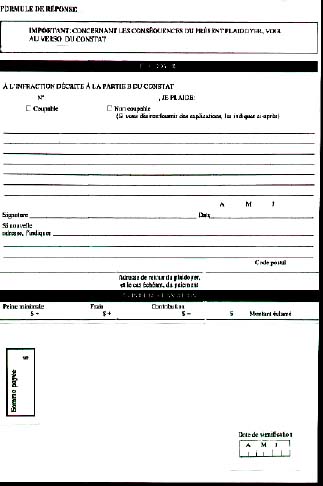
| |||
|
A-40 Constats d'infraction Annexes | ||||

| ||||
|
Annexes Constats d'infraction A-41 | |||
|
ANNEXE III | |||

| |||
|
A-42 Constats d'infraction Annexes | ||
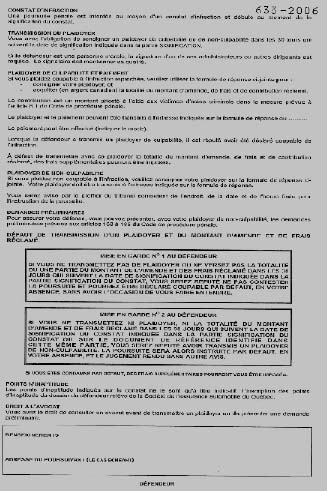
| ||
|
Annexes Constats d'infraction A-43 | ||||
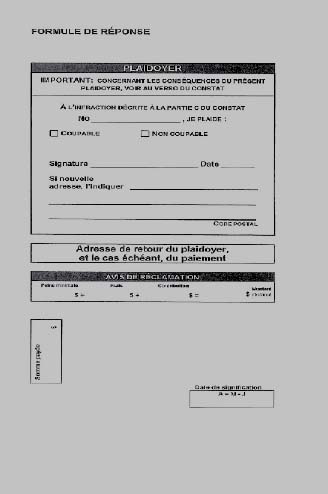
| ||||
|
A-44 Constats d'infraction Annexes | ||||

| ||||
|
Annexes Constats d'infraction A-45 | ||||
|
ANNEXE IV | ||||

| ||||
|
A-46 Constats d'infraction Annexes | |||
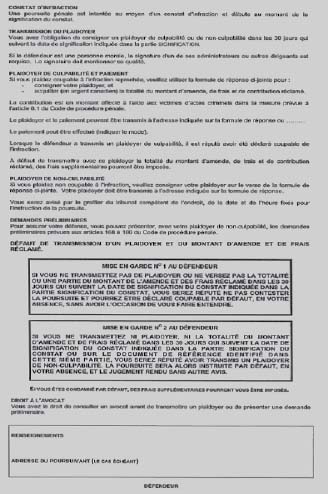
| |||
|
Annexes Constats d'infraction A-47 | |||

| |||
|
A-48 Constats d'infraction Annexes | |||

| |||
|
Annexes Constats d'infraction A-49 | |||
|
ANNEXE V | |||
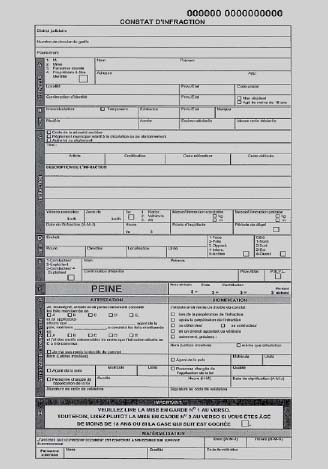
| |||
|
A-50 Constats d'infraction Annexes | |||
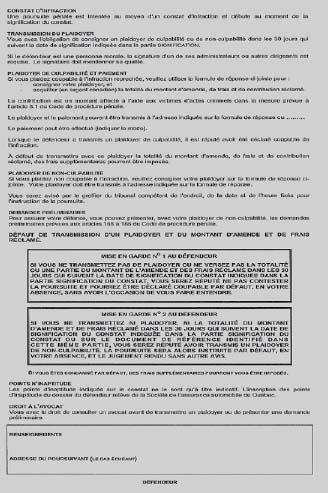
| |||
|
B-2 Rapports d'infraction Annexes | ||||
|
paix puissent décrire les faits pertinents qu'ils ont constatés.
4. Un formulaire de rapport d'infraction est un document qui se compose de rubriques, mots-clés et textes préimprimés ou préprogrammés dans le cadre desquels des espaces sont prévus pour l'inscription manuscrite, mécanique ou informatisée des mentions obligatoires et facultatives prévues par le présent règlement. Il peut aussi comporter, de façon sous-jacente ou apparente, des codes, marques ou mentions propres au support électronique ou visant à assurer la sécurité de l'information et de la documentation électroniques en matière pénale.
5. Le rapport d'infraction peut être réalisé sur support papier ou sur support électronique. Il peut aussi être réalisé sur support papier puis transféré sur support électronique, au moyen de la numérisation et il peut alors être matérialisé sur support papier. Ainsi, le rapport peut être sur support papier soit originairement, soit à la suite de sa matérialisation à partir d'un support électronique; le rapport peut aussi être sur support électronique soit originairement, soit en raison de sa numérisation à partir d'un support papier.
6. Lorsque le rapport d'infraction est originairement réalisé sur support électronique ou transféré sur un tel support au moyen de la numérisation, les données informatiques qui forment et permettent de visualiser ou de matérialiser le formulaire et les mentions qui composent le rapport sur support électronique ont valeur d'original, si le constat répond aux normes prévues au présent règle |
law or peace officers to describe the relevant facts that they have observed.
4. An offence report is a document containing headings, key words, pre-printed or pre-programmed texts and spaces allowing the optional or compulsory particulars prescribed by this Regulation relative to the penal proceeding to be entered by hand, mechanically or by computer. It may also contain computer codes, marks or particulars, either underlying or visible, that are specific to the electronic form or are designed to ensure the security of electronic data and documentation in penal matters.
5. An offence report may be generated in paper form or in electronic form. It may also be drawn up in paper form, then transferred into electronic form by means of digitization, and may then be converted into hard copy. Thus an offence report may be in paper form, either originally or after conversion from electronic form into hard copy; an offence report may also be in electronic form, either originally or after digitization from the paper form.
6. Where the offence report is originally generated in electronic form, or transferred into electronic form by means of digitization, the computer data that make it possible to display the report or convert into hard copy the report and the particulars recorded therein, have the same force as an original, if the report meets the standards provided for in this Regulation and those of a regulation respecting the security of | |||
|
Annexes Rapports d'infraction B-3 | ||||
|
ment et dans un règlement sur la sécurité de l'information et de la documentation électroniques en matière pénale pris en vertu du paragraphe 1.1 de l'article 367 du Code de procédure pénale (chapitre C-25.1). Ces données informatiques conservent leur valeur d'original lors de leur transfert, de leur transmission, de leur consultation, de leur utilisation, jusqu'à leur conservation ou leur archivage sur support électronique ou au moyen d'un tel support, si elles répondent aux normes prévues à ces règlements. Il en est de même des données informatiques qui forment le rapport d'infraction numérisé que le formulaire ou les mentions qui le composent soient numérisés simultanément ou séparément. Lorsque le rapport ainsi réalisé sur support électronique est matérialisé sur un formulaire préimprimé ou prépro-grammé, le rapport matérialisé a également valeur d'original. En outre, lorsqu'il y a matérialisation du rapport numérisé, le rapport matérialisé tient lieu d'original sur support papier.
7. Le rapport d'infraction sur support papier se compose de pages tandis que le rapport sur support électronique se compose de données informatiques présentées sur des pages-écran. Le formulaire et les mentions présentés sur les pages-écran d'un rapport peuvent être joints électroniquement ou reliés électroniquement par référence. Cependant, les pages-écran du rapport ou les sections qu'elles comportent doivent être intelligibles et elles doivent être accessibles sur une surface de visualisation, soit entièrement, soit partiellement, de manière séquentielle ou thématique. |
electronic data and documentation in penal matters made pursuant to paragraph 1.1 of article 367 of the Code of Penal Procedure (chapter C-25.1). The computer data have the same force as an original during electronic transfer, transmission, consultation, use, storage and archiving in electronic form or by electronic means, if they meet the standards provided for in the regulations referred to above. The foregoing also applies to computer data comprising the digitized offence report, whether the form or particulars comprising it were digitized simultaneously or separately. Where an offence report generated in electronic form is converted into hard copy on a pre-printed or pre-programmed form, the hard-copy offence report has the same force as an original. In addition, where a digitized offence report is converted into hard copy, the hard-copy offence report stands in lieu of the original.
7. An offence report in paper form is composed of pages, whereas an offence report in electronic form is composed of computer data displayed on page screens. The form and the particulars displayed on the page screens in an offence report may be electronically attached or referenced. However, the page screens in an offence report or the sections they contain shall be intelligible and shall be accessible on a display surface, either in whole or in part, sequentially or thematically. | |||
|
B-4 Rapports d'infraction Annexes | ||||
|
8. Le rapport d'infraction originairement réalisé sur support électronique ou transféré sur un tel support au moyen de la numérisation peut, soit demeurer sur support électronique et être ainsi utilisé à partir d'une surface de visualisation, soit être matérialisé sur un formulaire de rapport d'infraction préimprimé ou préprogrammé ou, en cas de numérisation, sur une feuille (sur support papier) destinée à porter la reconstitution du rapport.
SECTION II RAPPORTS D'INFRACTION: ORIGINAIREMENT SUR SUPPORT PAPIER, ORIGINAIREMENT SUR SUPPORT ÉLECTRONIQUE, NUMÉRISÉ ET MATÉRIALISÉ
9. Le rapport d'infraction général prévu au paragraphe 1 du premier alinéa de l'article 16 et originairement réalisé sur support papier est fait sur des feuilles d'au moins 10 cm de largeur sur au moins 20 cm de hauteur, mais d'au plus 21,5 cm de largeur sur 35,5 cm de hauteur. Le rapport d'infraction abrégé prévu au paragraphe 2 du premier alinéa de l'article 16 et originairement réalisé sur support papier est fait sur des feuilles détachables de même dimension que le constat d'infraction auquel il peut être attaché.
10. Le formulaire de rapport d'infraction sur support papier peut être préimprimé ou préprogrammé. Le caractère d'imprimerie ou d'imprimante ne peut alors être inférieur à six points. Le rapport d'infraction fait sur des feuilles comportant des inscriptions informatisées est un rapport d'infraction sur support papier assujetti aux normes |
8. An offence report originally generated in electronic form or transferred into such a form by means of digitization may remain in electronic form and be so used on a display surface, or be converted into hard copy on a pre-printed or pre-programmed offence report or, if digitized, on a page intended to reconstitute the report.
DIVISION II OFFENCE REPORTS: ORIGINALLY IN PAPER FORM, IN ELECTRONIC FORM, DIGITIZED OR CONVERTED INTO HARD COPY
9. The general offence report provided for in subparagraph 1 of the first paragraph of section 16 and originally drawn up in paper form shall be on sheets measuring not less than 10 cm wide by 20 cm high nor more than 21.5 cm wide by 35.5 cm high. The abridged offence report provided for in subparagraph 2 of the first paragraph of section 16 and originally drawn up in paper form shall be on detachable sheets of the same dimensions as the statement of offence to which it may be attached.
10. An offence report form may be pre-printed or pre-programmed. The type size of the printer or the printing press, as the case may be, shall be no smaller than 6 point. The offence report made up of pages comprising computer data constitutes an offence report in paper form subject | |||
|
Annexes Rapports d'infraction B-5 | ||||
|
de la présente section et il doit être signé de façon manuscrite.
11. Le rapport d'infraction originairement réalisé sur support électronique se présente sur des pages-écran qui sont composées de données informatiques et qui correspondent au formulaire et aux mentions qui composent les pages d'un rapport sur support papier.
12. Le rapport d'infraction qui est originairement réalisé sur support papier peut être numérisé. De plus, le formulaire et les mentions qui constituent le rapport peuvent être numérisés simultanément ou séparément. Dans ce dernier cas, le rapport numérisé se compose de pages-écran superposées.
13. Le rapport d'infraction originairement réalisé sur support électronique et le rapport numérisé peuvent être matérialisés sur des feuilles d'au moins 9 cm de largeur sur au moins 20 cm de hauteur et d'au plus 21,5 cm de largeur sur 35,5 cm de hauteur. Lorsque le rapport est matérialisé, il résulte de la combinaison d'une partie virtuelle et d'une partie matérielle. La partie virtuelle est constituée du formulaire préprogrammé et des mentions qui composent le rapport réalisé sur support électronique; en cas de numérisation, la partie virtuelle est constituée du formulaire et des mentions numérisés. La partie matérielle est constituée du formulaire du rapport sur support papier, lequel peut être préimprimé ou préprogrammé; en cas de numérisation, la partie matérielle est constituée, soit d'un formulaire préimprimé ou préprogrammé, soit de la reconstitution sur support papier du formulaire et des mentions numérisés du rapport. |
to the standards of this Division and must be signed by hand.
11. An offence report originally generated in electronic form is displayed on page screens containing computer data and corresponding to the form and the particulars contained in the pages of an offence report in paper form.
12. An offence report originally drawn up in paper form may be digitized. Furthermore, the form and the particulars contained in that offence report may be digitized either simultaneously or separately. In the latter case, the digitized offence report is composed of superimposed page screens.
13. An offence report originally generated in electronic form and a digitized offence report may be converted into hard copy on sheets measuring not less than 9 cm wide by 20 cm high nor more than 21.5 cm wide by 35.5 cm high. Where an offence report is converted into hard copy, it results from the combination of a virtual part and a material part. The virtual part is comprised of the particulars and the pre-programmed form contained in the offence report generated in electronic form; in case of digitization, the virtual part is comprised of the digitized form and particulars. The material part is comprised of the offence report form in paper form, which may be pre-printed or pre-programmed; in case of digitization, the material part is comprised of either a pre-printed or pre-programmed form or the reconstitution in paper form of the digitized form and particulars in the offence report. | |||
|
B-6 Rapports d'infraction Annexes | ||||
|
14. Le papier utilisé pour la matérialisation d'un rapport doit permettre de reconnaître qu'il s'agit d'un original, soit par l'emploi d'un papier d'un grain spécial, soit au moyen d'un sceau, d'un sigle, d'un code, d'un numéro, d'une marque ou d'une mention distinctive.
15. La taille du caractère d'imprimante ou, selon le cas, d'imprimerie utilisé pour la matérialisation du rapport d'infraction ne peut être inférieure à six points.
CHAPITRE II DISPOSITIONS PARTICULIÈRES
SECTION I TYPES DE RAPPORT D'INFRACTION
16. Les deux types de rapport d'infraction qui peuvent être utilisés sont les suivants: 1) le rapport d'infraction général; ce rapport est applicable à toutes les infractions et peut être produit en preuve avec tout constat d'infraction visé au Règlement sur la forme des constats d'infraction; un modèle de ce type de rapport se trouve à l'annexe I; 2) le rapport d'infraction abrégé; ce rapport est applicable à toutes les infractions; il peut être attaché au constat d'infraction visé au paragraphe 2 du premier alinéa de l'article 23 du Règlement sur la forme des constats d'infraction édicté par le décret 1211-97 du 17 septembre 1997 ou au constat visé au paragraphe 3 du premier alinéa de l'article 23 de ce règlement; un modèle de ce type de rapport se trouve à l'annexe II. Un modèle du type de rapport portant une attestation de matérialisation se trouve à l'annexe III. |
14. The paper used to convert a report into hard copy shall be such that the report can be recognized as an original, either by use of paper of a special grain, or by means of a seal, an acronym, a code, a number, a mark or a distinctive indication.
15. The type size of the printer or the printing press, as the case may be, used to convert an offence report into hard copy shall be no smaller than 6 point.
CHAPTER II SPECIAL PROVISIONS
DIVISION I TYPES OF OFFENCE REPORTS
16. The two types of offence reports that may be used are the following: 1) a general offence report, a model for which appears in Schedule I, applies to all offences and may be adduced as evidence with any statement of offence referred to in the Regulation respecting the form of statements of offence; and 2) an abridged offence report, a model for which appears in Schedule II, applies to all offences and may be attached to the statement of offence referred to in subparagraph 2 of the first paragraph of section 23 of the Regulation respecting the form of statements of offence made by Order in Council 1211-97 dated September 17, 1997 or to the statement of offence referred to in subparagraph 3 of the first paragraph of section 23 of that Regulation. A model for the offence report bearing an attestation of hard-copy conversion appears in Schedule III. | |||
|
Annexes Rapports d'infraction B-7 | ||||
|
SECTION II RAPPORT D'INFRACTION GÉNÉRAL
17. La première page ou les pages-écran correspondantes du rapport d'infraction général se composent d'au moins sept sections, lesquelles comportent les rubriques, mots-clés, textes et espaces permettant d'indiquer relativement: 1) à l'origine du rapport: a) le nom du ministère, de l'organisme public, de la municipalité ou de l'autorité de qui relève l'agent de la paix ou la personne chargée de l'application de la loi qui fait rapport de l'infraction; b) le numéro du dossier d'enquête de ce ministère, de cet organisme, de cette municipalité ou de cette autorité; c) les nom et adresse de la personne responsable de l'enquête; d) facultativement, le numéro du code d'événement servant à des fins statistiques; 2) à l'identité du défendeur: a) ses nom, adresse et numéro de téléphone; b) le fait qu'il s'agit d'une personne morale ou physique et, dans ce dernier cas, son sexe; c) le type de pièce ou de fichier et les éléments de la pièce ou du fichier confirmant son identité; d) facultativement, sa date de naissance, la description de ses traits caractéristiques, son occupation ou le genre d'activités de l'entreprise; 3) à l'infraction visée: a) la référence aux dispositions législatives créatrices de l'infraction sur laquelle porte le rapport; |
DIVISION II
17. The first page or the corresponding page screens in a general offence report shall comprise at least seven sections containing the headings, key words, texts and spaces allowing the following particulars to be indicated: 1) in respect of the origin of the report: a) the name of the department, public body, municipality or authority having jurisdiction over the peace officer or person responsible for enforcing the law who prepares the offence report; b) the investigation file number of the department, public body, municipality or authority; c) the name and address of the person responsible for the investigation; and d) optionally, the event code number used for statistical purposes; 2) in respect of the defendant's identity: a) his or its name, address and telephone number; b) whether the defendant is a legal or natural person and, in the latter case, whether male or female; c) the type of document or file and the items in the document or file confirming his identity; and d) optionally, his birthdate, his distinguishing features, his occupation or the type of activity carried out by the enterprise; 3) in respect of the offence in question: a) the reference to the legislative provisions creating the offence to which the offence report pertains; | |||
|
B-8 Rapports d'infraction Annexes | ||||
|
b) la description de l'infraction; c) la date et l'heure de la perpétration de l'infraction; 4) au lieu de perpétration de l'infraction: a) l'endroit où l'infraction aurait été commise; b) l'adresse et la description des lieux; c) le code de localisation, s'il est pertinent; d) le district judiciaire dans lequel se situe le lieu de perpétration de l'infraction; 5) aux choses saisies, aux documents ou aux événements connexes, soit notamment: a) le fait qu'une chose a été saisie, sa description et l'existence d'un procès-verbal de saisie; b) l'existence et la description d'un autre document ajouté au rapport et, lorsque ce dernier est sur support électronique, les codes, marques ou mentions informatiques permettant de repérer le document électroniquement joint au rapport ou qui y est relié électroniquement par référence; c) le type d'intervention de l'agent de la paix ou de la personne chargée de l'application de la loi; d) le cas échéant, le type de pièces d'où provient un renseignement; 6) aux faits, tant les faits pertinents constatés eu égard aux éléments essentiels de l'infraction que les gestes posés par l'agent de la paix ou la personne chargée de l'application de la loi qui les relate, présentés dans l'une ou plusieurs des formes suivantes, selon qu'elle convient au support papier ou au support électronique, soit: a) un espace ligné dans lequel les faits sont dactylographiés ou exposés de façon manuscrite, comme le prévoit le modèle 1 qui se trouve à l'annexe IV; |
b) a description of the offence; and c) the date and the time when the offence was committed; 4) in respect of the place where the offence was committed; a) the place where the offence is alleged to have been committed; b) the address and description of the place; c) the location code, if relevant; and d) the judicial district in which the place is located; 5) in respect of the property seized and related documents or events, in particular: a) mention of the fact that property was seized, a description of the property and mention of the existence of a record of the seizure; b) mention of the existence of any other document added to the offence report and, if that document is in electronic form, the computer codes, marks or particulars making it possible to locate the document electronically attached or referenced to the offence report; c) the type of intervention by the peace officer or person responsible for enforcing the law; and d) where applicable, the type of documents from which particulars were obtained; 6) in respect of the facts: both the relevant facts observed in regard to the essential aspects of the offence and the actions taken by the peace officer or person responsible for enforcing the law, who shall present them in one or more of the following ways, as appropriate for paper form or electronic form: a) a lined space in which the facts are to be typed or written by hand, as provided for in model 1 in Schedule IV; | |||
|
Annexes Rapports d'infraction B-9 | ||||
|
b) un espace blanc dans lequel l'exposé des faits peut être dactylographié ou la représentation graphique d'un fait peut être tracée, comme le prévoit le modèle 2 qui se trouve à l'annexe V; c) des textes préimprimés ou préprogrammés à l'intérieur desquels des espaces sont prévus pour l'inscription des faits particuliers à l'affaire, comme le prévoit le modèle 3 qui se trouve à l'annexe VI; d) des textes à option préimprimés ou préprogrammés décrivant des faits observables relatifs à l'infraction sur laquelle porte le rapport entre lesquels il faut choisir en cochant les cases appropriées, comme le prévoit le modèle 4 qui se trouve à l'annexe VII; 7) à l'attestation des faits: a) l'attestation des faits, avec la référence aux faits sur lesquels porte l'attestation; b) le nom, la qualité et, selon le cas, la signature de chaque personne chargée de l'application de la loi ou de chaque agent de la paix qui atteste les faits ou leur signature respective apposée au moyen d'un procédé électronique ou le code de validation de leur signature ainsi apposée, ainsi que le matricule de l'agent de la paix; c) la date et, lorsque la signature est apposée au moyen d'un procédé électronique, l'heure de la signature de l'attestation.
18. Lorsque le rapport d'infraction général originairement réalisé sur support électronique est matérialisé, la page matérialisée du rapport comporte en outre les mentions suivantes: 1) dans la section relative à la matérialisation du rapport: a) l'attestation de matérialisation; |
b) a blank space in which a statement of the facts may be typed or a graphic representation of a fact may be drawn, as provided for in model 2 in Schedule V; c) pre-printed or pre-programmed texts within which blanks are provided for the purpose of entering the particular facts of the case, as provided for in model 3 in Schedule VI; and d) multiple-choice pre-printed or pre-programmed texts describing the observable facts in respect of the offence to which the offence report pertains, among which a selection is to be made by checking off the appropriate boxes, as provided for in model 4 in Schedule VII; and 7) in respect of the attestation of the facts: a) the attestation of the facts, with mention of the facts to which the attestation pertains; b) the name, quality and signature of each person responsible for enforcing the law or each peace officer who attests to those facts or, as the case may be, their respective signatures affixed electronically or the validation code for their signatures so affixed, and the peace officer's number; and c) the date and, where the signature is affixed electronically, the time when the attestation is signed.
18. Where a general offence report originally generated in electronic form is converted into hard copy, the hard-copy page of the offence report shall also contain the following particulars: 1) in the section concerning the conversion of the report into hard copy: a) the attestation of hard-copy conversion; | |||
|
B-10 Rapports d'infraction Annexes | ||||
|
b) le nom et la qualité de la personne qui atteste la matérialisation ainsi que la date, l'heure et la minute au cours desquelles la matérialisation a été effectuée; c) la signature de la personne qui atteste la matérialisation ou, selon le cas, sa signature apposée au moyen d'un procédé électronique ou le code de validation de sa signature ainsi apposée; 2) les codes, marques ou mentions informatiques permettant de repérer les documents électroniquement joints au rapport ou qui y sont reliés électroniquement par référence; 3) les codes, marques ou mentions informatiques permettant d'assurer la sécurité de l'information que porte le rapport.
SECTION III RAPPORT D'INFRACTION ABRÉGÉ
19. La première page ou les pages-écran correspondantes du rapport d'infraction abrégé se composent d'au moins trois sections, lesquelles comportent les rubriques, mots-clés, textes et espaces permettant d'indiquer relativement: 1) à l'origine du rapport: a) le numéro du constat d'infraction auquel il peut être attaché; b) le numéro du dossier d'enquête du ministère, de l'organisme public, de la municipalité ou de l'autorité de qui relève l'agent de la paix ou la personne chargée de l'application de la loi qui fait rapport de l'infraction; c) facultativement, le numéro du code d'événement servant à des fins statistiques; 2) aux faits: tant les faits pertinents constatés eu égard aux éléments essentiels de l'infraction que les gestes |
b) the name and quality of the person attesting to the hard-copy conversion, and the date and exact time of conversion; and c) the signature of the person attesting to the hard-copy conversion or, as the case may be, his signature affixed electronically or the validation code for his signature so affixed; 2) the computer codes, marks or particulars making it possible to locate the documents electronically attached or referenced to the offence report; and 3) the computer codes, marks or particulars making it possible to ensure the security of the data contained in the offence report.
DIVISION III ABRIDGED OFFENCE REPORT
19. The first page or the corres-ponding page screens in an abridged offence report shall comprise at least three sections containing the headings, key words, texts and spaces allowing the following particulars to be indicated: 1) in respect of the origin of the report: a) the number of the statement of offence to which it may be attached; b) the investigation file number of the department, public body, municipality or authority having jurisdiction over the peace officer or person responsible for enforcing the law who prepares the offence report; and c) optionaly, the event code number used for statistical purposes; 2) in respect of the facts: both the relevant facts observed in regard to the essential aspects of the offence and the | |||
|
Annexes Rapports d'infraction B-11 | ||||
|
posés par l'agent de la paix ou la personne chargée de l'application de la loi qui les relate, présentés selon l'une ou plusieurs des formes prévues au paragraphe 6 de l'article 17; 3) à l'attestation des faits: les renseignements prévus au paragraphe 7 de l'article 17. Lorsque le rapport d'infraction abrégé originairement réalisé sur support électronique est matérialisé, la page matérialisée du rapport comporte en outre les mentions prévues à l'article 18.
SECTION IV COMPLÉMENT DE RAPPORT
20. Chaque page additionnelle d'un rapport d'infraction originairement réalisé sur support papier doit au moins permettre d'indiquer: 1) dans la section relative à l'origine: a) l'origine du rapport, soit les nom et adresse du ministère, de l'organisme public, de la municipalité ou de l'autorité de qui relève l'agent de la paix ou la personne chargée de l'application de la loi qui fait rapport de l'infraction; b) le numéro du dossier d'enquête de ce ministère, de cet organisme, de cette municipalité ou de cette autorité; 2) dans la section relative aux faits: a) la mention qui, au moyen d'un texte à option, permet d'identifier les faits comme étant: - la continuation de l'exposé des faits relatés sur la première page du rapport; - un nouvel exposé de faits par des agents de la paix ou des personnes qui n'ont pas fait rapport sur la première page; |
actions taken by the peace officer or person responsible for enforcing the law, who shall present them in one or more of the ways provided for in paragraph 6 of section 17; and 3) in respect of the attestation of the facts, the particulars provided for in paragraph 7 of section 17. Where an abridged offence report originally generated in electronic form is converted into hard copy, the hard-copy page of the offence report shall also contain the particulars provided for in section 18.
DIVISION IV SUPPLEMENT TO AN OFFENCE REPORT
20. Each additional page in an offence report originally drawn up in paper form shall allow at least the following particulars to be indicated: 1) in the section concerning the origin: a) the origin of the offence report, that is, the name and address of the department, public body, municipality or authority having jurisdiction over the peace officer a person responsible for enforcing the law who prepares the offence report; and b) the investigation file number of the department, public body, municipality or authority; 2) in the section concerning the facts: a) a selection of texts, one of which is to be checked off in order to indicate that the facts are: - the continuation of the statement on the first page of the report; - an additional statement by peace officers or persons who did not report facts on the first page; and | |||
|
B-12 Rapports d'infraction Annexes | ||||
|
- la continuation du nouvel exposé de faits; b) la description des faits, lesquels sont relatés selon l'une ou plusieurs des formes prévues au paragraphe 6 de l'article 17; 3) dans la section relative à l'attestation des faits: a) l'attestation des faits, avec la référence aux faits sur lesquels porte l'attestation; b) le nom, la qualité et, selon le cas, la signature de chaque personne chargée de l'application de la loi ou de chaque agent de la paix qui atteste ces faits ou leur signature respective apposée au moyen d'un procédé électronique ou le code de validation de leur signature ainsi apposée, ainsi que le matricule de l'agent de la paix; c) la date et, lorsque la signature est apposée au moyen d'un procédé électronique, l'heure de la signature de l'attestation.
21. Lorsque le rapport d'infraction est réalisé originairement sur support électronique, le rapport ne nécessite de pages additionnelles que s'il est matérialisé. Dans ce cas, chaque page additionnelle reproduit les sections prévues à l'article 20 et comporte les mentions prévues à l'article 18. Toutefois, la section prévue au paragraphe 3 de l'article 20 doit permettre d'inscrire la signature apposée au moyen d'un procédé électronique ou le code de validation de la signature ainsi apposée. Cette signature est apposée à la fin de l'exposé des faits par la personne qui les a constatés et elle est reproduite sur chacune des pages additionnelles du rapport matérialisé où se trouve l'exposé que cette personne a fait. |
- the continuation of the additional statement; and b) the discription of the facts, which shall be presented in one or more of the ways provided for in paragraph 6 of section 17; and 3) in the section concerning the attestation of the facts; a) the attestation of the facts, with mention of the facts to which the attestation pertains; b) the name, quality and signature of each person responsible for enforcing the law or each peace officer who attests to those facts or their respective signatures affixed electronically or the validation code for their signatures so affixed, and the peace officer's number; and c) the date and, where the signature is affixed electronically, the time when the attestation is signed.
21. Where the offence report is originally generated in electronic form, it requires additionnal pages only if it is converted into hard copy. In such case, each additional page shall reproduce the sections provided for in section 20 and shall contain the particulars provided for in section 18. Notwithstanding the foregoing, the section provided for in paragraph 3 of section 20 shall allow a signature affixed electronically or the validation code for a signature so affixed to be entered therein. That signature shall be affixed at the end of the statement of the facts by the person who observed them and shall be reproduced on each of the additionnal pages in the hard-copy offence report containing the statement made by that person. | |||
|
Annexes Rapports d'infraction B-13 | ||||
|
Un modèle de complément de rapport portant une attestation de matérialisation se trouve à l'annexe VIII.
CHAPITRE III DISPOSITIONS TRANSITOIRES ET FINALES
22. Les formulaires de rapports d'infraction qui sont préimprimés conformément aux dispositions du Règlement sur la forme des rapports d'infraction, édicté par le décret 1411-93 du 6 octobre 1993, peuvent continuer d'être utilisés pour la réalisation des rapports originairement sur support papier.
23. Le présent règlement remplace le Règlement sur la forme des rapports d'infraction édicté par le décret 1411-93 du 6 octobre 1993.
24. Le présent règlement entre en vigueur le quinzième jour qui suit la date de sa publication à la Gazette officielle du Québec.
D. 1411-93, 06/10/93, G.O. II, p. 7164; D. 1391-94, 07/09/94, G.O. II, p. 5938; D. 1210-97, 17/09/97, G.O. II, p. 6441. |
A model for a supplement to an offence report bearing an attestation of hard-copy conversion appears in Schedule VIII.
CHAPTER III ARRANGEMENTS TRANSITORYS AND FINALS
22. Offence report forms pre-printed in accordance with the provisions of the Regulation respecting the form of offence reports, made by Order in Council 1411-93 dated 29 September 1993, may continue to be used to generate offence reports originally in paper form.
23. This Regulation replaces the Regulation respecting the form of offence reports, made by Order in Council 1411-93 dated 29 September 1993.
24. This Regulation comes into force on the fifteenth day following the date of its publication in the Gazette officielle du Québec.
O.C. 1411-93, 06/10/97, G.O. II, p. 5544; O.C. 1391-94, 07/09/97, G.O. II, p. 4212; O.C. 1210-97, 17/09/97, G.O. II, p. 5061. | |||
|
C-2 Règles de la Cour d'appel du Québec Annexes | ||||
|
judiciaires (chapitre T-16). «juge» "judge" «juge» Une ou un juge de la Cour d'appel. «mémoire» "factum" «mémoire» Un document constitué d'un exposé et de trois annexes. «requête» "motion" «requête» Un acte de procédure destiné à la Cour, à un juge ou au greffier, selon le cas. «sources» "authorities" «sources» Les textes législatifs, réglementaires, jurisprudentiels et doctrinaux ainsi que tout extrait de ceux-ci. «voie accélérée» "fast track" «voie accélérée» La voie suivie dans le cas d'un appel ayant fait l'objet d'une gestion d'instance par un juge qui a permis un exposé d'un nombre de pages déterminé et soumis dans des délais raccourcis. «voie ordinaire» "standard track" «voie ordinaire» La voie suivie dans le cas d'un appel avec mémoires, selon les délais prévus aux présentes règles, sans gestion de l'instance.
PARTIE 2 ADMINISTRATION DE LA COUR 2. Heures d'ouverture. Le greffe de la Cour est ouvert les jours juridiques du lundi au vendredi, de 8 h 30 à 16 h 30.
3. Tenue d'un registre. Le greffier tient à jour un registre dans lequel il consigne, pour chaque cause, les indications suivantes: a) le nom, l'adresse civique et, le cas échéant, l'adresse électronique des parties, ceux du bureau d'avocats qui les |
"Judge" «juge» "Judge" means a judge of the Court of Appeal. "management conference in criminal matters" «conférence de gestion pénale» "management conference in criminal matters" means a conference at which a Judge presides in order to allow the parties to better define the issues genuinely in dispute, and to identify appropriate means to simplify the proceedings and reduce the duration of the hearing. "motion" «requête» "motion" means a proceeding before the Court, a Judge or the Clerk, as the case may be. "Office of the Court" «greffe» "Office of the Court" means a registry located at the seats of the Court of Appeal in Montreal at Édifice Ernest-Cormier, 100 Notre-Dame Street East, Montreal, Quebec H2Y 4B6 and in Quebec at 300 Boulevard Jean-Lesage, Quebec, Quebec G1K 8K6. "standard track" «voie ordinaire» "standard track" means the procedure followed when an appeal proceeds with factums, within the time limits provided for in these Rules and without case management.
PART 2 ADMINISTRATION OF THE COURT
2. Office hours. The Office of the Court is open on juridical days from Monday to Friday between 8:30 a.m. and 4:30 p.m.
3. Keeping of a register. The Clerk shall keep an up-to-date court register wherein the following information shall be entered for each case: (a) the name, civic address and, if available, the electronic address of each of the parties and the law offices of their | |||
|
Annexes Règles de la Cour d'appel du Québec C-3 | ||||
|
représente de même que le nom de l'avocat en charge du dossier; b) la date du dépôt de l'avis d'appel ou de la requête en autorisation d'appel et du jugement qui en décide; c) la date de l'ordonnance de mise en liberté provisoire, le cas échéant; d) la date de la comparution de la partie intimée; e) la date de la production du mémoire de chaque partie ou des documents en tenant lieu; f) la date de la production du certificat de mise en état ou celle de la mise en état par le greffier; g) la date de tout autre acte de procédure et, le cas échéant, celle de la décision intervenue; h) les renseignements relatifs à l'ajournement d'une requête; i) la date de la mise en délibéré et celle de l'arrêt.
4. Changement d'adresse. Les parties et leurs avocats doivent aviser le greffier sans délai de tout changement d'adresse.
5. Consultation d'un dossier. Un dossier ne peut être consulté qu'en présence du greffier. Si le dossier ne peut pas être consulté sur place, le greffier peut en permettre le retrait. Il exige alors une reconnaissance écrite qui est déposée au dossier.
6. Retrait d'un document. Une partie, ou son avocat, peut, avec l'autorisation du greffier et contre récépissé, retirer un document qu'il a déposé au dossier. |
counsel, as well as the name of the counsel responsible for the file; (b) the date of filing of the notice of appeal or the motion for leave to appeal, and the judgment thereon; (c) the date of the order for interim release, if applicable; (d) the date of appearance of the respondent; (e) for each party, the date of filing of the factum or the documents standing in lieu thereof; (f) the date of filing of the certificate of readiness or of the declaration of readiness by the Clerk; (g) the date of any other proceeding and, if applicable, of the judgment thereon; (h) information regarding the adjournment of a motion; and (i) the date on which the case is taken under advisement and that on which judgment is rendered.
4. Change of address. The parties and their counsel shall promptly advise the Clerk of any change of address.
5. Consultation of record. A record may be consulted only in the presence of the Clerk. If the record cannot be consulted on the premises, the Clerk may permit its removal. In such cases, the Clerk shall require a written acknowledgment, which shall be filed in the record.
6. Removal of document. Upon furnishing a receipt, and with the authorization of the Clerk, a party or a party's counsel may remove a document that the party has filed in the record. | |||
|
C-4 Règles de la Cour d'appel du Québec Annexes | ||||
|
7. Photocopie. Le greffier remet des photocopies aux frais de la partie qui en fait la demande.
8. Dépôt d'un arrêt. Lorsqu'un arrêt est déposé, le greffier de la Cour en transmet une copie à toutes les parties ou à leurs avocats ainsi qu'au juge de première instance.
PARTIE 3 RÈGLES GÉNÉRALES 9. Format et qualité du papier. Le format du papier est de 21,5 cm sur 28 cm. Il s'agit d'un papier blanc de bonne qualité. Le format du papier peut être de 21,5 cm sur 35,5 cm pour les documents accompagnant la requête ou, dans le cas d'un appel procédant par la voie accélérée, l'exposé.
10. Intitulé des actes de procédure. (1) Dans tout acte de procédure, l'intitulé comprend, dans l'ordre, les noms de la partie appelante, de la partie intimée et, le cas échéant, des autres parties. (2) Sous le nom de chaque partie est indiquée sa position en instance d'appel, en lettres majuscules, et en première instance, en lettres minuscules. (3) L'intitulé demeure identique dans tous les actes de procédure en cours d'instance d'appel. (4) S'agissant d'un appel en matière de recours extraordinaires, l'instance qui a rendu la décision attaquée en révision judiciaire est désignée comme mise en cause.
11. Titre des actes de procédure. Le titre de l'acte de procédure, apparaissant à l'endos et en première page, indique la position en instance d'appel de la partie qui le présente, suivie de la |
7. Photocopies. The Clerk shall furnish photocopies at the expense of the party who requests them.
8. Filing of judgment. When a judgment is filed, the Clerk shall send a copy to all the parties or their counsel and to the trial judge.
PART 3 GENERAL RULES
9. Format and quality of paper. The size of the paper shall be 21.5 cm by 28 cm. White paper of good quality shall be used. Documents accompanying a motion or submitted with an argument in the case of an appeal proceeding on the basis of the fast track procedure may be 21.5 cm by 35.5 cm.
10. Style of cause. (1) The style of cause in any proceeding shall include, in the following order, the name of the appellant, the name of the respondent and, if applicable, the names of the other parties. (2) Under each party's name, the status of the party in the appeal shall be indicated in upper-case letters, and the status of the party in first instance shall be indicated in lower-case letters. (3) The style of cause shall remain the same for all proceedings during the appeal. (4) In an appeal based on an extraordinary remedy, the decision maker that rendered the decision subject to review is designated as the mis en cause.
11. Title of proceedings. The title of a proceeding shall appear on the back and on the first page and shall indicate the status in the appeal of the party presenting the proceeding, followed by | |||
|
Annexes Règles de la Cour d'appel du Québec C-5 | ||||
|
référence précise aux textes législatifs ou réglementaires sur lesquels il s'appuie.
12. Signature. Tout acte de procédure doit être signé par la partie ou son avocat.
13. Amendement. En cas d'amendement à un acte de procédure, les additions ou substitutions doivent être soulignées ou signalées dans la marge au moyen d'un trait vertical, et les suppressions doivent être indiquées au moyen de pointillés entre parenthèses. 14. Désistement. (1) La partie appelante qui veut se désister de son appel produit un acte de désistement signé par elle-même ou son avocat; dans le premier cas, la signature de la partie appelante est attestée par un serment écrit ou contresigné par un avocat ou si la partie appelante est détenue, par un officier de l'établissement de détention. (2) Un juge peut donner acte du désistement même en l'absence des parties ou de leurs avocats. 15. Délai. Tout délai imparti par les présentes règles peut être prorogé ou abrégé par la Cour ou par un juge, avant ou après son expiration. 16. Huissier-audiencier. L'ouverture et la clôture des séances de la Cour et de celles tenues par le juge ou le greffier sont déclarées par le huissier-audiencier, qui assiste à toute la durée de l'audience, à moins d'en être dispensé.
17. Nombre d'avocats. (1) À l'audition de l'appel, chaque partie peut faire |
a precise citation to the statute or regulation upon which it is based.
12. Signature. Every proceeding shall bear the signature of the party or the counsel for the party.
13. Amendment. In the event of an amendment to a proceeding, additions or substitutions shall be underlined or indicated in the margin by a vertical line and deletions shall be indicated by ellipsis points within parentheses.
14. Discontinuance. (1) An appellant who wishes to discontinue the appeal shall file a discontinuance which shall be signed by the appellant or the appellant's counsel. In this case, the appellant's signature shall be certified by affidavit or endorsed by a counsel, if the appellant is detained by an officer of the detention facility. (2) A judge may confirm the discontinuance, even in the absence of the parties or their counsel.
15. Time limit. Any time limit established by these Rules may be extended or abridged by the Court or by a Judge, either before or after it expires.
16. Court usher. The Court usher shall announce the opening and termination of sittings of the Court, the Judge or the Clerk, and remain present for the entire hearing, unless otherwise permitted.
17. Number of counsel. (1) At the hearing of an appeal, two counsel may present oral arguments for each party, | |||
|
C-6 Règles de la Cour d'appel du Québec Annexes | ||||
|
entendre deux avocats, un seul pouvant répliquer pour la partie appelante. (2) À l'audition d'une requête, chaque partie ne peut faire entendre qu'un avocat, sauf permission.
18. Tenue vestimentaire. (1) À l'audience de la Cour, la tenue suivante est de rigueur: a) l'avocat: toge, rabat, col blanc et vêtement foncé; b) le stagiaire: toge et vêtement foncé; c) le greffier et l'huissier-audiencier: toge et vêtement foncé. (2) Devant un juge ou un greffier, le port de la toge n'est pas requis. Toutefois, la tenue vestimentaire doit être sobre.
19. Décorum. (1) Toutes les personnes présentes à une audience doivent s'assurer que leur téléphone cellulaire, téléavertisseur et autres appareils sonores sont fermés. (2) La Cour ou le juge peut prendre toutes les mesures requises pour assurer la saine administration de la justice, la sérénité des audiences et le respect des droits des parties et de leurs avocats.
20. Ajournement. Un juge, à la demande d'une partie, ou le greffier, avec le consentement de toutes les parties, peut en tout temps radier une affaire du rôle et ajourner l'audition à une date ultérieure.
PARTIE 4 FORMATION DE L'APPEL 21. Délai. L'avis d'appel et, le cas échéant, la requête en autorisation d'appel sont déposés dans les 30 jours de la décision. |
but only one counsel may reply for the appellant. (2) At the hearing of a motion, only one counsel may present oral argument for each party, unless otherwise permitted.
18. Dress. (1) At hearings before the Court, the following dress is obligatory: (a) counsel - gown, bands, white collar and dark garment; (b) articled student - gown and dark garment; and (c) clerk and court usher - gown and dark garment. (2) Before a Judge or the Clerk, the wearing of a gown is not required. All attire, however, shall be simple and unadorned.
19. Decorum. (1) All persons present at a hearing shall ensure that their cellular telephones, pagers and any other audio devices are turned off. (2) The Court or the Judge may adopt any measure to ensure the proper administration of justice, the serenity of hearings and respect for the rights of the parties and their counsel.
20. Adjournment. A Judge, at the request of a party, or the Clerk, with the consent of all parties, may at any time strike a matter from the roll and adjourn the hearing to a later date.
PART 4 INSTITUTION OF THE APPEAL
21. Time limit. The notice of appeal and, if applicable, the motion for leave to appeal shall be filed within 30 days after the judgment. | |||
|
Annexes Règles de la Cour d'appel du Québec C-7 | ||||
|
22. Contenu de l'avis d'appel et de la requête en autorisation d'appel. L'avis d'appel et la requête en autorisation d'appel contiennent les renseignements suivants: a) l'infraction; b) la peine imposée, s'il y a lieu; c) la date du verdict, du jugement et de la sentence, selon le cas; d) le lieu du procès; e) le tribunal de première instance et le numéro du dossier; f) de façon concise et précise, les moyens d'appel et les conclusions recherchées; g) l'adresse civique et, le cas échéant, l'adresse électronique de la partie appelante et de son avocat; h) le nom, l'adresse civique et, le cas échéant, l'adresse électronique de la partie intimée et, selon le cas, des autres parties et de leurs avocats en première instance.
23. Original et nombre de copies. L'original de l'avis d'appel ou de la requête en autorisation d'appel, une copie pour le greffier, deux copies pour le greffe du tribunal de première instance, une copie pour la partie intimée, et, le cas échéant, une copie pour chacune des autres parties sont déposés au greffe d'appel approprié.
24. Appel par le procureur général. En cas d'appel par le procureur général, l'avis d'appel, ou la requête en autorisation d'appel, est signifié à la partie intimée personnellement, avant ou après le dépôt, mais au plus tard dans les 30 jours de celui-ci, à moins qu'un juge n'en ordonne autrement.
25. Transmission par le greffier. Le greffier transmet au greffe du tribunal |
22. Content of notice of appeal and motion for leave to appeal. The notice of appeal and the motion for leave to appeal shall contain the following information: (a) the offence; (b) the sentence imposed, if applicable; (c) the date of the verdict, the judgment and the sentence, as the case may be; (d) the place of trial; (e) the court of first instance and court file number; (f) the grounds of appeal and the conclusions sought, stated clearly and concisely; (g) the civic address and, if available, the electronic address of the appellant and the appellant's counsel; and (h) the name, civic address and, if available, the electronic address of the respondent and, if applicable, of the other parties and their counsel in first instance.
23. Original and number of copies. The original of the notice of appeal or the motion for leave to appeal shall be filed at the appropriate Office of the Court of Appeal, together with one copy thereof for the Clerk, two copies for the office of the court of first instance, one copy for the respondent and, if applicable, one copy for each of the other parties.
24. Appeal by Attorney General. In the event of an appeal by the Attorney General, the notice of appeal and the motion for leave to appeal shall be served on the respondent personally, before or after its filing, but at the latest within 30 days after the filing of the motion, unless a Judge orders otherwise.
25. Delivery by the Clerk. The Clerk delivers two copies of the notice of ap | |||
|
C-8 Règles de la Cour d'appel du Québec Annexes | ||||
|
de première instance deux copies de l'avis d'appel ou de la requête en autorisation d'appel, une fois celle-ci accueillie. Lorsque le procureur général est intimé, le greffier en transmet également une copie, dès le dépôt, au bureau des substituts du procureur général du district d'appel où le procès a eu lieu ou au bureau de l'avocat qui a agi pour le procureur général en première instance et, le cas échéant, aux autres parties.
26. Allégation d'incompétence professionnelle. (1) L'appelant qui allègue l'incompétence de l'avocat qui le représentait en première instance en avise ce dernier en lui signifiant une copie des procédures écrites contenant cette allégation. (2) Si l'appelant désire présenter une preuve, qui n'est pas déjà au dossier de première instance, au soutien de ce moyen d'appel, il en informe par écrit le juge en chef, avec copie au procureur général et à l'avocat qui le représentait en première instance, en précisant le contenu de cette preuve et les modalités qu'il propose pour la recueillir. (3) De la même manière, si le procureur général désire présenter une preuve, qui n'est pas déjà au dossier de première instance, pour contrer ce moyen d'appel, il en informe également par écrit le juge en chef, avec copie à l'appelant et à l'avocat qui représentait ce dernier en première instance, en précisant le contenu de cette preuve et les modalités qu'il propose pour la recueillir. (4) Si l'avocat dont on allègue l'incompétence désire répondre, il en informe par écrit le juge en chef, avec copie aux parties, et indique les modalités qui lui paraissent appropriées pour faire part de son point de vue. |
peal or the motion for leave to appeal, if it is granted, to the registry of the court of first instance. If the Attorney General is the respondent, the Clerk also delivers a copy, as soon as it is filed, to the office of the Crown prosecutor of the appeal district in which the trial took place or to the office of the counsel who represented the respondent in first instance and, if applicable, to the other parties.
26. Allegation of professional incompetence. (1) An appellant who alleges the incompetence of counsel who acted on behalf of the appellant in first instance shall notify the counsel by serving on the latter a copy of the written proceedings containing the allegation. (2) If the appellant wishes, in support of this ground of appeal, to introduce evidence that is not already in the record of first instance, the appellant shall also notify the Chief Justice in writing, with copies to the Attorney General and the appellant's counsel in first instance. The notice shall describe the content of the evidence and the procedure the appellant proposes for taking the evidence. (3) In the same manner, if the Attorney General wishes, in rebuttal of this ground of appeal, to introduce evidence that is not already in the record of first instance, the Attorney General shall notify the Chief Justice in writing, with copies to the appellant and the appellant's counsel in first instance. The notice shall describe the content of the evidence and the procedure the Attorney General proposes for its reception. (4) If counsel against whom incompetence has been alleged wishes to respond, that counsel shall so notify the Chief Justice in writing, with a copy to the parties, and shall describe the means considered appropriate to present that counsel's position. | |||
|
Annexes Règles de la Cour d'appel du Québec C-9 | ||||
|
(5) Un juge peut, par une conférence de gestion pénale, tenter d'amener les parties à s'entendre sur les modalités pour recueillir la preuve ainsi que sur un échéancier. (6) Les parties présentent les requêtes appropriées afin d'être autorisées à produire la nouvelle preuve. 27. Requête en autorisation d'appel accueillie. Lorsqu'elle est accueillie, la requête en autorisation d'appel tient lieu d'avis d'appel sans autres formalités.
28. Comparution. L'avocat d'une partie, sauf celui de la partie appelante, produit un acte de comparution dans les 10 jours qui suivent le dépôt de l'avis d'appel ou le jugement autorisant l'appel.
PARTIE 5 CONSTITUTION DU DOSSIER
29. Transmission de l'avis d'appel. Dès la réception des copies de l'avis d'appel ou de la requête en autorisation d'appel, une fois celle-ci accueillie, le greffier du tribunal de première instance en transmet une copie au juge qui a instruit le procès ou prononcé la décision frappée d'appel.
30. Transcription du dossier de première instance. (1) Après consultation avec les parties ou leurs avocats, sauf renonciation des parties ou de leurs avocats ou l'accord de ceux-ci sur un exposé conjoint des faits nécessaires à la solution des questions en litige, le greffier de première instance fait les démarches nécessaires pour obtenir aussitôt que possible la transcription complète du dossier. |
(5) At a management conference in criminal matters, a Judge may attempt to have the parties agree on the means by which the evidence may be received as well as a timetable. (6) The parties may present appropriate motions in order to be authorized to produce any new evidence.
27. Motion for leave to appeal granted. When a motion for leave to appeal has been granted, it shall serve as the notice of appeal without further formality.
28. Appearance. Counsel for a party other than the appellant shall file a written appearance within the 10 days after the filing of the notice of appeal or the judgment granting leave to appeal.
PART 5 PREPARATION OF THE RECORD
29. Delivery of notice of appeal. Upon receipt of the copies of the notice of appeal or, if it is granted, the motion for leave to appeal, the clerk of the court of first instance shall deliver a copy to the judge who heard the case at trial or who rendered the judgment from which the appeal has been taken.
30. Transcript of trial proceedings. (1) After consulting with the parties or their counsel, the clerk of the court of first instance shall take all necessary steps to obtain, as soon as possible, the complete transcript of the proceedings, unless the parties or their counsel renounce or agree to a joint statement of the facts necessary to the resolution of the issues in dispute. | |||
|
C-10 Règles de la Cour d'appel du Québec Annexes | ||||
|
(2) À moins que l'appel ne porte sur ces questions, et sauf ordonnance contraire d'un juge ou consentement des parties, sont omis de la transcription: a) la procédure relative au choix du jury; b) l'exposé introductif du juge de première instance; c) les exposés introductifs et finals des avocats; d) les éléments de preuve déposés hors la présence du jury et les observations des avocats faites hors la présence du jury sauf: (i) les observations relatives à la teneur proposée des directives du juge au jury de même que la décision et les motifs du juge de première instance, (ii) les objections relatives aux directives de même que la décision et les motifs du juge de première instance, (iii) les observations relatives aux questions soumises par le jury de même que la décision et les motifs du juge de première instance; e) les oppositions à l'admissibilité d'un élément de preuve, sauf à noter l'opposition faite, la décision du juge et, le cas échéant, ses motifs.
31. Transmission du dossier de première instance. Le dossier de première instance n'est transmis au greffe de la Cour que sur demande d'un juge.
32. Avis au greffier de la Cour. Le greffier du tribunal de première instance avise les parties et le greffier de la Cour que le dossier d'appel est complet ce qui permet à la partie appelante d'en prendre aussitôt possession.
33. Paiement des frais. Quand la transcription ou la traduction comporte |
(2) Unless the appeal addresses those questions or unless otherwise ordered by a Judge or agreed by the parties, the following shall be omitted from the transcript: (a) proceedings regarding jury selection; (b) the opening address of the trial judge; (c) the opening and closing addresses of counsel; (d) evidence adduced in the absence of the jury and submissions of counsel in the absence of the jury, with the exception of (i) submissions regarding the proposed content of the judge's jury instructions, the trial judge's determination thereon and reasons, (ii) objections regarding the jury instructions, the trial judge's determination thereon and reasons, and (iii) submissions regarding questions from the jury, the trial judge's determination thereon and reasons; and (e) objections to the admissibility of evidence, except a notation of the objection, the trial judge's adjudication and, if they are available, the reasons for the judgment.
31. Delivery of trial proceedings.
Trial proceedings shall be delivered to the Office of the Court only upon a
request to this effect from a Judge of the Court.
33. Payment of costs. If the preparation of a transcript incurs costs, the | |||
|
Annexes Règles de la Cour d'appel du Québec C-11 | ||||
|
des frais, le greffier du tribunal de première instance peut en exiger le paiement à l'avance et, en tout état de cause, la partie appelante n'y a pas droit tant que les frais n'ont pas été acquittés.
PARTIE 6 LES REQUÊTES
DISPOSITIONS GÉNÉRALES 34. Présentation et contenu. (1) Les requêtes sont présentées, selon le cas, à la Cour, au juge ou au greffier. Elles doivent être accompagnées de tout ce qui est nécessaire à leur étude, notamment des actes de procédure, pièces, dépositions, procès-verbaux, jugements ou extraits de ces documents de même que des dispositions réglementaires et législatives autres que celles de la Loi constitutionnelle de 1982, du Code criminel, de la Loi sur la preuve au Canada, de la Loi réglementant certaines drogues et autres substances et de la Loi sur le système de justice pénale pour les adolescents. (2) Une partie peut demander d'être dispensée de produire sur support papier les documents accompagnant la requête, ou certains de ces documents, lorsque toutes les parties à la requête consentent à ce qu'ils soient produits sur support informatique. La demande est faite par lettre, par télécopieur ou par courriel adressée au greffe de la Cour, avec copie aux autres parties à l'instance, et tranchée par un juge dans le cas d'une requête à la Cour ou à un juge, ou par le greffier dans le cas d'une requête au greffier.
35. Déclaration sous serment. Toute requête qui comporte des allégations portant sur des faits qui n'apparais |
clerk of the court of first instance may require payment in advance. The appellant shall not be entitled to the transcript at any time during the course of the proceedings until those costs have been paid.
PART 6 MOTIONS
GENERAL
34. Presentation and content. (1) Motions shall be presented, according to their nature, before the Court, the Judge or the Clerk. They shall be accompanied by all that is required for their consideration, and in particular by proceedings, exhibits, depositions, minutes, judgments or excerpts therefrom, as well as any statutory or regulatory provisions cited, with the exception of provisions of the Constitution Act, 1982, the Criminal Code, the Canada Evidence Act, the Controlled Drugs and Substances Act and the Youth Criminal Justice Act. (2) A party may apply to be excused from producing paper copies of the documents that accompany the motion, or certain of those documents, if all the parties to the motion consent that they be produced in computer format. The application is to be made by letter, by facsimile or by e-mail addressed to the Office of the Court, with a copy to the other parties to the motion, and is adjudicated by a Judge in the case of a motion to the Court or to a Judge, or by the Clerk in the case of a motion to the Clerk.
35. Affidavit. Any motion alleging facts that do not appear in the record shall be supported by the affidavit of a | |||
|
C-12 Règles de la Cour d'appel du Québec Annexes | ||||
|
sent pas au dossier est appuyée d'une déclaration sous serment d'une personne qui a une connaissance personnelle de ces faits.
36. Signification. (1) Sauf disposition contraire, les requêtes ainsi que les documents joints sont signifiés de la manière prévue au Code de procédure civile. (2) La requête en rejet d'appel du procureur général est signifiée à la partie appelante personnellement à moins qu'un juge n'en ordonne autrement et, le cas échéant, à son avocat. 37. Dispense de présence. Sauf pour la mise en liberté provisoire de la partie appelante, l'envoi, par la partie intimée, d'un consentement écrit aux conclusions de la requête, par lettre, télécopieur ou courriel, avec copie aux parties, dispense les parties et leurs avocats d'être présents lors de sa présentation à moins que la Cour, le juge ou le greffier saisi de la requête n'en décide autrement et n'en avise les parties.
38. Convocation à une autre heure. La Cour, le juge ou le greffier peut dispenser les parties et leurs avocats d'être présents à l'ouverture de l'audience et les convoquer à une autre heure pour l'audition de la requête. 39. Absence. Faute par une partie de comparaître au jour et à l'heure fixés pour la présentation de la requête, la Cour, le juge ou le greffier peut n'entendre que les parties présentes et statuer sans entendre la partie absente, ou encore ajourner l'audience aux conditions indiquées. |
person who has personal knowledge of those facts.
36. Service. (1) Except where otherwise provided, motions and the attached documents shall be served in the manner prescribed in the Code of Civil Procedure. (2) A motion by the Attorney General to dismiss the appeal shall be served on the appellant personally, unless a Judge has ordered otherwise, and on the appellant's counsel, if applicable.
37. Attendance excused. Except in an application for the interim release of the appellant, the sending of the respondent's written consent to the conclusions of the motion, by letter, by facsimile or by e-mail and with copies to the parties, excuses the parties and their counsel from attending the presentation of the motion, unless the Court, the Judge or the Clerk who will hear the motion determines otherwise and so notifies the parties.
38. Convening at a different time. The Court, the Judge or the Clerk may excuse the parties and their counsel from being present at the opening of a sitting and convene them at a different time for the hearing of the motion.
39. Absence. If a party fails to appear on the day and at the time established for the hearing of the motion, the Court, the Judge or the Clerk may hear only those parties present and adjudicate the motion without hearing the absent party, or adjourn the hearing on the conditions deemed appropriate. | |||
|
Annexes Règles de la Cour d'appel du Québec C-13 | ||||
|
40. Conférence téléphonique. Lorsque les circonstances s'y prêtent et que les parties y consentent, la Cour, le juge ou le greffier peut entendre la requête par conférence téléphonique.
REQUÊTE À LA COUR 41. Réservation. La partie requérante réserve auprès du greffier la date et l'heure de présentation d'une requête destinée à la Cour.
42. Délai de signification et de production. La requête est ensuite signifiée et produite au greffe, avec les documents joints, en quatre exemplaires, au moins cinq jours juridiques francs avant la date de sa présentation.
43. Avis de présentation. L'avis de présentation mentionne la date, l'heure et la salle où la requête sera ainsi présentée.
44. Ajournement. (1) Dès que possible avant la présentation de la requête, la partie requérante avise le greffier par lettre, par télécopieur ou par courriel, du consentement des parties à un ajournement ou du fait que, le jour de la présentation, une partie demandera un ajournement. (2) À défaut de cet avis et à moins d'une circonstance spéciale, la Cour se saisit de la requête et en décide.
REQUÊTE AU JUGE 45. Présentation. La requête est présentée à 9 h 30. Entre le 24 juin et la fête du Travail, elle est présentée l'un des jours déterminés par le juge en chef. |
40. Telephone conference. When the circumstances are appropriate and the parties so consent, the Court, the Judge or the Clerk may hear a motion by telephone conference.
MOTIONS BEFORE THE COURT
41. Reservation. The petitioner shall arrange the date and time of the presentation of a motion before the Court with the Clerk.
42. Time limit for service and filing. The motion and the attached documents shall then be served and filed at the Office of the Court, in quadruplicate, at least five clear juridical days before the date of presentation.
43. Notice of presentation. The notice of presentation shall indicate the date, time and courtroom where the motion will be presented.
44. Adjournment. (1) As soon as possible before the presentation of the motion, the petitioner shall notify the Clerk by letter, by facsimile or by e-mail, that the parties have consented to an adjournment or that one of the parties will seek an adjournment on the day the motion is presented. (2) In the absence of such notice and excepting special circumstances, the Court shall hear the motion and adjudicate it.
MOTIONS BEFORE A JUDGE
45. Presentation. Motions shall be presented at 9:30 a.m. Between June 24 and Labour Day, motions shall be presented on one of the days the Chief Justice determines. | |||
|
C-14 Règles de la Cour d'appel du Québec Annexes | ||||
|
46. Délai de signification et de production. La requête est signifiée et produite au greffe, avec les documents joints, en deux exemplaires au moins deux jours juridiques francs avant la date de sa présentation, laquelle a lieu, sauf entente entre les parties, au plus tard huit jours après la signification. 47. Avis de présentation. L'avis de présentation mentionne la date, l'heure et la salle où la requête sera ainsi présentée.
48. Ajournement. (1) Dès que possible avant la présentation de la requête, la partie requérante avise le greffier par lettre, par télécopieur ou par courriel, du consentement des parties à un ajournement ou du fait que, le jour de la présentation, une partie demandera un ajournement. (2) À défaut de cet avis et à moins d'une circonstance spéciale, le juge se saisit de la requête et en décide.
REQUÊTE AU GREFFIER 49. Présentation. La requête est présentée à 9 h 00. Entre le 24 juin et la fête du Travail, elle est présentée l'un des jours déterminés par le juge en chef.
50. Délai de signification et de production. La requête est signifiée et produite au greffe, avec les documents joints, en deux exemplaires, au moins deux jours juridiques francs avant la date de sa présentation. 51. Avis de présentation. L'avis de présentation mentionne la date, l'heure et la salle où la requête sera ainsi présentée.
|
46. Time limit for service and filing. The motion and its attached documents shall be served and filed at the Office of the Court, in duplicate, at least two clear juridical days before the date of presentation, which shall take place at the latest eight days after service, unless the parties have agreed otherwise.
47. Notice of presentation. The notice of presentation shall indicate the date, time and courtroom where the motion will be presented.
48. Adjournment. (1) As soon as possible before the presentation of the motion, the petitioner shall notify the Clerk by letter, by facsimile or by e-mail, that the parties have consented to an adjournment or that one of the parties will seek an adjournment on the day the motion is presented. (2) In the absence of the notice and excepting special circumstances, the Judge shall hear the motion and adjudicate it.
MOTIONS BEFORE THE CLERK
49. Presentation. Motions shall be presented at 9:00 a.m. Between June 24 and Labour Day, motions shall be presented on one of the days the Chief Justice determines.
50. Time limit for service and filing. The motion and its attached documents shall be served and filed at the Office of the Court, in duplicate, at least two clear juridical days before the date of presentation.
51. Notice of presentation. The notice of presentation shall indicate the date, time and courtroom where the motion will be presented. | |||
|
Annexes Règles de la Cour d'appel du Québec C-15 | ||||
|
52. Ajournement. (1) Dès que possible avant la présentation de la requête, la partie requérante avise le greffier par lettre, par télécopieur ou par courriel, du consentement des parties à un ajournement ou du fait que, le jour de la présentation, une partie demandera un ajournement. (2) À défaut de cet avis et à moins d'une circonstance spéciale, le greffier se saisit de la requête et en décide.
53. (1) Requête pour mise en liberté provisoire. La partie appelante qui sollicite sa mise en liberté provisoire joint à sa requête une déclaration sous serment attestant: a) les endroits où elle a résidé durant les trois années avant sa condamnation et celui où elle entend résider si elle est mise en liberté; b) le cas échéant, son emploi avant sa condamnation et le nom de l'employeur et l'emploi qu'elle compte occuper si elle est mise en liberté; c) le cas échéant, ses condamnations antérieures, y compris les condamnations intervenues à l'étranger; d) le cas échéant, les accusations portées contre elle au Canada et à l'étranger, au moment de la demande; e) le fait qu'elle est titulaire ou non d'un passeport canadien ou étranger ou qu'elle a une demande de passeport en traitement. (2) Dispense de déclaration sous serment. Le juge à qui est présentée la requête peut accorder une dispense de la déclaration sous serment et s'en remettre à un exposé écrit des faits signé par l'avocat de la partie appelante et le substitut du procureur général. (3) Mise en liberté pendant l'appel à la Cour suprême. La requête de mise en liberté pendant l'appel à la Cour su |
52. Adjournment. (1) As soon as possible before the presentation of the motion, the petitioner shall notify the Clerk by letter, by facsimile or by e-mail, that the parties have consented to an adjournment or that one of the parties will seek an adjournment on the day on which the motion is presented. (2) In the absence of the notice and excepting special circumstances, the Clerk shall hear the motion and adjudicate it.
53. (1) Application for interim release. An appellant seeking interim release shall attach an affidavit to the application attesting to the following: (a) the appellant's places of residence in the three years preceding conviction and the place the appellant intends to reside if released; (b) if applicable, the appellant's employment before conviction, and the appellant's intended employer and employment if released; (c) if applicable, the appellant's previous convictions, including convictions outside Canada; (d) if applicable, any charges pending against the appellant either in Canada or elsewhere at the time of the application; and (e) whether or not the appellant holds a Canadian or foreign passport or has applied for a passport, the application for which is being processed. (2) Exemption from affidavit. The Judge hearing the application may excuse the filing of an affidavit and rely upon a statement of facts signed by the appellant's counsel and the Crown prosecutor. (3) Release pending appeal to the Supreme Court. A certificate of the Registrar of the Supreme Court of Canada attesting that a motion for leave | |||
|
C-16 Règles de la Cour d'appel du Québec Annexes | ||||
|
prême du Canada est accompagnée d'un certificat du registraire de celle-ci attestant qu'une requête en autorisation d'appel ou qu'un avis d'appel a été produit.
54. (1) Requête pour nouvelle preuve. La partie qui requiert la permission de produire une nouvelle preuve doit d'abord présenter une requête indiquant en quoi elle a fait preuve de diligence raisonnable à l'égard de l'obtention de cette preuve et en quoi celle-ci est pertinente, plausible et, si on y ajoute foi, susceptible d'influer sur le résultat. (2) Avis et modalités. La partie qui présente une telle requête en informe dès que possible les autres parties et tente d'établir avec celles-ci un échéancier et des modalités relatives à l'échange des documents pertinents et aux contre-interrogatoires, le cas échéant. Cet échéancier et les modalités proposées sont soumis à la Cour. (3) Jugement en deux étapes. Saisie de la requête, la Cour, dans une première étape, permet ou refuse que soit recueillie la preuve proposée en prévoyant, s'il y a lieu, les modalités et l'échéancier pour la recueillir et procéder aux contre-interrogatoires. Saisie du fond de l'appel, la Cour décide ensuite de l'admissibilité de cette preuve.
PARTIE 7 APPEL D'UNE PEINE 55. (1) Déféré sommaire. Le juge peut déférer à la Cour, sans en décider, une requête en autorisation d'interjeter appel d'une peine. (2) Audition simultanée. La Cour peut entendre à la fois la requête et l'appel et en décider, sans mémoire. Elle |
to appeal or a notice of appeal has been filed shall accompany an application for interim release pending an appeal to that court.
54. (1) Motion to adduce fresh evidence. A party seeking leave to adduce fresh evidence shall first present a motion and explain in what manner the party has exercised due diligence in obtaining the evidence, in what respect it is relevant and credible and, if believed, could be expected to affect the result. (2) Notice and terms. A party presenting such a motion shall notify the other parties thereof as soon as possible, and shall attempt to reach an agreement with them regarding a timetable and the terms that will govern the exchange of relevant documents and cross-examinations, if applicable. The proposed timetable and terms shall be submitted to the Court. (3) Two-stage determination. The Court shall first authorize or refuse the taking of fresh evidence and determine, if applicable, the terms by which relevant documents will be exchanged and cross-examinations undertaken. After the evidence has been taken, the Court hearing the appeal determines its admissibility.
PART 7 APPEAL FROM SENTENCE
55. (1) Summary referral of motion for leave to the Court. A judge may refer a motion for leave to appeal from a judgment imposing a sentence to the Court without adjudicating it. (2) Concurrent hearing. The Court may hear the motion and the appeal at the same time and adjudicate the matter | |||
|
Annexes Règles de la Cour d'appel du Québec C-17 | ||||
|
peut aussi décider uniquement de la requête et, si elle l'accueille, ajourner l'audition de l'appel.
56. (1) Voie accélérée, sans mémoire. Le juge qui accueille ou défère une requête en autorisation d'interjeter appel d'une peine peut, avec le consentement des parties, permettre que l'appel se poursuive sans mémoire, selon la voie accélérée. (2) Échéancier. En déférant la requête ou, le cas échéant, l'appel à la Cour, le juge établit un échéancier pour la production, en quatre exemplaires, après signification à l'autre partie, des documents qui tiennent lieu de mémoire. (3) Défaut. À l'expiration du délai, si les documents ne sont pas produits, le greffier dépose au dossier un certificat constatant le défaut et refuse par la suite toute documentation émanant de la partie défaillante. Un avis de ce dépôt est immédiatement remis au juge en chef et aux juges qui doivent entendre la requête ou l'appel.
57. Documents. La partie appelante doit produire les documents suivants: a) la requête en autorisation d'appel; b) l'acte d'accusation; c) la sentence, motifs et dispositif compris; d) les dépositions lors de l'audition sur la peine, le cas échéant; e) toute autre remarque pertinente formulée par le juge de première instance et les avocats au cours des observations sur la peine; f) un questionnaire dûment rempli, conforme à l'annexe 1. 58. Questionnaire de la partie intimée. Au moins trois semaines avant la date fixée pour l'audition de la requête ou de l'appel, la partie intimée peut aussi |
without factums. It may also dispose only of the motion and, if leave is granted, postpone the hearing of the appeal.
56. (1) Fast track, without factums. A Judge who grants or refers a motion for leave to appeal from a sentence may, with the consent of the parties, allow the appeal to be heard without factums, on the basis of the fast track procedure. (2) Timetable. In referring the motion or, if applicable, the appeal to the Court, the Judge shall establish a timetable for the filing, in quadruplicate and after service on the other party, of the documents that stand in lieu of the factum. (3) Default. If the documents are not filed before the time limit has passed, the Clerk shall file a certificate of default in the record and shall thereafter refuse any documents from the defaulting party. A notice of the filing of this certificate shall be delivered immediately to the Chief Justice and the judges who are to hear the motion or the appeal.
57. Documents. The appellant shall file the following documents: (a) the motion for leave to appeal; (b) the indictment; (c) the sentence, including the reasons and the conclusion; (d) the depositions from the sentencing hearing, if any; (e) any other relevant remarks of the trial judge and counsel in the course of submissions as to the sentence; and (f) the questionnaire on the form in Schedule 1, duly completed.
58. Respondent's questionnaire. At least three weeks before the date of the hearing of the motion or the appeal, the respondent may also serve the ques | |||
|
C-18 Règles de la Cour d'appel du Québec Annexes | ||||
|
signifier à la partie appelante et produire au greffe, en quatre exemplaires, un questionnaire dûment rempli par elle. 59. Exposé. (1) Les parties peuvent joindre à leur documentation un exposé d'au plus 10 pages, à au moins un interligne et demi, à l'exception des citations qui doivent être à interligne simple et en retrait. Le caractère à l'ordinateur est de 12 points et il n'y a pas plus de 12 caractères par 2,5 cm. (2) Un juge peut ordonner la confection d'un tel exposé lorsqu'il estime que les questions soulevées par l'appel le justifient.
60. Support informatique. Le juge ou la Cour peut permettre que certains documents requis pour constituer le dossier dans le cas d'un appel de sentence soient produits sur support informatique plutôt que sur support papier lorsque toutes les parties à l'appel y consentent. Les parties produisent sur support papier l'exposé, la requête en autorisation d'appel, l'acte d'accusation, la sentence, motifs et dispositif compris, ainsi que les parties des documents auxquelles elles réfèrent spécifiquement dans leur exposé. Les textes complets des documents sont alors produits sur cédérom ou un autre support informatique ayant au minimum la capacité de recherche par mot-clé et, lorsque cela est possible, des hyperliens entre l'index et les procédures, pièces et dépositions.
PARTIE 8 CONFÉRENCE DE FACILITATION PÉNALE
61. Demande. Les parties représentées par avocat peuvent demander la tenue d'une conférence de facilitation pé |
tionnaire, duly completed, on the appellant and file the questionnaire at the Office of the Court, in quadruplicate.
59. Argument. (1) The parties may include an argument no longer than 10 pages in length with their documents. It shall have at least one and one-half spaces between the lines, with the exception of quotations, which shall be single-spaced and indented. The characters shall be in 12-point font size, and there shall be no more than 12 characters per 2.5 cm. (2) A judge may order that an argument be prepared when the issues raised by the appeal so warrant.
60. Computer format. In an appeal from sentence, the Judge or the Court may authorize that certain documents required to constitute the file be filed in a computer format rather than on paper when all of the parties to the appeal consent. The parties then produce the argument, the motion for leave to appeal on paper, as well as the indictment, the sentence, including the reasons and the conclusion, and those parts of the documents to which they refer specifically in their argument. The complete texts of the documents are then filed on a CD-ROM or any other computer format that at a minimum has a keyword search capacity and, when possible, hyperlink connections between the index, the proceedings, the exhibits and the depositions.
PART 8 FACILITATION CONFERENCE IN CRIMINAL MATTERS
61. Request. Parties represented by counsel may request a facilitation conference in criminal matters. In doing so, | |||
|
Annexes Règles de la Cour d'appel du Québec C-19 | ||||
|
nale et doivent signer le formulaire dont le modèle figure à l'annexe 2. Une telle conférence doit être autorisée par un juge. 62. Participation. Seuls les avocats y participent à moins que, du consentement des parties, une autre personne n'y soit autorisée par le juge. Le juge facilite la discussion et favorise les échanges qui ne sont pas enregistrés.
63. Confidentialité. Les avocats s'engagent, par écrit, à garder confidentielle la teneur des pas d'identifier une solution, le juge qui a présidé la conférence de facilitation pénale ne peut pas par la suite participer à l'audition de l'appel.
PARTIE 9 GESTION DE L'INSTANCE
64. Conférence de gestion pénale. Un juge peut, d'office ou à la demande d'une partie, présider une conférence de gestion pénale.
65. Ordonnances et directives relatives à la gestion de l'instance. (1) La Cour peut rendre toute ordonnance conforme aux exigences de la justice. (2) Une partie peut s'adresser au juge en chef ou à un juge que le juge en chef désigne pour demander des directives quant à la poursuite d'un appel. (3) Le juge en chef ou un juge que le juge en chef désigne peut, dans l'intérêt de la justice, rendre toute ordonnance et prendre toute mesure pour accélérer le processus d'appel.
|
they shall sign the form in Schedule 2. The conference requires the authorization of a Judge.
62. Participation. Only counsel shall participate in the conference unless the Judge, with the consent of the parties, has authorized another person to participate. The Judge shall facilitate the discussion and encourage dialogue. Those discussions shall not be recorded.
63. Confidentiality. Counsel shall undertake in writing not to disclose the content of the discussions. If the conference does not lead to a solution and there is a hearing of the appeal, the judge who presided at the facilitation conference may not participate in the hearing of the appeal.
PART 9 CASE MANAGEMENT
64. Management conference. A judge may, ex officio or at the request of a party, preside at a management conference in criminal matters.
65. Orders and directions regarding case management. (1) The Court may make any order required in the interest of justice. (2) A party may apply to the Chief Justice or to a Judge the Chief Justice designates to request directions in relation to an appeal. (3) The Chief Justice or a Judge the Chief Justice designates may, in the interest of justice, make any order and take any measure to accelerate the appeal process. | |||
|
C-20 Règles de la Cour d'appel du Québec Annexes | ||||
|
PARTIE 10 LES MÉMOIRES
66. (1) Délai de la partie appelante. Dans les 60 jours de l'avis prévu à l'article 32, la partie appelante produit au greffe son mémoire, en sept exemplaires, et elle en signifie deux autres exemplaires à la partie intimée. (2) Sanction. Si la partie appelante ne produit pas son mémoire dans le délai imparti, la Cour, sur requête, peut rejeter l'appel.
67. (1) Délai de la partie intimée. Dans les 60 jours de la production du mémoire de la partie appelante, la partie intimée produit au greffe son mémoire, en sept exemplaires, et elle en signifie deux autres exemplaires à la partie appelante. (2) Sanction. À l'expiration du délai pour la production du mémoire de la partie intimée, la partie appelante peut demander la mise au rôle. 68. Contenu du mémoire. Le mémoire est constitué d'un exposé et de trois annexes.
69. L'exposé. L'exposé est divisé en cinq sections.
SECTION 1 LES FAITS
69.1. Faits de la partie appelante. La partie appelante y expose succinctement les faits.
69.2. Position de la partie intimée. La partie intimée indique sa position à l'égard de l'exposé des faits de la partie appelante et, au besoin, expose les autres faits qu'elle estime pertinents. |
PART 10 FACTUMS
66. (1) Time limit for appellant. Within 60 days after the notice prescribed in section 32, the appellant shall file seven copies of the appellant's factum at the Office of the Court and serve two other copies of the factum on the respondent. (2) Sanction. If the appellant fails to file the factum within the prescribed time limit, the Court may, on motion, dismiss the appeal.
67. (1) Time limit for respondent. Within 60 days after the filing of the appellant's factum, the respondent shall file seven copies of the respondent's factum at the Office of the Court and serve two other copies of the factum on the appellant. (2) Sanction. Once the time limit for the filing of the respondent's factum has passed, the appellant may request that the case be placed on the roll.
68. Content of factum. The factum shall comprise an argument and three schedules.
69. Argument. The argument shall be divided into five parts.
DIVISION 1 FACTS
69.1. Facts by the appellant. The appellant shall state the facts succinctly.
69.2. Position of the respondent. The respondent shall state its position with respect to the appellant's statement of facts and, if necessary, state any other facts deemed relevant. | |||
|
Annexes Règles de la Cour d'appel du Québec C-21 | ||||
|
SECTION 2 LES QUESTIONS EN LITIGE
69.3. Questions en litige. La partie appelante expose de manière concise les questions en litige. La partie intimée expose avec concision sa position relativement aux questions posées par la partie appelante et indique les autres questions qu'elle entend débattre, y compris celles que le tribunal de première instance n'a pas retenues ou examinées.
69.4. Moyens de droit. La partie appelante qui désire invoquer des moyens de droit non énoncés dans son avis d'appel doit en faire mention dans son mémoire et les y exposer clairement.
69.5. Moyens de fait ou moyens mixtes de fait et de droit. Si la partie appelante désire invoquer des moyens de fait ou des moyens mixtes de fait et de droit non énoncés dans son avis d'appel, elle doit préalablement obtenir la permission d'un juge à cet égard, à moins que celui-ci ne défère la question à la formation saisie de l'appel.
SECTION 3 LES ARGUMENTS
69.6. Arguments des parties. Les parties y développent les arguments reliés aux questions en litige, avec références précises aux annexes. 69.7. Sous-alinéa 686(1)b)(iii) du Code Criminel. Si la partie intimée demande l'application du sous-alinéa 686(1)b)(iii) du Code criminel, elle le |
DIVISION 2 ISSUES IN DISPUTE
69.3. Issues in dispute. The appellant shall set forth the issues in dispute concisely. The respondent shall state its position concisely in regard to the issues the appellant raises and list any other points to be argued, including those that were not adopted or considered by the court of first instance.
69.4. Questions of law. The appellant who wishes to raise questions of law not stated in the notice of appeal shall state and clearly set forth those grounds in the factum.
69.5. Questions of law or mixed questions of fact and law. If the appellant wishes to raise questions of fact or mixed questions of fact and law not stated in the notice of appeal, the appellant shall first obtain leave from a Judge to that effect, unless the Judge refers the matter to the panel that will hear the appeal.
DIVISION 3 ARGUMENT
69.6. Arguments of the parties. The parties shall develop their arguments regarding the issues in dispute, with precise references to the Schedules.
69.7. Subparagraph 686(1)b)(iii) of the Criminal Code. Where the respondent seeks the application of subparagraph 686(1)(b)(iii) of the Criminal Code, the respondent shall refer to | |||
|
C-22 Règles de la Cour d'appel du Québec Annexes | ||||
|
mentionne et fait valoir ses arguments de fait et de droit à cet égard.
SECTION 4 LES CONCLUSIONS
69.8. Conclusions des parties. Les parties formulent de façon précise les conclusions recherchées. SECTION 5 LES SOURCES
69.9. Liste des sources. Les parties donnent, pour la jurisprudence et pour la doctrine, une liste de leurs sources dressée selon l'ordre de l'exposé, avec renvoi aux paragraphes où elles sont mentionnées.
LES ANNEXES
70. Pour la partie appelante. Le mémoire de la partie appelante comporte trois annexes.
ANNEXE 1
70.1. Contenu. Elle comprend le jugement frappé d'appel et, le cas échéant, les motifs du jugement. En matière de recours extraordinaire ou d'appel d'un jugement de la Cour supérieure siégeant en appel, elle comprend également le jugement attaqué par le recours extraordinaire ou par l'appel en Cour supérieure.
ANNEXE 2
70.2. Contenu. Elle comprend: a) l'avis d'appel et, le cas échéant, l'autorisation d'appel avec la requête l'ayant sollicitée; |
that subparagraph and set forth the arguments of fact and of law in support of its application.
DIVISION 4 CONCLUSIONS
69.8. Conclusions of parties. The parties shall formulate the conclusions they seek in a precise manner.
DIVISION 5 AUTHORITIES
69.9. List of authorities. The parties shall provide a list of authorities for the case law and doctrine cited, arranged in the order in which they are cited in the argument and indicating the paragraphs at which they are mentioned.
SCHEDULES
70. For the appellant. The factum of the appellant shall include three schedules.
SCHEDULE 1
70.1. Contents. It shall include the judgment appealed from and, if applicable, the reasons for judgment. In matters of extraordinary remedies, or on appeal from a judgment of the Superior Court sitting in appeal, it shall also include the decision subject to the extraordinary remedy, or the judgment appealed to the Superior Court.
SCHEDULE 2
70.2. Contents. It shall include (a) the notice of appeal and, if applicable, the judgment granting leave to appeal with the motion requesting it; | |||
|
Annexes Règles de la Cour d'appel du Québec C-23 | ||||
|
b) l'acte d'accusation; c) les dispositions réglementaires ou législatives autres que celles de la Loi constitutionnelle de 1982, du Code criminel, de la Loi réglementant certaines drogues et autres substances et de la Loi sur le système de justice pénale pour les adolescents.
ANNEXE 3
70.3. (1) Contenu. Elle comprend les seules pièces et dépositions ou les extraits de pièces et de dépositions nécessaires à l'examen de toutes les questions en litige. (2) Exposé conjoint des faits. Les parties peuvent se mettre d'accord sur un exposé conjoint des faits nécessaires à la solution des questions en litige au lieu d'avoir recours à la transcription des dépositions et aux pièces. Cet exposé est alors inséré au début de l'annexe 3. (3) Pour la partie intimée. La partie intimée ne retient dans les annexes de son mémoire que les éléments nécessaires à l'examen des questions en litige et qui n'ont pas été retenus par la partie appelante.
71. Présentation du mémoire. La présentation du mémoire obéit aux règles suivantes: a) Couleur de la couverture. La couleur de la couverture varie selon les parties: jaune pour la partie appelante, vert pour la partie intimée et gris pour les autres parties; b) Indications du plat supérieur de la couverture. Le plat supérieur de la couverture présente les indications suivantes: (i) le numéro de dossier attribué par le greffier, |
(b) the indictment; and (c) regulatory or statutory provisions cited, other than provisions of the Constitution Act, 1982, the Criminal Code, the Controlled Drugs and Substances Act and the Youth Criminal Justice Act.
SCHEDULE 3
70.3. (1) Contents. It shall include only those exhibits and depositions or extracts therefrom that are necessary for the consideration of all the issues in dispute. (2) Joint statement of facts. The parties may agree on a joint statement of the facts necessary to resolve the issues in dispute, rather than relying on the transcripts of the depositions and the exhibits. The joint statement shall be inserted at the beginning of the Schedule. (3) For the respondent. The schedules to the respondent's factum shall include only those elements that are necessary for the consideration of the issues in dispute and that were not included by the appellant.
71. Format of factum. The format of the factum shall comply with the following rules: (a) Colour of cover. The colour of the cover shall vary according to the party - yellow for the appellant, green for the respondent and grey for the other parties; (b) Front cover. The front cover shall set out the following: (i) the court file number assigned by the Clerk, | |||
|
C-24 Règles de la Cour d'appel du Québec Annexes | ||||
|
(ii) le tribunal qui a rendu le jugement frappé d'appel, le district judiciaire, le nom du juge, la date du jugement ainsi que le numéro du dossier, (iii) les noms de la partie appelante, de la partie intimée et, le cas échéant, des autres parties, dans cet ordre; sous le nom de chaque partie est indiquée sa position en appel, en lettres majuscules et en première instance, en lettres minuscules, (iv) l'identification du mémoire par la position de la partie qui le produit, (v) le nom de l'avocat; c) Table des matières. Le premier volume du mémoire comporte, au début, une table générale des matières et chaque volume subséquent, une table de son contenu; d) Pagination. La pagination est faite dans le coin supérieur gauche de chaque page quant à l'exposé et en haut de page quant aux annexes; e) Nombre de pages. Sauf avec la permission d'un juge, l'exposé ne peut excéder 30 pages; f) Caractère et interligne. Le texte de l'exposé est présenté à au moins un interligne et demi, à l'exception des citations qui doivent être à interligne simple et en retrait. Le caractère à l'ordinateur est de 12 points et il n'y a pas plus de 12 caractères par 2,5 cm; g) Numérotation des paragraphes. Les paragraphes de l'exposé sont numérotés; h) Numérotation des volumes. S'il y a plusieurs volumes, le numéro de chacun et la séquence des pages contenues dans chaque volume sont indiqués sur le plat supérieur de la couverture et la tranche inférieure des volumes. |
(ii) the court that rendered the judgment appealed from, the judicial district, the name of the judge, the date of the judgment and the court file number, (iii) in the following order, the names of the appellant, the respondent and, if applicable, the other parties and; under each party's name, that party's status in the appeal shall be indicated in upper-case letters and the party's status in first instance shall be indicated in lower-case letters, (iv) the identification of the factum according to the status of the party filing it, and (v) the name of the party's counsel; (c) Table of contents. The first volume of the factum shall contain a general table of contents at the front, and each subsequent volume shall contain a table of its contents; (d) Pagination. Page numbers shall be indicated in the upper left-hand corner of each page of the factum and at the top of each page of the schedules; (e) Number of pages. Except where a Judge has permitted otherwise, the argument shall not exceed 30 pages in length; (f) Characters and spacing. The text of the argument shall have at least one and one-half spaces between the lines, with the exception of quotations, which shall be single-spaced and indented, the characters shall be in 12-point font size and there shall be no more than 12 characters per 2.5 cm; (g) Numbering of paragraphs. The paragraphs of the argument shall be numbered; and (h) Numbering of volumes. If there is more than one volume, the volume number and the sequence of pages contained therein shall be indicated on the cover and bottom edge of each volume. | |||
|
Annexes Règles de la Cour d'appel du Québec C-25 | ||||
|
72. (1) Les pièces - disposition. Chaque pièce ou extrait de pièce, commence sur une page nouvelle, portant en titre la date et, dans les cas qui le permettent, la nature et la cote de la pièce. Les pièces sont reproduites, autant que possible, selon l'ordre chronologique plutôt que selon l'ordre de production en première instance. (2) Les pièces - clarté. Toute pièce incluse dans les annexes doit être lisible et, au cas contraire, elle doit être accompagnée d'un texte lisible; les photocopies de photographies ne sont permises que si elles sont claires. 73. (1) Les dépositions - dispositions. Les dépositions ou extraits de dépositions commencent sur une page nouvelle, portant en titre le nom du témoin en lettres majuscules, suivi, la première fois seulement et entre parenthèses, de son prénom de même que, s'ils ont été divulgués en première instance, de son âge, de sa profession et de sa résidence. Ce titre est complété par diverses mentions, données en abréviation: a) le nom de la partie qui a fait entendre le témoin; b) le fait que le témoignage n'a pas été rendu à l'audience, le cas échéant; c) le stade de l'instruction (preuve principale, défense, contre-preuve, voir-dire); d) le stade de l'interrogatoire (interrogatoire, contre-interrogatoire, réinterro-gatoire). (2) Les dépositions - présentation. Les dépositions ou extraits de dépositions peuvent être reproduits dans un format quatre pages en une pourvu que le caractère utilisé soit équivalent à la police Arial 10 et que chaque page comporte un maximum de 25 lignes numérotées dans la marge de gauche. |
72. (1) Exhibits - Layout. Each exhibit or excerpt therefrom shall begin on a new page with a heading indicating the date and, where possible, the nature and number of the exhibit. So far as possible, the exhibits shall be reproduced in chronological order, rather than in the order of filing in first instance. (2) Exhibits - Clarity. All exhibits included in the schedules shall be legible. If they are illegible, they shall be accompanied by a legible text. Photocopies of photographs shall be permitted only if they are clear.
73. (1) Depositions - Layout. Each deposition or excerpt therefrom shall begin on a new page with a heading setting out the witness' surname in upper-case letters, followed the first time only by parentheses containing the witness' given name, as well as, if they have been disclosed at first instance, the age, the occupation and the residence of the witness. The heading shall also contain the following information, listed in abbreviated form: (a) the name of the party who called the witness; (b) the fact that the testimony was not given at trial, if such be the case; (c) the stage of the hearing (case in chief, defence, rebuttal, voir-dire); and (d) the stage of the examination (examination, cross-examination, re-examination). (2) Depositions - Format. Depositions or excerpts therefrom may be reproduced in a condensed format (four pages in one), provided that the font is equivalent to Arial 10 and that each page contains a maximum of 25 lines numbered in the left margin. | |||
|
C-26 Règles de la Cour d'appel du Québec Annexes | ||||
|
74. Impression et reliure. Le mémoire est relié de façon que les feuilles de l'exposé et de l'annexe 1 ne soient imprimées que sur la page de gauche et les feuilles des annexes 2 et 3, sur les deux côtés.
75. Nombre de feuilles. Chaque volume ne peut comporter plus de 225 feuilles.
76. (1) Attestation. À la fin des annexes, la partie ou l'avocat atteste que le mémoire est conforme aux présentes règles et qu'il met gratuitement à la disposition des autres parties l'original ou un exemplaire de toutes les dépositions obtenues sur support papier. La même obligation s'applique, avec les adaptations nécessaires, lorsque les dépositions sont sur support informatique. (2) Temps d'audience demandé. La partie ou l'avocat indique de plus le temps demandé pour sa plaidoirie. 77. (1) Mémoire refusé. Tout mémoire non conforme au Code criminel ou aux présentes règles est refusé par le greffier aussitôt que possible après sa production. (2) Avis. Le greffier en avise les avocats ou les parties non représentées. (3) Effet du refus. Le mémoire refusé est tenu pour non avenu à moins qu'il ne soit remédié à l'irrégularité dans le délai fixé par le greffier. (4) Délai. Ce délai doit être juste, compte tenu des circonstances et ne doit pas dépasser sept jours suivant l'avis. (5) Révision de la décision du greffier. La décision de refuser le mémoire peut être révisée à la suite d'une requête |
74. Printing and binding. The factum shall be bound so that the pages of the argument and Schedule 1 are printed only on the left and the pages of Schedules 2 and 3 are printed on both sides.
75. Number of sheets. Each volume shall contain no more than 225 sheets of paper.
76. (1) Attestation. At the end of the schedules, the party or the party's counsel shall attest that the factum is in compliance with these Rules and that the original or paper copies of all the depositions obtained have been placed at the disposal of the other parties, free of charge. The same obligation applies, mutatis mutandis, when the depositions are in computer format. (2) Duration of hearing requested. In addition, the party or the party's counsel shall indicate the length of time requested for oral argument.
77. (1) Refusal of factum. The Clerk shall refuse any factum that is not in compliance with the Criminal Code or these Rules as soon as possible after it is filed. (2) Notice. The Clerk shall notify counsel or any party not represented by counsel of the refusal. (3) Effect of refusal. A factum that has been refused shall be deemed not to have been filed unless the irregularity is corrected within the time limit the Clerk determines. (4) Time limit. This time limit shall be reasonable in light of the circumstances, but shall not exceed seven days after the notice. (5) Review of the Clerk's decision. The decision to refuse the factum may be reviewed upon a motion submitted | |||
|
Annexes Règles de la Cour d'appel du Québec C-27 | ||||
|
soumise à un juge dans les 15 jours suivant l'avis.
78. Support informatique. La Cour ou le juge peut permettre que certains documents du mémoire soient produits sur support informatique plutôt que sur support papier lorsque toutes les parties à l'instance d'appel y consentent. Les parties produisent sur support papier l'exposé, les documents qui forment l'annexe 1 ainsi que les parties des documents qui forment les annexes 2 et 3 auxquelles elles réfèrent spécifiquement dans leur exposé. Les textes complets des documents formant les annexes 2 et 3 sont alors produits sur cédérom ou un autre support informatique ayant au minimum la capacité de recherche par mot-clé et, lorsque cela est possible, des hyperliens entre l'index et les procédures, pièces et dépositions.
PARTIE 11 MISE EN ÉTAT
79. Appels abandonnés. (1) Si l'appel n'est pas en état dans les six mois qui suivent la production de l'avis prévu à l'article 32, le greffier donne aux parties et à leurs avocats, par courrier recommandé ou certifié, un avis les prévenant au moins 30 jours à l'avance que la cause a été portée sur un rôle spécial. (2) Si l'appel n'est pas en état à la date fixée dans l'avis, la Cour, après avoir donné aux parties l'occasion de se faire entendre, peut déclarer l'appel abandonné à moins qu'une partie ne fournisse une justification valable, auquel cas la Cour rend l'ordonnance qu'elle juge appropriée. |
before a Judge within 15 days of the notice.
78. Computer format. The Court or the Judge may authorize the filing of certain documents in the factum in computer format rather than on paper when all of the parties to the appeal consent. The parties shall then file their argument on paper, together with the documents included in Schedule 1 of the factum as well as those parts of the documents included in Schedules 2 and 3 to which they have referred specifically in their argument. The complete text of the documents included in Schedules 2 and 3 are then filed on a CD-ROM or any other computer format that at a minimum has a keyword search capacity and, where possible, hyperlink connections between the index, the proceedings, the exhibits and the depositions.
PART 11 READINESS
79. Abandoned appeals. (1) If the appeal is not ready to be placed on the roll within six months after the filing of the notice of appeal provided for in section 32, the Clerk shall provide by registered or certified mail a minimum of 30 days' notice to the parties and their counsel that the appeal shall be placed on a special roll. (2) If the appeal is not ready to be placed on the roll on the date mentioned in the notice, the Court, after providing the parties an opportunity to be heard, may declare the appeal abandoned unless a party can show cause otherwise, in which case the Court shall make the order it deems appropriate. | |||
|
C-28 Règles de la Cour d'appel du Québec Annexes | ||||
|
AVANT LA DATE D'ENTRÉE EN VIGUEUR
80. Certificat. Pour tous les appels antérieurs à l'entrée en vigueur des présentes règles, le certificat de mise en état dont le modèle figure à l'annexe 3 doit être produit au greffe dans les 15 jours de la production des mémoires. Il est signé par les avocats des parties ou par les parties non représentées. Il indique le nom de l'avocat en charge du dossier.
81. Certificat non obtenu. (1) Si la partie appelante ne signe pas le certificat, la partie intimée peut demander, par requête, la mise au rôle. La requête est accompagnée du certificat signé par la partie intimée et signifiée à la partie adverse. (2) Si la partie intimée ne signe pas le certificat ou n'a pas déposé son mémoire dans les délais prescrits, la partie appelante peut, de la même manière, demander la mise au rôle. 82. Requête pour mise au rôle. La requête pour mise au rôle est présentée au greffier. En l'absence de contestation, la présence des parties ou de leurs avocats n'est pas requise et le greffier déclare le dossier en état, le cas échéant. S'il y a contestation, le greffier décide de la requête, ce qui peut se faire au moyen d'une conférence téléphonique.
À COMPTER DE LA DATE D'ENTRÉE EN VIGUEUR DES RÈGLES
83. (1) Déclaration par le greffier. À compter de date d'entrée en vigueur des présentes règles, pour tous les dossiers qui ne font pas l'objet d'une gestion particulière, le greffier déclare le dossier |
PRIOR TO DATE OF COMING INTO FORCE - CERTIFICATE
80. Certificate. For all appeals filed before date of coming into force of these Rules, the certificate of readiness shall be filed at the Office of the Court within 15 days after the filing of the factums. It shall be on the form in Schedule 3 and bear the signature of the parties' counsel or of any party not represented by counsel. It shall indicate the name of the counsel responsible for the file.
81. Certificate not obtained. (1) If the appellant does not sign the certificate, the respondent may file a motion to place the case on the roll. The motion shall be accompanied by a certificate bearing the signature of the respondent and served on the opposing party. (2) If the respondent does not sign the certificate or does not file a factum within the prescribed time limit, the appellant may, in the same manner, seek to have the case placed on the roll.
82. Motion to place a case on the roll. A motion to place a case on the roll shall be presented before the Clerk. If the motion is uncontested, the attendance of the parties or their counsel is not required and the Clerk shall declare the case ready to be placed on the roll. If it is contested, the Clerk shall adjudicate the motion. This may be done by way of telephone conference.
EFFECT AS OF DATE OF COMING INTO FORCE
83. (1) Declaration by the Clerk. With effect as of date of coming into force, the Clerk shall declare all cases not under special case management ready to be placed on the roll once all the | |||
|
Annexes Règles de la Cour d'appel du Québec C-29 | |||||
|
en état quand tous les mémoires sont produits. Il en avise les parties par un écrit dont le modèle figure à l'annexe 4 en y indiquant de plus le moment approximatif où l'appel sera entendu. (2) Défaut de la partie intimée. Si la partie intimée fait défaut de produire son mémoire dans le délai imparti, le greffier peut, de sa propre initiative ou sur demande de la partie appelante, déclarer le dossier en état. Il en avise alors les parties par un écrit dont le modèle figure à l'annexe 4.
84. (1) Renonciation à l'audition orale. De consentement, les parties peuvent demander qu'un appel soit décidé sur la foi des mémoires, sans présentation orale. La Cour peut exiger que l'accusé y consente personnellement. (2) Avis. Le greffier avise les parties de la date de la mise en délibéré de l'appel et de l'identité des juges qui ont pris charge du dossier. (3) Convocation. Si la formation chargée de l'appel juge qu'une présentation orale est nécessaire, les parties sont informées que le délibéré est radié et l'appel est remis au rôle général.
PARTIE 12 RÔLE D'AUDIENCE
85. Mise au rôle. Le greffier dresse le rôle d'audience en respectant le plus possible la date de la mise en état des dossiers, sous réserve des priorités prévues par la loi ou accordées par le juge en chef.
86. Cause fixée par préférence. (1) La requête pour fixer un dossier par préférence doit être accompagnée d'un avis dont la date et l'heure de présenta |
factums have been filed. The Clerk shall notify the parties by written notice on the form in Schedule 4 and, in addition, indicate the approximate date the appeal will be heard. (2) Failure of respondent to file. Where the respondent fails to file a factum within the time prescribed, the Clerk may, ex officio or at the request of the appellant, declare the case ready to be placed on the roll. The Clerk shall then notify the parties by written notice on the form in Schedule 4.
84. (1) Waiver of oral hearing. If the parties consent, they may request that the appeal be decided on the basis of the factums and without an oral hearing. In such a case, the Court may require the personal consent of the accused. (2) Notice. The Clerk shall notify the parties of the date on which the appeal is taken under advisement and of the names of the judges assigned to the case. (3) Notice to appear. If the panel assigned to the appeal considers that oral argument is necessary, the parties shall be informed that the case is no longer under advisement and the appeal shall be returned to the general roll.
PART 12 ROLL FOR HEARING
85. Placing on the roll. The Clerk shall prepare the roll for hearing, observing to the extent possible the date of readiness of the cases, subject to the priorities prescribed by law or that the Chief Justice grants.
86. Case heard by preference. (1) A motion to have a case heard by preference shall be accompanied by a notice | ||||
|
C-30 Règles de la Cour d'appel du Québec Annexes | ||||
|
tion auront été préalablement fixées par le greffier. (2) Après signification, la requête doit être produite au greffe au moins deux jours juridiques francs avant sa présentation. (3) La requête est présentée au juge en chef ou au juge que le juge en chef désigne.
87. Temps alloué pour plaider. Pour chaque cause, le greffier indique, sous la direction du juge en chef ou d'un juge que le juge en chef désigne, le temps alloué pour la plaidoirie de chacune des parties.
88. Avis d'audition. Au moins 30 jours avant l'ouverture de la session le greffier fait parvenir un exemplaire du rôle aux avocats des parties ou aux parties non représentées. En outre, un exemplaire est affiché au greffe et est disponible sur le site web de la Cour. Ces formalités valent avis de la date fixée pour l'audience.
89. Les sources. (1) Il est loisible à toute partie de produire un cahier de sources où les passages pertinents sont identifiés. L'impression recto verso est permise. (2) Il est possible de produire un cahier de sources ne comprenant que les extraits pertinents en prenant soin toutefois de reproduire les pages qui les précèdent et les suivent immédiatement de même que la référence et le sommaire de la décision, le cas échéant. (3) Le cahier de sources peut également être accompagné d'un cédérom ou autre support informatique comprenant le texte complet des sources. |
for which the Clerk has previously determined the date and time of presentation. (2) After service, the motion shall be filed at the Office of the Court at least two clear juridical days before its presentation. (3) The motion shall be presented before the Chief Justice or a Judge the Chief Justice designates.
87. Time allotted for argument. Under the supervision of the Chief Justice or a Judge the Chief Justice designates, the Clerk shall indicate for each case the time each party is allotted for oral argument.
88. Notice of hearing. At least 30 days before the opening of the session, the Clerk shall send a copy of the roll to the parties' counsel or to any party not represented by counsel. In addition, a copy shall be posted at the Office of the Court and shall be available on the Court's web site. Those formalities shall constitute notice of the date of hearing.
89. Authorities. (1) All parties may file a book of authorities, in which the relevant excerpts are highlighted. The pages of this book may be printed on both sides. (2) The book of authorities may be limited to relevant excerpts only, in which case the pages immediately preceding and immediately following any excerpt shall also be included, as well as the citation and the headnote, if there is one. (3) The book of authorities may also be accompanied by a CD-ROM or other computer format containing the complete text of the authorities. | |||
|
Annexes Règles de la Cour d'appel du Québec C-31 | ||||
|
(4) Les textes utilisés pour constituer le cahier de sources, en version intégrale ou abrégée, doivent être en format Word, lorsque disponible. (5) Dans le cas des arrêts de la Cour suprême du Canada, le cahier de sources est constitué des arrêts, ou des extraits pertinents, publiés dans le Recueil des arrêts de la Cour suprême du Canada ou dans une base de données informatiques dont la numérotation des paragraphes est conforme à celle du Recueil des arrêts de la Cour suprême du Canada.
90. Délai de production. (1) Le cahier de sources doit être signifié à chacune des autres parties et produit en quatre exemplaires au greffe au moins 30 jours avant la date fixée pour l'audition de l'appel ou, dans le cas d'une requête, le plus tôt possible avant l'audition. (2) Si la requête est destinée au juge ou au greffier, il suffit de produire le cahier de sources en un seul exemplaire.
PARTIE 13 AUDIENCE DE LA COUR
91. (1) Début. L'audience débute à 9 h 30 ou à toute autre heure fixée par la Cour. (2) Dispense. La Cour peut dispenser les parties et leurs avocats d'être présents à l'ouverture de l'audience et les convoquer à une autre heure pour l'audition de l'appel.
92. Ordre. Les causes sont plaidées dans l'ordre du rôle à moins qu'il n'en soit décidé autrement. |
(4) The texts used in a book of authorities, whether partial or complete, must be in Word format, when that format is available. (5) When the book of authorities contains judgments or extracts of judgments rendered by the Supreme Court of Canada, that version must be that published in the Reports of the Supreme Court of Canada, or any computer based version that has the same paragraph numbering as the version published in the Reports of the Supreme Court of Canada.
90. Time limit for filing. (1) The book of authorities must be served on all the other parties and filed at the Office of the Court, in quadruplicate, at least 30 days before the date fixed for hearing of the appeal or, in the case of a motion, as early as possible before the hearing. (2) If the motion is to be presented before a Judge or the Clerk, it is sufficient to file only one copy of the book of authorities.
PART 13 SITTINGS OF THE COURT
91. (1) Beginning. Sittings of the Court shall begin at 9:30 a.m. or at any other time the Court determines. (2) Attendance excused. The Court may excuse the parties and their counsel from being present at the beginning of a sitting and convene them at a different time for the hearing of the appeal.
92. Order. Cases shall be pleaded in the order in which they appear on the roll, unless otherwise determined.
| |||
|
C-32 Règles de la Cour d'appel du Québec Annexes | ||||
|
93. Absence. Faute par une partie de comparaître au jour et à l'heure fixés pour l'audience, la Cour peut n'entendre que les parties présentes et statuer sans entendre la partie absente, ou encore ajourner l'audience aux conditions indiquées.
94. Radiation du rôle et ajournement. Un juge de la Cour, à la demande d'une partie, ou le greffier, avec le consentement de toutes les parties, peut en tout temps radier une affaire du rôle et ajourner l'audience à une séance ultérieure.
PARTIE 14 VISIOCONFÉRENCE
95. (1) Requêtes et appels. Les requêtes adressées à la Cour ou au juge de même que les appels dont la date et l'heure de la présentation orale ont déjà été déterminées peuvent être entendus par visioconférence. (2) Demande. Les parties présentent une demande écrite au greffier à Québec ou à Montréal. En cas d'urgence cette demande peut être faite par téléphone. (3) Décision. Après examen du dossier, le juge qui doit présider la séance communique sa décision aux parties. (4) Démarche. Il appartient aux parties et à leurs avocats de faire les démarches appropriées auprès des sociétés de téléphonie. (5) Mode de fonctionnement. Les parties peuvent toutes plaider à partir de l'une ou l'autre des salles disponibles dans le territoire ou, encore, l'une ou l'autre d'entre elles peut plaider dans la salle d'audience où se trouve l'appareil récepteur et où siège la Cour ou le juge. (6) Consentement. L'accusé doit consentir personnellement et par écrit à cette visioconférence. |
93. Absence. If a party fails to appear on the date and at the time established for the hearing, the Court may hear only the parties present and adjudicate the matter without hearing the absent party, or adjourn the hearing on the conditions deemed appropriate.
94. Striking a case from the roll and adjournment. A Judge of the Court, at the request of a party, or the Clerk, with the consent of all parties, may at any time strike a matter from the roll and adjourn the hearing to a later date.
PART 14 VIDEOCONFERENCE
95. (1) Motions and appeals. Motions before the Court or a Judge and appeals whose date and time of oral pleadings have already been determined may be heard by way of videoconference. (2) Request. To that end, the parties shall submit a written request to the Clerk of the Court in Quebec or Montreal. In urgent circumstances, this request may be made by telephone. (3) Decision. After examining the record, the Judge who is to preside at the hearing shall inform the parties of the decision. (4) Preparation. It is the responsibility of the parties and their counsel to make the necessary arrangements with the telephone service providers. (5) Procedure. All parties to the case may plead from any video room available in the territory or any one party may plead in the courtroom where the receiving device is located and where the Judge or the Court is sitting. (6) Consent. The accused must consent to the videoconference, personally and in writing. | |||
|
Annexes Règles de la Cour d'appel du Québec C-33 | ||||
|
(7) Tenue vestimentaire. S'il s'agit d'une audience de la Cour, le port de la toge est obligatoire. (8) Frais. Le loyer des salles et le coût des communications interurbaines sont à la charge de la partie ou des parties qui ont requis la visioconférence. PARTIE 15 DISPOSITIONS DIVERSES
96. Application des règles. Les présentes règles s'appliquent, compte tenu des adaptations nécessaires, à toutes les procédures portées devant la Cour et qui sont visées par l'article 482 du Code criminel.
97. Application du Code de procédure civile. Sauf en cas d'incompatibilité avec le Code criminel ou les présentes règles, les dispositions du Code de procédure civile s'appliquent aux appels en matière criminelle. PARTIE 16 DISPOSITION TRANSITOIRE
98. Disposition transitoire. Les règles applicables avant l'entrée en vigueur des présentes règles continuent de s'appliquer à toutes les instances pour lesquelles l'avis d'appel a été déposé avant l'entrée en vigueur des présentes règles. Les parties peuvent toutefois convenir de soumettre le pourvoi aux présentes règles.
PARTIE 17 ENTRÉE EN VIGUEUR
99. Les présentes règles entrent en vigueur le 1er janvier 2007. |
(7) Dress. For hearings before the Court, a gown must be worn. (8) Fees. The cost of renting the video facilities and long-distance fees shall be borne by the party or parties who have requested the videoconference.
PART 15 MISCELLANEOUS PROVISIONS
96. Application of the rules. These Rules shall apply, mutatis mutandis, to all proceedings brought before the Court that are contemplated in section 482 of the Criminal Code.
97. Application of the Code of Civil Procedure. Except where incompatible with the Criminal Code or these Rules, the provisions of the Code of Civil Procedure shall apply to appeals in criminal matters.
PART 16 TRANSITIONAL PROVISION
98. Transitional. The Rules applicable before the coming into force of these Rules shall continue to apply to all proceedings for which the notice of appeal was filed before the date of the coming into force of these Rules. The parties may nevertheless agree to have their appeal be governed by these Rules.
PART 17 COMING INTO FORCE
99. These Rules shall come into force on January 1, 2007. | |||
|
C-34 Règles de la Cour d'appel du Québec Annexes | ||||
|
TR/83-107; TR/87-255; TR/93-218; TR/99-10; TR/00-106; TR/06-142. |
SI/83-107; SI/87-255; SI/93-218; SI/99-10; SI/00-106; SI/06-142. | |||
|
Annexes Règles de la Cour d'appel du Québec C-35 | ||
|
ANNEXE 1 (article 57)
(COUR D'APPEL) QUESTIONNAIRE RELATIF À L'APPEL D'UNE PEINE
1. Dans quel district la sentence fut-elle prononcée? __________________________________________________________________ __________________________________________________________________ 2. Quel juge l'a prononcée? __________________________________________________________________ ____________________________________________________________ ______ 3. Quel fut le type de procès (devant juge seul ou juge et jury)? __________________________________________________________________ __________________________________________________________________ 4. Description de l'infraction ou des infractions sur lesquelles il y a eu condamnation (au besoin présenter sur feuille additionnelle): ____________________________________________________________ ______ __________________________________________________________________ 5. Les articles du Code criminel (ou d'une loi) violés: __________________________________________________________________ __________________________________________________________________ 6. Quelle est la date de l'enquête préliminaire, le cas échéant? __________________________________________________________________ __________________________________________________________________ 7. Quel plaidoyer fut enregistré au procès? __________________________________________________________________ __________________________________________________________________ 8. Quelle fut la durée du procès? __________________________________________________________________ __________________________________________________________________ 9. Quelle fut la peine imposée? __________________________________________________________________ __________________________________________________________________ 10. Quelle est la date de la condamnation? __________________________________________________________________ __________________________________________________________________ __________________________________________________________________ __________________________________________________________________ 12. Où l'accusé est-il incarcéré? __________________________________________________________________ __________________________________________________________________ 13. L'accusé a-t-il été mis en liberté en attendant la décision de l'appel? __________________________________________________________________ __________________________________________________________________ 14. Quelle fut la durée de la détention sous garde de l'accusé (en première instance comme en appel)? __________________________________________________________________ __________________________________________________________________ | ||
|
C-36 Règles de la Cour d'appel du Québec Annexes | ||
|
ANNEXE 1 (suite) (article 57)
(COUR D'APPEL) QUESTIONNAIRE RELATIF À L'APPEL D'UNE PEINE (suite)
15. Préciser l'identité du ou des coaccusés, s'ils furent trouvés coupables et à quelle peine furent-ils condamnés? __________________________________________________________________ __________________________________________________________________ 16. Détailler le dossier judiciaire de l'accusé. __________________________________________________________________ __________________________________________________________________ 17. a) L'accusé a-t-il un emploi actuellement? b) En avait-il un au moment de sa mise en accusation? __________________________________________________________________ __________________________________________________________________ 18. Situation personnelle de l'accusé (marié(e), divorcé(e), personnes à charge, etc.): __________________________________________________________________ __________________________________________________________________ 19. Date de naissance de l'accusé: __________________________________________________________________ __________________________________________________________________ 20. Y a-t-il eu préparation d'un rapport présentenciel? Si oui, l'annexer. __________________________________________________________________ __________________________________________________________________ 21. Y a-t-il eu préparation de rapports médicaux ou psychiatriques? Si oui, les annexer. __________________________________________________________________ __________________________________________________________________ 22. Le cas échéant, quelle fut la peine proposée conjointement par le poursuivant et l'avocat de l'accusé en première instance? __________________________________________________________________ __________________________________________________________________ 23. a) Quelle fut la peine suggérée par la Couronne? b) Quelle fut la peine suggérée par la défense? __________________________________________________________________ 24. Y a-t-il eu déclaration écrite de la victime? Si oui, l'annexer. __________________________________________________________________ __________________________________________________________________ 25. Y a-t-il une nouvelle preuve? Si oui, l'annexer. __________________________________________________________________ __________________________________________________________________ | ||
|
Annexes Règles de la Cour d'appel du Québec C-37 | ||
|
SCHEDULE 1 (section 57)
(COURT OF APPEAL) QUESTIONNAIRE CO NCERNING SENTENCE
1. In what district was the sentence imposed? _________________________________________________________________ __________________________________________________________________ 2. By which judge? __________________________________________________________________ __________________________________________________________________ 3. What was the type of trial (judge alone, judge and jury)? __________________________________________________________________ __________________________________________________________________ 4. What was/were the offence(s) for which the accused was convicted? Attach an additional sheet, if necessary. __________________________________________________________________ __________________________________________________________________ 5. The sections of the Criminal Code (or other statute) contravened. __________________________________________________________________ __________________________________________________________________ 6. Date of the preliminary inquiry, if any. __________________________________________________________________ __________________________________________________________________ 7. How did the accused plead at trail? __________________________________________________________________ __________________________________________________________________ 8. How long did the trial last? __________________________________________________________________ __________________________________________________________________ 9. What sentence was imposed? __________________________________________________________________ __________________________________________________________________ 10. Date of conviction. __________________________________________________________________ __________________________________________________________________ 11. Date of sentence. __________________________________________________________________ 12. Where is the accused confined? __________________________________________________________________ __________________________________________________________________ 13. Was the accused released from custody pending the determination of the accused's appeal? __________________________________________________________________ __________________________________________________________________ 14. How long was the accused held in custody (in first instance as well as in appeal)? __________________________________________________________________ __________________________________________________________________ | ||
|
C-38 Règles de la Cour d'appel du Québec Annexes | ||
|
SCHEDULE 1 (continued) (section 57)
(COURT OF APPEAL) QUESTIONNAIRE CO NCERNING SENTENCE (continued)
15. Identify any co-accused, whether they were convicted, and if so, what sentence was imposed on them. __________________________________________________________________ __________________________________________________________________ 16. Give details of the accused's criminal record. __________________________________________________________________ __________________________________________________________________ 17. a) Is the accused now employed? b) Was the accused employed at the time of indictment? __________________________________________________________________ __________________________________________________________________ 18. Accused's family situation (married, divorced, dependants, etc.). __________________________________________________________________ __________________________________________________________________ 19. Accused's date of birth. __________________________________________________________________ __________________________________________________________________ 20. Was there a pre-sentence report? If so, attach it. __________________________________________________________________ __________________________________________________________________ 21. Were there any medical or psychiatric reports? If so, attach them. __________________________________________________________________ __________________________________________________________________ 22. Was there any joint sentencing recommendation by the prosecution and defence counsel in first instance? If so, what was it? __________________________________________________________________ __________________________________________________________________ 23. a) What sentence did the Crown suggest? b) What sentence did the defence suggest? __________________________________________________________________ __________________________________________________________________ 24. Did the victim make a written statement? If so, attach it. __________________________________________________________________ 25. Has any new evidence been adduced? If so, attach it. __________________________________________________________________ _____________________________________ _____________________________ | ||
|
Annexes Règles de la Cour d'appel du Québec C-39 | ||
|
ANNEXE 2 (article 61)
COUR D'APPEL CANADA PROVINCE DE QUÉBEC GREFFE DE No : 500-................................. Première instance No : ........................................
......................................................................................... Partie APPELANTE c. .......................................................................................... Partie INTIMÉE _________________________________________________
DEMANDE CONJOINTE DE FACILITATION PÉNALE Nous présentons une demande conjointe de facilitation afin de trouver une solution à notre litige pénal par la conclusion d'une entente qui pourrait être soumise à la Cour. Nous nous engageons à constituer, conjointement, un dossier sommaire qui sera déposé au greffe de la Cour dans les sept jours précédant la séance de facilitation.Ce dossier comprendra l'inscription en appel, le jugement frappé d'appel ainsi que les procédures et les pièces que nous jugerons utiles. Nous comprenons que les délais impartis en appel sont suspendus dès le dépôt de la demande de facilitation. Nous nous engageons à respecter la confidentialité de tous les échanges se déroulant pendant la procédure de facilitation, incluant les conférences téléphoniques, les visioconférences, les rencontres plénières, les rencontres individuelles ainsi que les documents déposés dans le cours de la facilitation. Le __________________ ............................................................ .............................................................. Partie appelante Partie intimée
(Avocat/e spécialement chargé/e du dossier) (Avocat/e spécialement chargé/e du dossier) Nom:..................................................... Nom:..................................................... Étude:................................................... Étude:................................................... Adresse: .............................................. Adresse:............................................... ............................................................. ............................................................. ............................................................. ............................................................. Téléphone:........................................... Téléphone:........................................... Télécopieur:......................................... Télécopieur:......................................... S.V.P. retourner le formulaire auprès du greffe de la Cour d'appel (dûment signé par toutes les parties) en indiquant sur l'enveloppe «DEMANDE CONJOINTE DE FACILITATION PÉNALE» | ||
|
C-40 Règles de la Cour d'appel du Québec Annexes | ||
|
SCHEDULE 2 (section 61)
COURT OF APPEAL PROVINCE OF QUEBEC REGISTRY OF ________________ No.: 500-.......................................... Trial No.: .........................................
.......................................................................................... APPELLANT v.
.......................................................................................... RESPONDENT ______________________________________________________ JOINT REQUEST FOR FACILITATION IN A CRIMINAL MATTER We hereby present this joint request for facilitation in a criminal matter in order to seek a solution to our criminal case by reaching an agreement that could be submitted to the Court. We undertake to jointly constitute a summary file that will be filed at the Office of the Court at least seven days prior to the facilitation conference and that will contain the relevant materials for the purpose of the conference, including the notice of appeal, the judgment against which an appeal is taken, as well as the proceedings and exhibits that we determine will be necessary for the conduct of the conference. We understand that the elapsed delays in appeal will be suspended as of the date of the filing of this joint request. We undertake to respect the confidential nature of all of the discussions that take place during the facilitation conference, including telephone conferences, video conferences, plenary sessions, individual meetings as well as of all documents submitted during the conduct of the facilitation. Date ____________________
............................................................... ............................................................... APPELLANT RESPONDENT Firm: ..................................................... Firm:...................................................... Address: ............................................... Address:................................................ .............................................................. .............................................................. .............................................................. ..............................................................
Tel.:....................................................... Tel.:....................................................... Please return a duly signed copy of this form to the Office of the Court of Appeal, clearly indicating on the envelope: «JOINT REQUEST FOR FACILITATION IN CRIMINAL MATTERS» | ||
|
Annexes Règles de la Cour d'appel du Québec C-41 | ||
|
ANNEXE 3 (article 80)
C.A. No
____________________________ ____________________________ Partie appelante Partie intimée
Objet du litige : _____________________________________________
Sont produits : Motifs du jugement
attaqué Mémoire de la partie
appelante Mémoire de la partie
intimée Mémoire des autres
parties Nous renonçons à la présentation orale du pourvoi et déclarons n'avoir aucune autre argumentation supplémentaire à celle contenue dans nos mémoires respectifs.
OUI Signé à ______________ le _____________ PARTIE APPELANTE PARTIE INTIMÉE Nom et adresse du bureau d'avocat et Nom et adresse du bureau d'avocat et nom de l'avocat(e) spécialement nom de l'avocat(e) spécialement chargé(e) du dossier chargé(e) du dossier ______________________________ ______________________________ ______________________________ ______________________________ Téléphone:_____________________ Téléphone: _____________________ PARTIE MISE EN CAUSE Nom et adresse du bureau d'avocat et nom Téléphone: _____________________
Note au greffe : numéros des dossiers opposant les mêmes parties qui feront l'objet de la même audition:
No _____________________________ No _____________________________ | ||
|
C-42 Règles de la Cour d'appel du Québec Annexes | ||
|
SCHEDULE 3 (section 80)
COURT OF APPEAL
Certificate of readiness
____________________________ ____________________________ Appellant Respondent
Object of the dispute: ___________________________________________
Filed: Reasons for judgment appealed
from Factum of the appellant Factum of the respondent Factum of other parties We waive oral argument of the appeal and declare that we have no further argument to submit beyond that which is contained in our respective factums.
YES At ______________ this _____________
APPELLANT RESPONDENT Name and address of the law office and Name and address of the law office and name of the attorney personally in name of the attorney personally in charge of the file charge of the file ______________________________ ______________________________ ______________________________ ______________________________ Telephone:_____________________ Telephone: _____________________ OTHER PARTIES Name and address of the law office and name of the attorney personally in charge of the file _______________________________ _______________________________ Telephone: _____________________
Note to the Clerck: The following are the numbers of the files between the same parties that will be joined at the same hearing.
No. _____________________________ No. _____________________________ | ||
|
Annexes Règles de la Cour d'appel du Québec C-43 | ||
|
ANNEXE 4 (article 83)
COUR D'APPEL
CANADA PROVINCE DE QUÉBEC No : __________
———————————————————————— Partie appelante
c. ———————————————————————— Partie intimée
DÉCLARATION DE MISE EN ÉTAT
1. Mémoire partie appelante ( __ volumes) produit le _______ produit le __________ produit le ________
2. Temps requis: Partie appelante : ____________________
Partie intimée : ______________________
Autres :____________________________
Total : _____________________________
3. Date de l'audition:
approximativement à la session de _________ 20 ___
_______________________________ (Signature) . | ||
|
C-44 Règles de la Cour d'appel du Québec Annexes | ||
|
SCHEDULE 4 (section 83)
COUR D'APPEL
CANADA PROVINCE OF QUEBEC REGISTRY OF NO. : __________
———————————————————————— Appellant
v. ———————————————————————— Respondent
DECLARATION OF READINESS
1. Appellant's factum ( __ volumes) filed on _______ filed on __________ filed on ________
2. Planned duration of the hearing: Appellant : ________________________
Respondent : _______________________
Other :_____________________________
Total : _____________________________
3. Date of hearing:
approximatly at the session of _________ 20 ___
_______________________________ (Signature) . | ||
|
D-2 Règles de pratique - Cour supérieure du Québec Annexes | ||||
|
5. À l'ouverture de la séance, l'huissier-audiencier dit à haute voix: «Silence. Veuillez vous lever. La Cour supérieure, présidée par l'honorable ..................................... est ouverte». Dès que le juge a pris son siège, l'huissier-audiencier invite l'assistance à s'asseoir.
6. À l'audience du tribunal, le tenue suivante est de rigueur: a) pour l'avocat: toge, rabat, col blanc et tenue vestimentaire foncée; b) pour le stagiaire: toge et tenue vestimentaire foncée; c) pour le greffier et pour l'huissier-audiencier: toge et tenue vestimentaire foncée. Toutefois, le port de la toge n'est pas requis durant les mois de juillet et août.
7. Toute personne comparaissant devant le tribunal doit être convenablement vêtue. Toute personne s'adressant au tribunal doit se lever, sauf permission du juge.
8. Est interdit à l'audience tout ce qui porte atteinte au décorum et au bon ordre du tribunal. Sont également prohibés à l'audience, la lecture des journaux, la photographie, la cinématographie, la radiodiffusion, la télévision et l'usage des téléphones cellulaires et des téléavertisseurs. L'enregistrement sonore par les médias des débats et de la décision, le cas échéant, est permis, sauf interdiction du juge. La diffusion sonore d'un tel enregistrement est interdite. |
5. At the opening of the session, the court usher shall say aloud: «Silence. All rise please. The Superior Court is now in session, the Honourable ....................................... presiding». Once the judge is seated the court usher shall invite those present also to be seated.
6. During the session of the court, the following attire is obligatory: a) for members of the bar: black gown, bands, white collar and dark clothing; b) for articled students: black gown and dark clothing; c) for the court clerk and usher: black gown and dark clothing. The wearing of the gown is not required during the months of July and August.
7. Every person appearing before the court shall be suitably attired. Anyone addressing the court shall stand, unless the judge permits otherwise.
8. Any conduct or demeanour which interferes with the dignity and good order of the court is forbidden. In particular it is forbidden to read newspapers, to take photographs, practice cinematography, or to utilise radio or television equipment, or cellular telephones and pagettes during sessions of the court. The media may nevertheless record proceedings before the court on audiotape, including any decision rendered, unless the judge orders otherwise. The broadcasting of any such recording, is prohibited. | |||
|
Annexes Règles de pratique - Cour supérieure du Québec D-3 | ||||
|
b) Demandes et requêtes
9. Toute demande écrite est présentée par requête signifiée à la partie adverse avec avis de présentation d'au moins un jour juridique franc, sauf dans les cas où la loi impose un autre délai.
10. Toute demande ou requête énonce de façon précise les moyens de fait et de droit invoqués de même que les conclusions recherchées.
c) Jurisprudence et doctrine
11. Si l'une des parties désire soumettre une argumentation écrite prévue à l'article 284 du Code, elle doit la produire dans les 30 jours du dépôt du dossier complet au greffe de la Cour supérieure; cette argumentation doit exposer les faits de la cause avec renvois appropriés à la transcription et énoncer les arguments avec autorités à l'appui.
12. La partie qui invoque un jugement ou un article de doctrine, des dispositions réglementaires ou des dispositions législatives autres que la Charte canadienne des droits et libertés de la personne, la Charte des droits et libertés de la personne et le Code de la sécurité routière, en produit un exemplaire au dossier et indique les dispositions pertinentes.
d) Inscription au rôle
13. Sauf dispositions spécifiques, seules sont portées au rôle d'audience |
b) Applications and Motions
9. All written applications are presented by way of motion, served upon the opposing party with a notice of presentation of at least one clear juridical day except in cases where the law expressly provides for another delay.
10. All applications or motions must set out precisely and concisely the factual and legal grounds upon which the petitioner intends to rely together with the conclusions sought.
c) Jurisprudence and Doctrine
11. A party wishing to plead in writing as contemplated by Article 284 of the Code, must file a memorandum within 30 days of the deposit of the complete record at the office of the clerk of the Superior Court. The memorandum must summarize the facts of the case with cross references to the relevant pages of transcript and must set out the arguments invoked together with the supporting authorities.
12. A party who refers to jurisprudence of doctrine or upon regulatory of statutory provisions other than those set out in the Canadian Charter of Rights and Freedoms, the Charter of Human Rights and Freedoms or the Highway Safety Code must file in the court record a copy of the relevant provisions of the applicable regulation or statute appropriately highlighted.
d) Inscription on the Roll
13. Only those applications and motions filed in the office of the clerk of | |||
|
D-4 Règles de pratique - Cour supérieure du Québec Annexes | ||||
|
les demandes ou requêtes déposées au greffe conformément aux présentes règles.
e) Audition par vidéo conférence
14. Toute requête, demande ou pourvoi peut être présenté par vidéo dans les districts où les équipements nécessaires sont disponibles. À cette fin, la partie qui désire se prévaloir de cette procédure présente une demande écrite au juge responsable avec copie aux autres parties du litige. En cas d'urgence, cette demande peut être faite par téléphone. Après examen du dossier, le juge communique sa décision aux parties ou à leurs avocats. Les parties en cause peuvent toutes plaider à partir de l'une ou l'autre des salles vidéo disponibles dans le territoire ou, encore, l'une ou l'autre d'entre elles peut plaider dans la salle d'audience où se trouve l'appareil récepteur et où siège le tribunal.
f) Jugement
15. Le tribunal peut rendre toute ordonnance nécessaire dans l'intérêt de la justice et aux conditions estimées justes.
16. Le greffier communique tout jugement écrit ou dispositif de jugement prononcé à l'audience et noté au procès-verbal, aux parties ou à leurs avocats de même qu'au juge qui a prononcé la décision attaquée ainsi qu'au greffier du tribunal de première instance. |
the court in conformity with these rules shall be placed on the roll for hearing, unless specific provisions provide otherwise.
e) Hearing by Video Conferencing
14. All motions, applications or appeals may be presented by way of videolink in districts where the necessary equipment is available. Any party wishing to proceed in this manner must present a written application to the Judge Administrator of the Criminal Division with a copy to the other parties involved. In cases of urgency, such applications may be made by telephone. After examining the matter, the judge shall forward his decision to the parties or to their attorneys. The parties may plead from any video facility available in the territory where they respectively reside or either party may, at its option, address the court in the court room where the receiving apparatus is located and where the court is sitting.
f) Judgment
15. The court may make any order which it deems necessary in the interest of justice and may include therein such conditions as it deems just.
16. The clerk shall forward every written judgment or, as the case may be, the conclusions of any judgment rendered in open court and noted in the court record, to the parties or their counsel, to the judge who rendered the decision in first instance, and to the clerk of the court of first instance. | |||
|
Annexes Règles de pratique - Cour supérieure du Québec D-5 | ||||
|
III - DISPOSITIONS PARTICULIÈRES
a) Recours extraordinaires
17. Le juge peut prescrire toutes mesures susceptibles d'accélérer le déroulement de l'audition et de limiter la preuve si elles ne portent par préjudice à une partie. Il peut notamment prescrire les mesures prévues à l'article 24 des présentes règles.
b) Appels en vertu des articles 266 et suivants du Code
18. L'avis d'appel d'une décision doit être signé par l'appelant ou son avocat et contenir les renseignements suivants: a) l'infraction en cause; b) la peine imposée, s'il y a lieu; c) la date de la décision et/ou de la peine, selon le cas; d) le lieu du procès; e) le tribunal de première instance et le numéro de dossier; f) avec précision et concision, les moyens d'appel et les conclusions recherchées; g) l'adresse de l'appelant et de son avocat; h) les noms et adresse de l'intimé, et le cas échéant, des autres parties et de leurs avocats en première instance.
19. L'appelant qui désire invoquer des motifs non énoncés dans son avis d'appel doit déposer auprès du greffier, au plus tard dans les 15 jours avant l'audition du pourvoi, un avis énonçant |
III - PARTICULAR PROVISIONS
a) Extraordinary remedies
17. The judge may issue any directions deemed appropriate with a view to accelerating the hearing and may also limit the proof provided that such a direction entails no prejudice for any party. In particular the judge may require the measures contemplated in rule 24.
b) Appeals pursuant to Articles 266 et sq. of the Code
18. The notice of appeal from any decision must be signed by the appellant or by his counsel and must contain the following information: a) the offence charged; b) the sentence imposed, where applicable; c) the date of decision and/or the sentence, as the case may be; d) the place where the trial was held; e) the name of the Court of first instance and the number of the court record; f) the grounds of appeal and the conclusions sought, stated precisely and concisely; g) the address of the appellant and his counsel; h) the names and addresses of the respondent and, where applicable, of all the other parties, and of their respective counsel at first instance.
19. Any appellant wishing to urge grounds of appeal other than those set out in the notice of appeal, must deposit with the clerk, no later than 15 days before the hearing of the appeal, a notice setting out precisely and concisely such | |||
|
D-6 Règles de pratique - Cour supérieure du Québec Annexes | ||||
|
avec précision et concision avec preuve de signification à la partie adverse ou à son avocat.
20. L'appel est formé par le dépôt de l'avis auprès du greffier dans les délais prévus à l'article 271 du Code ou dans le délai prorogé en vertu du deuxième alinéa de cet article. Sur réception de l'avis d'appel le greffier en transmet copie aux avocats qui agissaient en première instance ainsi qu'au juge qui a prononcé la décision attaquée et au greffier du tribunal de première instance.
c) Comparution
21. L'avocat qui a signé l'avis d'appel ou produit un acte de comparution en vertu de l'article 274 du Code est réputé représenter la partie. L'intimé peut comparaître personnellement en vertu des mêmes dispositions.
22. L'avocat qui désire cesser d'occuper doit aviser son client, l'autre partie ou son avocat. Toutefois, l'avocat qui désire cesser d'occuper moins de 10 jours avant la date prévue pour l'audition de l'appel doit obtenir l'autorisation d'un juge après avoir fait signifier une demande exposant ses motifs, avec avis d'un jour franc, à son client, à l'autre partie ou à son avocat si elle est représentée ainsi qu'au greffier. |
additional grounds, together with proof of service upon the other party of his attorney.
20. An appeal is commenced by the filing of a notice of appeal in the office of the clerk within the delays contemplated in Article 271 of the Code or within such extended delay as may have been authorized pursuant to the second paragraph of Article 271. Upon receipt of the notice of appeal the clerk shall transmit copies of same to counsel who acted in first instance as well as to the judge who rendered the decision appealed from and to the clerk of the court of first instance.
c) Appearance
21. Any attorney who has signed a notice of appeal or who has filed an Appearance in virtue of the provisions of Article 274 of the Code, is deemed to have appeared for the party whom he purportedly represents. An un-represented respondent must appear personally within the delays contemplated in the Code.
22. An attorney who wishes to cease representing a party, must so advise his client, together with the other party or his attorney if he is represented. Furthermore, any attorney who wishes to cease representing a party within the 10 days preceding the date fixed for the hearing of the appeal must obtain the authorization of a judge to do so, and to this end must serve upon his client, upon the opposing party or his attorney if he is represented, and the upon the clerk an application setting out the reasons, with one clear day's notice of presentation. | |||
|
Annexes Règles de pratique - Cour supérieure du Québec D-7 | ||||
|
d) Demande de cautionnement ou rejet d'appel
23. Les demandes prévues aux articles 278 et 279 du Code sont présentées dans les 10 jours de l'expiration du délai prévu pour comparaître, sauf si un juge, pour une raison qu'il estime valable, en permet la présentation, à une date ultérieure.
Mise en état du dossier
24. Dès la réception de l'avis d'appel ou de la requête en prolongation des délais d'appel, une fois celle-ci accueillie, le greffier doit: a) obtenir le dossier de première instance y compris les pièces et documents au dossier; b) fixer la cause pro forma au rôle dans les 30 jours du dépôt de l'avis d'appel avec avis aux parties ou dans tout autre délai selon les directives du juge. À cette séance préparatoire à l'audition ou lors d'une conférence préparatoire qui en tient lieu, tenue notamment par voie téléphonique, le juge, après examen des questions en litige, décide sur les moyens propres à abréger l'audition, fixe les modalités de mise en état du dossier dans un délai imparti, notamment la détermination de la preuve pertinente aux moyens d'appels et la confection des exposés. Après l'établissement d'un échéancier, il reporte le dossier à une autre séance ou conférence ou fixe une date d'audition.
25. En application de l'article 281 du Code, à moins que l'appelant n'ait |
d) Applications for Security or Dismissal of the Appeal
23. The applications contemplated by Articles 278 and 279 of the Code must be presented within 10 days of the expiry of the delay fixed to appear, unless a judge, for reasons deemed sufficient, authorizes the presentation of any such applications at a later date.
Compilation of the Record
24. Upon receipt of the notice of appeal or where granted, of the motion for extension of the delays to appeal, the clerk shall: a) call for the record of the court of the first instance; b) place the case pro forma on the practice roll, within 30 days of the deposit of the notice of appeal or within such other delay as may be directed by the judge, and give notice in writing of the date to the parties. At the calling of the practice roll or in the course of a preparatory conference which, at the option of the judge, may be held by telephone the latter, after examining the questions in issue and discussing with the parties the evidence as it relates to the grounds of appeal may prescribe whatever steps art deemed appropriate to complete the record, settle questions relating to the written submissions and shorten the hearing. After establishing a timetable for the completion of the record the judge may continue the matter to a subsequent calling of the practice roll, fix a date for a further preparatory conference, or set a date forthwith for the hearing.
25. Notwithstanding Article 281 of the Code, unless the appellant has | |||
|
D-8 Règles de pratique - Cour supérieure du Québec Annexes | ||||
|
indiqué qu'il entend présenter une demande en vertu de l'article 282 du Code, le dossier est mis en état de la façon suivante: a) le greffier du tribunal de première instance, sur ordonnance d'un juge, requiert la transcription complète ou partielle des dépositions et du jugement frappé d'appel prononcé à l'audience; b) dès la transcription requise est complétée, le greffier du tribunal de première instance en avise le greffier par écrit ; il en informe aussi l'appelant et l'intimé ou leurs avocats par poste prioritaire ou par télécopieur; c) dès la réception de cet avis, l'appelant doit sans délai acquitter les frais de la transcription s'il en est ; aussitôt après, le greffier du tribunal de première instance doit en transmettre l'original au greffier et une copie aux parties ou à leurs avocats.
26. En application de l'article 284 du Code dans le délai imparti par le juge, les parties devront soumettre, par écrit, un exposé des faits de la cause avec renvois appropriés à la transcription de la preuve et énoncer les arguments invoqués avec les autorités appuyant ses moyens, sauf dispense par le juge.
Pouvoirs du tribunal
27. Le tribunal peut: a) rejeter le pourvoi de l'appelant qui n'est par prêt à procéder lorsque la cause est appelée; b) permettre à l'appelant de procéder ex parte contre l'intimé qui n'est pas prêt à procéder lorsque la cause est appelée; c) sur demande, ou de son propre |
indicated an intention to present an application in virtue of article 282 of the Code, the record is compiled in the following manner: a) upon being so ordered by the judge, the clerk of the court of first instance orders a complete or partial transcription of the evidence and of the judgement appealed from; b) as soon as the transcript is complete, the clerk of the court of first instance shall so inform the clerk in writing. He shall also so inform the appellant and the respondent by priority post or by facsimile; c) upon receipt of said notice the appellant shall, without delay, acquit the costs, if any, of the transcription. The clerk of the court of first instance shall thereupon forward the original of the transcription to the clerk with copies to the parties or to their counsel.
26. In conformity with Article 284 of the Code the parties, unless exempted from doing so by the judge, file, within the delay fixed by the latter, a written memorandum supported by appropriate references to the transcript, setting out the facts of the case, the arguments upon which they intend to rely and the case law and doctrine which they propose to invoke.
Powers of the Court
27. The Court may: a) dismiss the appeal where the appellant is not ready to proceed when called upon to do so; b) allow the appellant to proceed ex parte against a respondent who is not ready to proceed when called upon to do so; c) upon motion or proprio motu, dismiss the appeal of an appellant who | |||
|
Annexes Règles de pratique - Cour supérieure du Québec D-9 | ||||
|
chef, débouter de son appel la partie qui contrevient aux formalités prescrites par la loi ou aux présentes règles.
IV - DISPOSITIONS TRANSITOIRES
28. a) Les présentes règles entrent en vigueur le quinzième jour qui suit de la date de leur publication à la Gazette officielle du Québec et, sous réserve du paragraphe b, les règles en vigueur avant cette date seront révoquées. b) Les règles antérieures continuent de s'appliquer aux instances introduites avant l'entrée en vigueur des présentes règles.
Décret 326-91, 13/03/91, G.O. II, p. 1580; Décret 1112-2001, 19/09/01, G.O. II, p. 6972. |
is in default to conform to the requirements prescribed by law or set out in these rules.
IV - TRANSITORY PROVISIONS
28. a) The present rules shall come into force on the fifteenth day after their publication in the Gazette officielle du Québec and, subject to paragraph b, below, supersede the rules in force prior to that date. b) The former rules of practice continue to apply to cases commenced before the coming into force of these rules.
O.C. 326-91, 13/03/91, G.O. II, p. 1164. O.C. 1112-2001, 19/09/01, G.O. II, p. 5570. | |||
 |
|
|
|
|
|
h) lorsque l'amende réclamée est égale ou supérieure à 1 000 $ mais n'excède pas 10 000 $, le montant correspondant à 25 % de l'amende; i) lorsque l'amende réclamée est supérieure à 10 000 $, la somme obtenue en additionnant 2 500 $ au montant correspondant à 1 % de la partie de l'amende qui excède 10 000 $; 8) pour le montant des frais supplémentaires exigibles d'un défendeur qui, ayant déjà consigné un plaidoyer de non-culpabilité, le modifie avant l'instruction, soit pour consigner un plaidoyer de culpabilité, soit pour payer la totalité de l'amende et des frais réclamés: 25 $. Pour l'application des sous-paragraphes h et i du paragraphe 7) du premier alinéa, la somme obtenue est diminuée au dollar le plus près si elle comprend une fraction de dollar inférieure à 0,50 $; elle est augmentée au dollar le plus près si elle comprend une fraction de dollar égale ou supérieure à 0,50 $. D. 1412-93, a. 1; D. 1210-96, a. 1.
2. Les frais qu'une partie peut être condamnée à payer en première instance ou en appel sont les suivants: 1) pour un jugement de culpabilité rendu par défaut, la somme obtenue en additionnant 55 $ au montant des frais prévus au paragraphe 7) de l'article 1; 2) pour un jugement de culpabilité rendu lors de l'instruction contestée ou pour la contestation de la peine plus forte réclamée, la somme obtenue en additionnant 89 $ au montant des frais prévus au paragraphe 7 de l'article 1; 3) pour une demande préliminaire, accueillie ou rejetée, présentée après qu'elle a été avisée de la date fixée pour l'instruction, en sus des frais prévus dans un tarif judiciaire pour l'assignation et le déplacement de témoins: 34 $; 4) pour le rejet d'une demande préliminaire dilatoire ou manifestement mal fondée, en sus des frais prévus dans un tarif judiciaire pour l'assignation et le déplacement de témoins: 67 $; |
(h) where the fine requested is equal to or greater than $1,000 without exceeding $10,000, the amount corresponding to 25 % of the fine; (i) where the fine requested is greater than $10,000, the sum obtained by adding $2,500 to the amount corresponding to 1 % of the part of the fine exceeding $10,000; (8) for the amount of supplementary costs payable by a defendant who, having entered a plea of not guilty, amends it before the trial, either to enter a plea of guilty or to pay the total amount of the fine and costs requested $25. and For the purposes of clauses h and i of subparagraph 7 of the first paragraph, the sum obtained shall be reduced to the nearest dollar where it contains a fraction of a dollar less than $0.50; it shall be increased to the nearest dollar where it contains a fraction of a dollar equal to or greater than $0.50. O.C. 1412-93, s. 1; O.C. 1210-96, s. 1.
2. The costs that may be awarded against a party in first instance or in appeal are: (1) for a judgment of guilty rendered by default, the sum obtained by adding $55 to the amount of the costs provided for in subparagraph 7 of the first paragraph of section 1; (2) for a judgment of guilty rendered during the contested trial or for the contestation of the greater sentence requested, the sum obtained by adding $89 to the amount of the costs provided for in subparagraph 7 of the first paragraph of section 1; (3) for a preliminary application granted or dismissed, presented after the party was notified of the date fixed for the trial, in addition to the costs provided for in a tariff of court costs for the summons and travel expenses of witnesses: $34; (4) for the dismissal of a preliminary application that is dilatory or clearly unfounded, in addition to the costs provided for in a tariff of court costs for the summons and travel expenses of witnesses: $67; | |||
|
|
|
|
|
|
5) pour l'assignation comme témoin de la personne dont le constat ou le rapport d'infraction peut tenir lieu de témoignage, en sus des frais prévus dans un tarif judiciaire pour l'assignation et le déplacement de ce témoin: 40 $; 6) pour une signification par huissier, agent de la paix ou personne autorisée par la loi, de tout document autre qu'un constat d'infraction, le tarif prévu au Tarif d'honoraires et des frais de transport des huissiers (c. H-4.1, r. 14); 7) pour un autre mode de signification d'un document autre qu'un constat d'infraction: 14 $; 8) pour un ajournement accordé à sa demande: 30 $; 9) pour une poursuite abusive ou manifestement mal fondée, en sus des frais prévus dans un tarif judiciaire et assumés par le défendeur: 264 $; 10) pour le rejet par la Cour supérieure d'une demande afin de faire déclarer un appel frivole ou manifestement mal fondé: 67 $; 11) pour le rejet par la Cour supérieure d'un appel frivole ou manifestement mal fondé: 132 $; 12) pour tout rejet d'un appel: 67 $; 13) pour le rejet d'une demande d'appel sous forme d'une nouvelle instruction: 67 $; 14) pour le rejet d'une demande de permission d'appeler en Cour d'appel: 67 $; 15) les frais de greffe exigibles, payés par la partie adverse en vertu des paragraphes 1) à 6) de l'article 1; 16) l'indemnité payable au témoin, déterminée en vertu de l'article 6; 17) les honoraires pour la prise et la transcription des dépositions des témoins, déterminés en vertu de l'article 15. D. 1412-93, a. 2; D. 1210-96, a. 2.
3. Les droits exigibles pour obtenir la copie d'une chose saisie ou d'un document: 1) pour une page: 2 $; 2) pour une bande magnétique ou vidéo, ou une autre chose qui ne peut être photocopiée, le coût réel. D. 1412-93, a. 3. |
(5) for the summons as a witness of the person whose statement of offence or offence report may stand in lieu of testimony, in addition to the costs provided for in a tariff of court costs for the summons and travel expenses of that witness: $40; (6) for service by bailiff, by peace officer or by a person authorized by law, of any document other than a statement of offence, the tariff provided for in the Tariff of fees and transportation expenses of bailiffs (c. H-4.1, r. 14); (7) for another method of serving a document other than a statement of offence: $14; (8) for an adjournment granted at the party's request: $30; (9) for abusive or clearly unfounded proceedings, in addition to the costs provided for in a tariff of court costs and borne by the defendant: $264; (10) for the dismissal by the Superior Court of an application to declare an appeal frivolous or clearly unfounded: $67; (11) for the dismissal by the Superior Court of an appeal that is frivolous or clearly unfounded: $132; (12) for any dismissal of an appeal: $67; (13) for the dismissal of an application for an appeal in the form of a new trial: $67; (14) for the dismissal of an application for leave to appeal in the Court of Appeal: $67; (15) the court fees payable and paid by the opposing party under paragraphs 1 to 6 of section 1; (16) an allowance payable to a witness, as determined under section 6; (17) the fees for taking down and transcribing depositions of witnesses, as determined under section 15. O.C. 1412-93, s. 2; O.C. 1210-96, s. 2.
3. The fees exigible for the issue of a copy of a thing seized or of a document are: (1) for each page: $2; (2) for a magnetic or video tape or another thing that cannot be photocopied, the actual cost. O.C. 1412-93, s. 3. | |||
|
|
|
|
|
|
4. La personne qui reçoit un cautionnement doit le déposer sans délai à l'endroit indiqué sur le constat pour la transmission du plaidoyer de culpabilité ou de non-culpabilité du défendeur. D. 1412-93, a. 4.
5. Le montant des frais qui s'ajoute au montant de l'amende minimale pour la détermination du cautionnement visé à l'article 76 du Code de procédure pénale (L.R.Q., c. C-25.1) est la somme obtenue en additionnant 53 $ au montant des frais prévus au paragraphe 7) de l'article 1. D. 1412-93, a. 5; D. 1210-96, a. 3.
6. L'indemnité accordée au témoin est déterminée selon le Règlement sur les indemnités payables aux témoins assignés devant les cours de justice (c. C-25, r. 2). D. 1412-93, a. 6.
7. Les frais qu'un témoin défaillant peut être condamné à payer sont de: 79 $. D. 1412-93, a. 7.
8. Les frais pour le rejet d'une demande de rectification de jugement sont de: 27 $. D. 1412-93, a. 8.
9. Le montant minimum des frais payables sur ordonnance de réduction des frais est le montant des frais prévus au paragraphe 7) de l'article 1. D. 1412-93, a. 9; D. 1210-96, a. 4.
10. Les frais pour le rejet d'une demande de réduction de frais sont de: 27 $. D. 1412-93, a. 10.
11. Les frais pour le rejet d'une demande de rétractation de jugement ou, lorsque la demande est accueillie, les frais déterminés lors du jugement sur la poursuite sont de: 27 $. D. 1412-93, a. 11. |
4. A person who receives security shall deposit it without delay in the place indicated on the statement for the sending of the defendant's plea of guilty or not guilty. O.C. 1412-93, s. 4.
5. The amount of costs added to the amount of the minimum fine for the purpose of determining the security referred to in article 76 of the Code of Penal Procedure (R.S.Q., c. C-25.1) is the sum obtained by adding $53 to the amount of the costs provided for in subparagraph 7 of the first paragraph of section 1.O.C. 1412-93, s. 5; O.C. 1210-96, s. 3.
6. The allowance payable to a witness shall be determined in accordance with the Regulation respecting indemnities payable to witnesses summoned before courts of justice (c. C-25, r. 2).O.C. 1412-93, s. 6.
7. The costs that may be awarded against a defaulting witness are: $79. O.C. 1412-93, s. 7.
8. The costs for the dismissal of an application for rectification of judgment are: $27.O.C. 1412-93, s. 8.
9. The minimum amount of the costs payable upon an order to reduce costs is the amount of the costs provided for in subparagraph 7 of the first paragraph of section 1.O.C. 1412-93, s. 9; O.C. 1210-96, s. 4.
10. The costs for the dismissal of an application for reduction of costs are: $27.O.C. 1412-93, s. 10.
11. The costs for the dismissal of an application for revocation of a judgment or, where the application is granted, the costs determined at the time of the judgment on the proceedings are: $27. O.C. 1412-93, s. 11. | |||
|
|
|
|
|
|
12. Les frais pour le rejet d'une demande de recours extraordinaires ou en habeas corpus ou, lorsque la demande est accueillie, les frais déterminés lors du jugement sur la poursuite sont de: 158 $. D. 1412-93, a. 12.
13. Les frais d'exécution du jugement qu'une partie peut être condamnée à payer sont les suivants: 1) le montant supplémentaire de frais prévus, en sus des frais du paragraphe 7 de l'article 1, si le défendeur transmet un plaidoyer de culpabilité sans la totalité de l'amende et des frais réclamés: 7 $; 2) pour un avis de jugement transmis pour le paiement d'une somme due: 20 $; 3) pour un avis de non-paiement d'une somme due transmis à la Société de l'assurance automobile du Québec: 34 $; 4) pour délivrer un bref de saisie: 34 $; 5) pour décerner un mandat d'amener: 34 $; 6) pour une ordonnance rendue à la demande du percepteur en vue d'obtenir des renseignements sur la résidence ou le lieu de travail du défendeur débiteur d'une somme d'argent: 34 $; 7) pour délivrer un mandat d'emprisonnement: 34 $; 8) pour la signification d'un bref de saisie-arrêt par courrier: 14 $; 9) pour l'exécution de tout bref, le tarif prévu au Tarif d'honoraires et des frais de transport des huissiers (c. H-4.1, r. 14); 10) pour l'exécution d'un mandat d'amener ou d'un mandat d'emprisonnement: a) si le mandat est exécuté par un agent de la paix: 53 $; b) si le mandat est exécuté par un huissier, le tarif prévu au Tarif d'honoraires et des frais de transport des huissiers; 11) pour tout paiement effectué par un chèque non honoré par l'institution sur laquelle il est tiré, les frais édictés selon l'article 12.2 de la Loi sur l'administration fiscale (L.R.Q., c. A-6.002); 12) pour tout débours fait par le percepteur pour le recouvrement d'une somme due: |
12. The costs for the dismissal of an application for an extraordinary remedy or habeas corpus proceedings or, where the application is granted, the costs determined at the time of the judgment on the proceedings are: $158. O.C. 1412-93, s. 12.
13. The costs of execution of the judgment that may be awarded against a party are: (1) for a plea of guilty sent by the defendant without the total of the fine and costs requested, in addition to the costs provided for in paragraph 7 of section 1: $7; (2) for a notice of judgment sent for payment of a sum due: $20. (3) for a notice of non-payment of a sum due sent to the Société de l'assurance automobile du Québec: $34; (4) for the issue of a writ of seizure: $34; (5) for the issue of a warrant of arrest: $34; (6) for an order rendered at the request of the collector to obtain information concerning the residence or workplace of a defendant who owes a sum of money: $34; (7) for the issue of a warrant of committal: $34; (8) for the service, by mail, of a writ of seizure by garnishment: $14; (9) for the execution of any writ, the tariff provided for in the Tariff of fees and transportation expenses of bailiffs (c. H-4.1, r. 14); (10) for the execution of a warrant of arrest or of a warrant of committal: (a) where the warrant is executed by a peace officer: $53; (b) where the warrant is executed by a bailiff, the tariff provided for in the Tariff of fees and transportation expenses of bailiffs; (11) for any payment with a cheque not honoured by the institution on which it is drawn, the fee provided for in section 12.2 of the Tax Administration Act (R.S.Q., c. A-6.002); (12) For any disbursement made by a collector to recover a sum due: | |||
|
|
|
|
|
|
a) les frais prévus à l'entente conclue entre la Régie de l'assurance maladie du Québec et le ministre de la Justice en vertu de l'article 65.0.2 de la Loi sur l'assurance maladie (L.R.Q., c. A-29), pour la recherche manuelle et la transmission des renseignements concernant une personne qui n'a pas acquitté dans le délai prescrit une somme due au sens du Code de procédure pénale; b) outre les honoraires prévus à l'article 8.1 de la Loi favorisant la réforme du cadastre québécois (L.R.Q., c. R-3.1), les droits versés par le percepteur pour l'inscription d'une hypothèque légale prévus: i. au Tarif des droits relatifs à la publicité foncière et à l'application de certaines dispositions transitoires relatives aux anciens registres des bureaux d'enregistrement (D. 1597-93 du 17 novembre 1993); ii. au Tarif des droits relatifs à la publicité foncière (c. B-9, r. 1); c) les droits versés par le percepteur conformément au Tarif des droits relatifs au registre des droits personnels et réels mobiliers (c. B-9, r. 2). D. 1412-93, a. 13; D. 811-2002, a. 1.
14. Sur réception du paiement de l'amende et des frais, le percepteur remet au poursuivant visé au paragraphe 3) de l'article 9 de ce code, les frais prévus dans un tarif judiciaire et qu'il a assumés en vertu du présent règlement pour mener la poursuite. D. 1412-93, a. 14.
15. Les honoraires pour la prise et la transcription des dépositions des témoins sont déterminés selon le Tarif des honoraires pour la prise et la transcription des dépositions des témoins (c. S-33, r. 1). D. 1412-93, a. 15; D. 239-2006, a. 1.
16. Les frais et les droits sont majorés le 1er avril 1996, et par la suite à tous les 3 ans, à cette même date, de la manière suivante: |
(a) the fees provided for in the agreement entered into between the Régie de l'assurance maladie du Québec and the Minister of Justice under section 65.0.2 of the Health Insurance Act (R.S.Q., c. A-29), for manual retrieval and transmission of information concerning a person who has not paid a sum due within the meaning of the Code of Penal Procedure within the prescribed time; (b) in addition to the fees provided for in section 8.1 of the Act to promote the reform of the cadastre in Québec (R.S.Q., c. R-3.1), the fees paid by the collector for the registration of a legal hypothec provided for (i) in the Tariff of fees respecting publication by registration in the land register and the application of certain transitional provisions relating to the former registers of registry offices, (O.C. 1597-93 dated 17 November 1993); (ii) in the Tariff of fees respecting land registration, (c. B-9, r. 1); (c) the fees paid by the collector in accordance with the Tariff of fees respecting the register of personal and movable real rights, (c. B-9, r. 2). O.C. 1412-93, s. 13; O.C. 1210-96, s. 5; O.C. 811-2002, s. 1.
14. Upon receipt of payment of the fine and costs, the collector shall remit to a prosecutor referred to in paragraph 3 of article 9 of the Code of Penal Procedure the costs provided for in a tariff of court costs and assumed by him under this Regulation in order to carry on the proceedings.O.C. 1412-93, s. 14.
15. The fees for taking down and transcribing depositions of witnesses shall be determined in accordance with the Tariff of fees for the recording and transcription of depositions of witnesses (c. S-33, r. 1). O.C. 1412-93, s. 15; O.C. 239-2006, s. 1.
16. The costs and fees shall be increased on 1 April 1996 and thereafter every 3 years on 1 April, as follows: | |||
|
|
|
|
|
|
1) lorsque le montant des frais et des droits applicable le 31 mars qui précède est égal ou supérieur à 35 $, il est majoré selon le taux d'augmentation cumulatif de l'indice général des prix à la consommation pour le Canada, tel que déterminé par Statistique Canada pour une période de 3 ans se terminant le 31 décembre de l'année précédente; 2) lorsque le montant des frais et des droits applicable le 31 mars qui précède est inférieur à 35 $, la majoration est faite en appliquant au montant des frais et des droits exigible le 1er novembre 1993, le taux d'augmentation cumulatif de l'indice général des prix à la consommation pour le Canada tel que déterminé par Statistique Canada pour la période débutant le 1er janvier de l'année qui précède celle de l'entrée en vigueur de telle disposition et se terminant le 31 décembre de l'année qui précède cette majoration. Les frais et les droits ajustés de la manière prescrite sont diminués au dollar le plus près s'ils comprennent une fraction de dollar inférieur à 0,50 $; ils sont augmentés au dollar le plus près s'ils comprennent une fraction de dollar égale ou supérieure à 0,50 $. Le ministre de la Justice informe le public du résultat de l'indexation faite en vertu du présent article, par voie de la Gazette officielle du Québec ou par tout autre moyen qu'il croit approprié. D. 1412-93, a. 16.
17. Omis. D. 1412-93, a. 17.
18. Omis. D. 1412-93, a. 18.
19. Le présent règlement remplace le règlement 9254 portant sur les frais judiciaires en matière pénale applicables aux infractions pouvant être instruites devant la Cour municipale de Montréal, adopté par la ville de Montréal et approuvé par le décret 1833-92 du 16 décembre 1992. D. 1412-93, a. 19. |
(1) where the amount of the costs and fees applicable on the preceding 31 March is equal to or greater than 35 $, it shall be increased on the basis of the cumulative rate of increase in the general Consumer Price Index for Canada, as determined by Statistics Canada for a 3-year period ending on 31 December of the preceding year; (2) where the amount of the costs and fees applicable on the preceding 31 March is less than 35 $, the increase shall be carried out by applying to the amount of the costs and fees exigible on 1 June 1993 the cumulative rate of increase in the general Consumer Price Index for Canada, as determined by Statistics Canada, for the period beginning on 1 January of the year preceding the year of coming into force of such provision and ending on 31 December of the year preceding that increase. The costs and fees indexed in the prescribed manner shall be reduced to the nearest dollar where they contain a fraction of a dollar less than 0,50 $, they shall be increased to the nearest dollar where they contain a fraction of a dollar equal to or greater than 0,50 $. The Minister of Justice shall inform the public, through the Gazette officielle du Québec or by such other means as he considers appropriate, of the indexing calculated under this section. O.C. 1412-93, s. 16.
17. Omitted. O.C. 1412-93, s. 17.
18. Omitted. O.C. 1412-93, s. 18.
19. This Regulation replaces By-law 9254 concerning legal costs in penal matters applicable to offences that may be tried before the Municipal Court of Montréal, made by the City of Montréal and approved by Order in Council 1833-92 dated 16 December 1992. O.C. 1412-93, s. 19. | |||
|
|
|
|
|
|
20. Le présent règlement remplace la partie du règlement 92-3602 concernant les frais de greffe exigibles en vertu du Code de procédure pénale et des frais qu'une partie peut être condamnée à payer en première instance, adopté par la ville de Longueuil et approuvé par le décret 583-93 du 28 avril 1993. D. 1412-93, a. 20.
21. Omis. D. 1412-93, a. 21.
D.1412-93, 06/10/93, G.O. II, p. 7174; Avis, 01/04/96, G.O. I, p. 357; D. 1210-96, 25/09/96, G.O. II, p. 5592; Avis, 01/04/99, G.O. I, p. 498; Avis, 18/05/02, G.O. I, p. 567; D. 811-2002, 26/06/02, G.O. II, p. 4851; Avis, 25/06/05, G.O. I, p. 575; D. 239-2006, 29/03/06, G.O. II, p. 1520. L.Q. 2010, c. 31, a. 91; Avis, 01/04/11 (02/07/11), G.O. I, p. 735. |
20. This Regulation replaces the part of Règlement 92-3602 of the City of Longueuil that concerns court fees payable under the Code of Penal Procedure and costs that may be awarded against a party in first instance, approved by Order in Council 583-93 dated 28 April 1993. O.C. 1412-93, s. 20.
21. Omitted. O.C. 1412-93, s. 21.
O.C. 1412-93, 06/10/93, G.O. II, p. 5554; Notice, 01/04/96, G.O. I, p. 357; O.C. 1210-96, 25/09/96, G.O. II, p. 4096; Notice, 01/04/99, G.O. I, p. 498; Notice, 18/05/02; G.O. I, p. 567; O.C. 811-2002, 26/06/02, G.O. II, p. 3801; Notice, 25/06/05, G.O. I, p. 575; O.C. 239-06, 29/03/06, G.O. II, p. 1234; Notice, 21/06/08, G.O. I, p. 520; S.Q. 2010, c. 31, s. 91; Notice, 01/04/11 (02/07/11), G.O. I, p. 735. | |||
|
|
|
|
|
|
3. Les frais qu'une partie peut être condamnée à payer en première instance ou en appel sont les suivants: 1) pour un jugement de culpabilité rendu par défaut: a) lorsque l'amende réclamée est égale ou inférieure à 10 $: 21 $; b) lorsque l'amende réclamée est supérieure à 10 $ mais inférieure à 50 $: 28 $; c) lorsque l'amende réclamée est égale ou supérieure à 50 $ mais n'excède pas 100 $: 34 $; 2) pour un jugement de culpabilité rendu lors de l'instruction contestée ou pour la contestation de la peine plus forte réclamée: a) lorsque l'amende réclamée est égale ou inférieure à 10 $: 33 $; b) lorsque l'amende réclamée est supérieure à 10 $ mais inférieure à 50 $: 54 $; c) lorsque l'amende réclamée est égale ou supérieure à 50 $ mais n'excède pas 100 $: 61 $; 3) pour une demande préliminaire, accueillie ou rejetée, présentée après qu'elle a été avisée de la date fixée pour l'instruction, en sus des frais prévus dans un tarif judiciaire pour l'assignation et le déplacement de témoins: 13 $; 4) pour le rejet d'une demande préliminaire dilatoire ou manifestement mal fondée, en sus des frais prévus dans un tarif judiciaire pour l'assignation et le déplacement de témoins: 26 $;
5) pour l'assignation comme témoin de la personne dont le constat ou le rapport d'infraction peut tenir lieu de témoignage, en sus des frais prévus dans un tarif judiciaire pour l'assignation et le déplacement de ce témoin: 15 $; 6) pour une signification par huissier, agent de la paix ou personne autorisée par la loi, de tout document autre qu'un constat d'infraction, la moitié du tarif prévu au Tarif d'honoraires et des frais de transport des huissiers (c. H-4.1, r. 14); 7) pour un autre mode de signification d'un document autre qu'un constat d'infraction: 5 $; 8) pour un ajournement accordé à sa demande: 11 $; |
3. for a judgment of guilty rendered by default: (a) where the fine requested is equal to or less than $10: $21; (b) where the fine requested is greater than $10 but less than $50: $28; (c) where the fine requested is equal to or greater than $50 without exceeding $100: $34; (2) for a judgment of guilty rendered during the contested trial or for the contestation of the greater sentence requested: (a) where the fine requested is equal to or less than $10: $33; (b) where the fine requested is greater than $10 but less than $50: $54$; (c) where the fine requested is equal to or greater than $50 without exceeding $100: $61; (3) for a preliminary application granted or dismissed, presented after the party was notified of the date fixed for the trial, in addition to the costs provided for in a tariff of court costs for the summons and travel expenses of witnesses: $13; (4) for the dismissal of a preliminary application that is delaying or clearly unfounded, in addition to the costs provided for in a tariff of court costs for the summons and travel expenses of witnesses: $26; (5) for the summons as a witness of the person whose statement of offence or offence report may stand in lieu of testimony, in addition to the costs provided for in a tariff of court costs for the summons and travel expenses of that witness: $15; (6) for service by bailiff, by peace officer or by a person authorized by law, of any document other than a statement of offence, half the tariff provided for in the Tariff of fees and transportation expenses of bailiffs (c. H-4.1, r. 14); (7) for another method of serving a document other than a statement of offence: $5; (8) for an adjournment granted at the party's request: $11; | |||
|
|
|
|
|
|
9) pour une poursuite abusive ou manifestement mal fondée, en sus des frais prévus dans un tarif judiciaire et assumés par le défendeur: 138 $; 10) pour le rejet par la Cour supérieure d'une demande afin de faire déclarer un appel frivole ou manifestement mal fondé: 26 $; 11) pour le rejet par la Cour supérieure d'un appel frivole ou manifestement mal fondé: 70 $; 12) pour tout rejet d'un appel: 26 $; 13) pour le rejet d'une demande d'appel sous forme d'une nouvelle instruction: 26 $; 14) pour le rejet d'une demande de permission d'appeler en Cour d'appel: 26 $; 15) la moitié des frais de greffe exigibles, payés par la partie adverse en vertu des paragraphes 1 à 6 de l'article 1 du Tarif judiciaire en matière pénale (D. 1412-93; [C-25.1, r. 2]); 16) la moitié de l'indemnité payable au témoin, déterminée en vertu de l'article 6 du Tarif judiciaire en matière pénale (D. 1412-93 [C-25.1, r. 2]); 17) la moitié des honoraires pour la prise et la transcription des dépositions des témoins, déterminés en vertu de l'article 12. D. 40-94, a. 3; D. 1283-96, a. 2.
4. Les droits exigibles pour obtenir la copie d'une chose saisie ou d'un document: 1) pour une page: 1 $; 2) pour une bande magnétique ou vidéo, ou une autre chose qui ne peut être photocopiée, la moitié du coût réel. D. 40-94, a. 4.
5. Les frais qu'un témoin défaillant peut être condamné à payer sont de: 31 $. D. 40-94, a. 5.
6. Les frais pour le rejet d'une demande de rectification de jugement sont de: 10 $. D. 40-94, a. 6. |
(9) for abusive or clearly unfounded proceedings in addition to the costs provided for in a tariff of court costs and borne by the defendant: $138; (10) for the dismissal by the Superior Court of an application to declare an appeal frivolous or clearly unfounded: $26; (11) for the dismissal by the Superior Court of an appeal that is frivolous or clearly unfounded: $70; (12) for any dismissal of an appeal: $26; (13) for the dismissal of an application for an appeal in the form of a new trial: $26; (14) for the dismissal of an application for leave to appeal in the Court of Appeal: $26;
(15) half the court fees payable and paid by the adverse party under paragraphs 1 to 6 of section 1 of the Tariff of court costs in penal matters (O.C. 1412-93 [C-25.1, r. 2]); (16) half the allowance payable to a witness, as determined under section 6 of the Tariff of court costs in penal matters (O.C. 1412-93 [C-25.1, r. 2]); (17) half the fees for taking down and transcribing depositions of witnesses, as determined under section 12. O.C. 40-94, s. 3; O.C. 1283-96, s. 2.
4. The fees exigible for the issue of a copy of a thing seized or of a document are: (1) for each page: 1 $; (2) for a magnetic or video tape or another thing that cannot be photocopied, the actual cost. O.C. 40-94, s. 4.
5. The costs that may be awarded against a defaulting witness are: 31 $.O.C. 40-94, s. 5.
6. The costs for the dismissal of an application for rectification of judgment are: 10 $. O.C. 40-94, s. 6. | |||
|
|
|
|
|
|
7. Le montant minimum des frais payables sur ordonnance de réduction des frais est le montant des frais prévus au paragraphe 6) de l'article 2. D. 40-94, a. 7; D. 1283-96, a. 3.
8. Les frais pour le rejet d'une demande de réduction de frais sont de: 10 $. D. 40-94, a. 8.
9. Les frais pour le rejet d'une demande de rétractation de jugement ou, lorsque la demande est accueillie, les frais déterminés lors du jugement sur la poursuite sont de: 10 $. D. 40-94, a. 9.
10. Les frais pour le rejet d'une demande de recours extraordinaires ou en habeas corpus ou, lorsque la demande est accueillie, les frais déterminés lors du jugement sur la poursuite sont de: 83 $. D. 40-94, a. 10.
11. Les frais d'exécution du jugement qu'une partie peut être condamnée à payer sont les suivants: 1) le montant supplémentaire de frais prévus, en sus des frais du paragraphe 6 de l'article 2, si le défendeur transmet un plaidoyer de culpabilité sans la totalité de l'amende et des frais réclamés: 3 $; 2) pour un avis de jugement transmis pour le paiement d'une somme due: 8 $; 3) pour un avis de non-paiement d'une somme due transmis à la Société de l'assurance automobile du Québec: 13 $; 4) pour délivrer un bref de saisie: 13 $; 5) pour décerner un mandat d'amener: 13 $; 6) pour une ordonnance rendue à la demande du percepteur en vue d'obtenir des renseignements sur la résidence ou le lieu de travail du défendeur débiteur d'une somme d'argent: 13 $; 7) pour délivrer un mandat d'emprisonnement: 13 $; 8) pour la signification d'un bref de saisie-arrêt par courrier: 5 $; |
7. The minimum amount of the costs payable upon an order to reduce costs is the amount of the costs provided for in paragraph 6 of section 2. O.C. 40-94, s. 7; O.C. 1283-96, s. 3.
8. The costs for the dismissal of an application for reduction of costs are: 10 $.O.C. 40-94, s. 8.
9. The costs for the dismissal of an application for revocation of a judgment or, where the application is granted, the costs determined at the time of the judgment on the proceedings are: 10 $. O.C. 40-94, s. 9.
10. The costs for the dismissal of an application for an extraordinary remedy or habeas corpus proceedings or, where the application is granted, the costs determined at the time of the judgment on the proceedings are: $83. O.C. 40-94, s. 10.
11. The costs of execution of the judgment that may be awarded against a party are: (1) the additional amount of costs anticipated, in addition to the costs provided for in paragraph 6 of section 2, where the defendant sends a plea of guilty without the total of the fine and costs requested: 3 $; (2) for a notice of judgment sent for payment of a sum due: 8 $; (3) for a notice of non-payment of a sum due sent to the Société de l'assurance automobile du Québec: 13 $; (4) for the issue of a writ of seizure: 13 $; (5) for the issue of a warrant of arrest: 13 $; (6) for an order rendered at the request of the collector to obtain information concerning the residence or workplace of a defendant who owes a sum of money: 13 $; (7) for the issue of a warrant of committal: 13 $; (8) for the service, by mail, of a writ of seizure by garnishment: 5 $; | |||
|
|
|
|
|
|
9) pour l'exécution de tout bref, la moitié du tarif prévu au Tarif d'honoraires et des frais de transport des huissiers (c. H-4.1, r. 14); 10) pour l'exécution d'un mandat d'amener ou d'un mandat d'emprisonnement: a) si le mandat est exécuté par un agent de la paix: 20 $; b) si le mandat est exécuté par un huissier, la moitié du tarif prévu au Tarif d'honoraires et des frais de transport des huissiers; 11) pour tout paiement effectué par un chèque non honoré par l'institution sur laquelle il est tiré, la moitié des frais édictés selon l'article 12.2 de la Loi sur l'administration fiscale (L.R.Q., c. A-6.002). D. 40-94, a. 11.
12. Les honoraires pour la prise et la transcription des dépositions des témoins sont déterminés selon le Tarif des honoraires pour la prise et la transcription des dépositions des témoins (c. S-33, r. 1). D. 40-94, a. 12; D. 239-2006, a. 1.
13. Les frais et les droits sont majorés le 1er avril 1999, et par la suite à tous les trois ans, à cette même date, de la manière prévue à l'article 16 du Tarif judiciaire en matière pénale édicté par le décret 1412-93 du 6 octobre 1993. D. 40-94, a. 13; D. 1283-96, a. 5.
14. Le montant total des frais et des droits exigibles d'une personne âgée de moins de 18 ans ne doit pas excéder le montant de 100 $. D. 40-94, a. 14; D. 1283-96, a. 6.
15. Omis. D. 40-94, a. 15.
D. 40-94, 1994, G.O. II, p. 797; D. 1283-96, 1996, G.O. II, p. 5885; Avis, 01/04/99, G.O. I, p. 495; Avis, 18/05/02, G.O. I, p. 563; Avis, 25/06/05, G.O. I, p. 572; D. 239-2006, 29/03/06, G.O. II, p. 1520; L.Q. 2010, c. 31, a. 91; Avis, 01/04/11 (02/07/11), G.O. I, p. 734. |
(9) for the execution of any writ, half the tariff provided for in the Tariff of fees and transportation expenses of bailiffs (c. H-4.1, r. 14); (10) for the execution of a warrant of arrest or of a warrant of committal: (a) where the warrant is executed by a peace officer: 20 $; (b) where the warrant is executed by a bailiff, half the tariff provided for in the Tariff of fees and transportation expenses of bailiffs; (11) for any payment with a cheque not honoured by the institution on which it is drawn, half the fee provided for in section 12.2 of the Tax Administration Act (R.S.Q., c. A-6.002). O.C. 40-94, s. 11; O.C. 1283-96, s. 4.
12. The fees for taking down and transcribing depositions of witnesses shall be determined in accordance with the Tariff of fees for the recording and transcription of depositions of witnesses (c. S-33, r. 1). O.C. 40-94, s. 12; O.C. 239-2006, s. 1.
13. The costs and fees shall be increased on 1 April 1999 and thereafter every 3 years on 1 April, in the manner provided for in section 16 of the Tariff of court costs in penal matters, made by Order in Council 1412-93 dated 6 October 1993.O.C. 40-94, s. 13; O.C. 1283-96, s. 5.
14. The total amount of the costs and fees payable by a person under 18 years of age shall not exceed 100 $.O.C. 40-94, s. 14; O.C. 1283-96, s. 6.
15. Omitted. O.C. 40-94, s. 15.
O.C. 40-94, 10/01/94, G.O. II, p. 657; O.C. 1283-96, 9/10/96, G.O. II, p. 4307; Notice, 01/04/99, G.O. I, p. 495; Notice, 18/05/02, G.O. I, p. 563; Notice, 25/06/05, G.O. I, p. 572; O.C. 239-06, 29/03/06, G.O. II, p. 1234; Notice, 21/06/08, G.O. I, p. 517. | |||
|
Annexes Tribunal de la jeunesse G-1 | |||||
|
RÈGLES DE PRATIQUE DU TRIBUNAL DE LA JEUNESSE EN MATIÈRE CRIMINELLE ET PÉNALE
(CHAPITRE T-16, r. 8)
(L.R.Q., c. T-16, a. 98 et 113) (S.R.C., 1970, c. C-34, a. 438) |
| ||||
|
Ces règles sont remplacées par le Règlement de la Cour du Québec.
D. 3923-80, (1981), G.O. II, p. 293; D. 673-2003, (2003), G.O. II, p. 2967. |
This rules replaced by the Regulation of the Court of Quebec.
O.C. 3923-80, (1981), G.O. II, p. 225; O.C. 673-2003, (2003), G.O. II, p. 2003. | ||||
|
Annexes Cour du Québec H-1 | ||||
|
Règlement de la Cour du Québec
TABLE DES MATIÈRES (Les chiffres renvoient aux numéros des articles)
Généralités
CHAPITRE I DISPOSITIONS APPLICABLES À TOUTES LES CHAMBRES DE LA COUR
SECTION I GREFFES, REGISTRES ET FICHIERS 1 à 4 SECTION II ORDRE, TENUE VESTIMENTAIRE ET DÉCORUM À L'AUDIENCE 5 à 16
SECTION III SÉCURITÉ DANS LES SALLES D'AUDIENCE 17
CHAPITRE II DISPOSITIONS APPLICABLES À LA CHAMBRE CIVILE
SECTION I CONSULTATION ET RETRAIT D'UN DOSSIER OU D'UNE PIÈCE 18 et 19
SECTION II ACTES DE PROCÉDURE ET PIÈCES 20 à 29
SECTION III PROCÉDURES DEVANT LA DIVISION DE PRATIQUE ET CELLES PRÉSENTABLES AU JUGE EXERÇANT EN SON BUREAU 30 à 32
SECTION IV INSCRIPTION POUR JUGEMENT PAR DÉFAUT 33 |
REGULATION OF THE COURT OF QUÉBEC
TABLE OF CONTENTS (The numbers refer to the section numbers)
Generalities
CHAPTER I PROVISIONS APPLICABLE TO ALL DIVISIONS OF THE COURT
DIVISION I OFFICE OF THE COURT, REGISTERS AND FILES 1-4
DIVISION II ORDER, DRESS CODE AND DECORUM DURING COURT HEARINGS 5-16
DIVISION III SECURITY IN THE COURTROOMS 17
CHAPTER II PROVISIONS APPLICABLE TO THE CIVIL DIVISION
DIVISION I CONSULTATION AND WITHDRAWAL OF A RECORD OR EXHIBIT 18 and 19
DIVISION II PLEADINGS AND EXHIBITS 20-29
DIVISION III PLEADINGS PRESENTED TO THE PRACTICE DIVISION AND THOSE TO BE PRESENTED TO THE JUDGE ACTING IN CHAMBERS 30-32
DIVISION IV INSCRIPTION FOR JUDGMENT BY DEFAULT 33 | |||
|
H-2 Cour du Québec Annexes | ||||
|
SECTION V DEMANDES SPÉCIALES
REQUÊTE POUR FIXATION PAR PRÉFÉRENCE 34
REQUÊTE EN RÉCUSATION 35
DEMANDE DE REMISE 36 à 38
REQUÊTE POUR ENQUÊTE ET AUDITION D'UN DOSSIER DANS UN AUTRE DISTRICT 39
DISTRICT JUDICIAIRE DE MONTRÉAL 40
SECTION VI INSCRIPTION POUR ENQUÊTE ET AUDITION DANS LES CAUSES CONTES-TÉES 41 et 42
SECTION VII ENVOI DU RÔLE POUR ENQUÊTE ET AUDITION 43 et 44
SECTION VIII ENREGISTREMENT AUDIO OU STÉNO-GRAPHIQUE 45 à 48
SECTION IX PROCÈS-VERBAL 49
SECTION X PLAIDOIRIES ORALES OU ÉCRITES 50 et 51
SECTION XI JUGEMENTS ET DÉLIBÉRÉS 52 à 56
SECTION XII DISPOSITIONS APPLICABLES AUX CAUSES PORTÉES EN APPEL DEVANT LA COUR DU QUÉBEC 57 et 58 |
DIVISION V SPECIAL MOTIONS
MOTION TO SCHEDULE A CASE BY PREFERENCE 34
MOTION FOR RECUSATION 35
MOTION FOR ADJOURNMENT 36-38
MOTION FOR PROOF AND HEARING OF A CASE IN ANOTHER DISTRICT 39
JUDICIAL DISTRICT OF MONTRÉAL 40
DIVISION VI INSCRIPTION FOR PROOF AND HEARING IN THE CASES BEING CONTESTED 41-42
DIVISION VII SENDING OF THE ROLL FOR PROOF AND HEARING 43-44
DIVISION VIII AUDIO OR STENOGRAPHIC RECORDING 45-48
DIVISION IX MINUTES OF THE HEARING 49
DIVISION X ORAL OR WRITTEN ADDRESSES 50-51
DIVISION XI JUDGMENTS AND ADVISEMENTS 52-56
DIVISION XII PROVISIONS APPLICABLE TO CASES APPEALED FROM BEFORE THE COURT OF QUÉBEC 57-58 | |||
|
Annexes Cour du Québec H-3 | ||||
|
SECTION XIII DISPOSITIONS APPLICABLES EN MATIÈRE D'APPEL DES DÉCISIONS DE LA RÉGIE DU LOGEMENT 59 à 67
CHAPITRE III DISPOSITIONS APPLICABLES À LA CHAMBRE CRIMINELLE ET PÉNALE
SECTION I CONSULTATION ET RETRAIT D'UN DOSSIER OU D'UNE PIÈCE 68 et 69
SECTION II RÔLES ET AUDIENCES 70 à 75
SECTION III ENREGISTREMENT AUDIO OU STÉNO-GRAPHIQUE 76 à 79
SECTION IV PROCÈS-VERBAL 80
SECTION V REQUÊTES 81 à 84
SECTION VI REMISE 85 et 86
SECTION VII ANNULATION DE L'ASSIGNATION DE TÉMOINS 87
SECTION VIII COMPARUTION ET RETRAIT D'UN AVOCAT 88 à 90
SECTION IX PLAIDOIRIES ORALES OU ÉCRITES 91 et 92
SECTION X DÉPÔT D'UNE PLAINTE PRIVÉE 93 à 95
SECTION XI CONFÉRENCE PRÉPARATOIRE 96 |
DIVISION XIII PROVISIONS APPLICABLE TO APPEALS THAT LIE FROM DECISIONS OF THE RÉGIE DU LOGEMENT 59-67
CHAPTER III PROVISIONS APPLICABLE TO THE CRIMINAL AND PENAL DIVISION
DIVISION I CONSULTATION AND WITHDRAWAL OF A RECORD OR EXHIBIT 68-69
DIVISION II ROLLS AND HEARINGS 70-75
DIVISION III AUDIO OR STENOGRAPHIC RECORDING 76-79
DIVISION IV MINUTES OF THE HEARING 80
DIVISION V MOTIONS 81-84
DIVISION VI ADJOURNMENT 85-86
DIVISION VII ANNULMENT OF THE SUMMONING OF WITNESSES 87
DIVISION VIII APPEARANCE AND WITHDRAWAL OF AN ATTORNEY 88-90
DIVISION IX ORAL OR WRITTEN ADDRESSES 91-92
DIVISION X FILING OF A PRIVATE COMPLAINT 93-95
DIVISION XI PRE-HEARING CONFERENCE 96 | |||
|
H-4 Cour du Québec Annexes | ||||
|
SECTION XII PROCÉDURE PÉNALE 97 et 98
CHAPITRE IV DISPOSITIONS APPLICABLES À LA CHAMBRE DE LA JEUNESSE
SECTION I EN MATIÈRE DE PROTECTION
1. Consultation et retrait d'un dossier ou d'une pièce 99 et 100
2. Dossiers, actes de procédure et pièces 101 à 114
3. Rôles et audiences 115 à 119
4. Enregistrement audio ou sténographique 120 à 122
5. Procès-verbal 123
6. Jugements et délibérés 124
7. Comparution et retrait d'un avocat 125
8. Destruction des dossiers 126 à 130
9. Changement de district 131
10. Absence ou incapacité d'un juge 132
SECTION II EN MATIÈRE D'ADOPTION
1. Consultation et retrait d'un dossier ou d'une pièce 133
2. Dossiers, actes de procédure et pièces 134 à 139
3. Rôles et audiences 140 à 145
4. Enregistrement audio ou sténographique 146 |
DIVISION XII PENAL PROCEDURE 97-98
CHAPTER IV PROVISIONS APPLICABLE TO THE YOUTH DIVISION
DIVISION I MATTERS OF PROTECTION
1. Consultation and withdrawal of a record or exhibit 99-100
2. Records, pleadings and exhibits 101-114
3. Rolls and hearings 115-119
4. Audio or stenographic recording 120-122
5. Minutes of the hearing 123
6. Judgments and advisements 124
7. Appearance and withdrawal of an attorney 125
8. Destruction of records 126-130
9. Change of district 131
10. Absence or incapacity of a judge 132
DIVISION II MATTERS OF ADOPTION
1. Consultation and withdrawal of a record or exhibit 133
2. Records, pleadings and exhibits 134-139
3. Rolls and hearings 140-145
4. Audio or stenographic recording 146 | |||
|
Annexes Cour du Québec H-7 | ||||
|
Règlement de la Cour du Québec
Chapitre C-25, r. 1.01.1
Code de procédure civile (chapitre C-25, a. 47) Code de procédure pénale (chapitre C-25.1, a. 368) Loi sur la Régie du logement (chapitre R-8.1, a. 107) Loi sur les tribunaux judiciaires (chapitre T-16, a. 146) Code criminel (L.R.C., 1985, c. C-46, a. 482, par. 2) | ||||
|
Généralités
Les dispositions de ce règlement qui seraient incompatibles avec les modifications apportées au Code de procédure civile (chapitre C-25) par la Loi portant réforme du Code de procédure civile (2002, c. 7) ne s'appliquent qu'aux demandes introduites avant le 1er janvier 2003.
CHAPITRE I DISPOSITIONS APPLICABLES À TOUTES LES CHAMBRES DE LA COUR
SECTION I GREFFES, REGISTRES ET FICHIERS
1. Les registres, index et fichiers nécessaires à l'application du Code de procédure civile, du Code criminel (L.R.C., 1985, c. C-46) et du Code de procédure pénale (chapitre C-25.1) et ceux imposés par les lois spéciales doivent être tenus aux greffes conformément aux directives du juge en chef. Les registres, index et fichiers nécessaires à l'application de la Loi sur la protection de la jeunesse (chapitre P-34.1) et des dispositions sur l'adoption contenues au Code civil doivent être tenus aux greffes conformément aux directives du juge en chef et de la manière prévue à l'Annexe I. |
Generalities
Provisions of this Regulation which are incompatible with the amendments made to the Code of Civil Procedure (chapter C-25), by the Act to reform the Code of Civil Procedure (2002, c. 7), shall only apply to applications made prior to 1 January 2003.
CHAPTER I PROVISIONS APPLICABLE TO ALL DIVISIONS OF THE COURT
DIVISION I OFFICE OF THE COURT, REGISTERS AND FILES
1. The registers, indexes and files required for the purposes of the Code of Civil Procedure, the Criminal Code (R.S.C., 1985, c. C-46) and the Code of Penal Procedure (chapter C-25.1), and those imposed by special Acts, shall be held in the office of the court in accordance with the directives of the chief judge. The registers, indexes and files required for the purposes of the Youth Protection Act (chapter P-34.1) and the provisions on adoption contained in the Civil Code shall be held in the office of the court in accordance with the directives of the chief judge and in the manner set out in Schedule I. | |||
|
H-8 Cour du Québec Annexes | ||||
|
2. Les greffes de la Cour sont ouverts les jours juridiques du lundi au vendredi de 8 h 30 à 16 h 30 et tout autre jour lorsqu'une cour criminelle siège.
3. Toute personne peut avoir accès aux dossiers, aux registres et aux fichiers de la Cour pendant les heures d'ouverture des greffes.
4. Les règles sur la consultation des dossiers ainsi que sur leur retrait des greffes sont prévues aux dispositions propres à chaque chambre de la Cour contenues au présent règlement.
SECTION II ORDRE, TENUE VESTIMENTAIRE ET DÉCORUM À L'AUDIENCE
5. Les audiences de la Cour débutent à 9 h 30 et à 14 h 00, à moins d'indication contraire du juge qui préside l'audience.
6. En chambre civile, dans les causes contestées au fond ainsi qu'à la division des petites créances, en chambre criminelle et pénale pour toutes enquêtes et auditions et en tout temps en chambre de la jeunesse, le juge porte la toge. Dans ces causes, aucun avocat n'est admis à s'adresser au tribunal sans être revêtu soit d'une toge noire avec veston noir, pantalon foncé et chemise, col et rabat blancs, soit d'une toge noire fermée devant, à encolure relevée, manches longues et rabat blanc. L'avocate peut porter, au lieu de ce qui précède, toge noire et rabat blanc avec robe noire à manches longues ou jupe ou pantalon foncés et chemisier blanc à manches longues.
7. En chambre civile, dans les causes contestées au fond, en chambre criminelle et pénale pour toutes enquêtes et auditions et en tout temps en chambre de la jeunesse, le stagiaire n'est pas admis à s'adresser au tribunal sans être revêtu soit d'une toge noire |
2. The office of the court is open on juridical days from Monday to Friday, 8:30 a.m. to 4:30 p.m., and any other day on which a criminal court sits.
3. Any person may have access to the records, registers and files of the court during the business hours of the office of the court.
4. The rules governing the consultation of records and their withdrawal from the office of the court are set out in provisions that are specific to each division of the court and stipulated in this Regulation.
DIVISION II ORDER, DRESS CODE AND DECORUM DURING COURT HEARINGS
5. Court hearings begin at 9:30 a.m. and at 2:00 p.m., unless otherwise indicated by the judge presiding over the hearing.
6. In the Civil Division, for cases contested on the merits and in the Small Claims Division, in the Criminal and Penal Division for all proof and hearings, and at all times in the Youth Division, the judge shall wear a robe. For these cases, no attorney shall be authorized to address the court unless wearing either a black robe, long-sleeved black vest and dark trousers with a white shirt, collar and bands, or a black robe, closed in front, with a raised neck opening, long sleeves and white bands. In lieu of the foregoing, female attorneys may wear a black robe and white bands with a black long-sleeved dress, or a dark skirt or trousers and a white long-sleeved blouse.
7. In the Civil Division, for cases contested on the merits, in the Criminal and Penal Division for all proof and hearings, and at all times in the Youth Division, no articled student shall be authorized to address the court unless wearing either a black robe, with a | |||
|
Annexes Cour du Québec H-9 | ||||
|
avec complet foncé, chemise blanche et cravate foncée, soit d'une toge noire fermée devant, à encolure relevée et manches longues. La stagiaire peut porter, au lieu de ce qui précède, toge noire avec jupe ou pantalon foncés et chemisier blanc à manches longues ou avec un vêtement foncé.
8. Dans les affaires où le port de la toge n'est pas requis, l'avocat ou le stagiaire porte pantalon, veston, chemise et cravate sobres et l'avocate ou la stagiaire porte jupe ou pantalon avec chemisier et veston ou une robe sobres.
9. Pendant les séances du tribunal, les greffiers, huissiersaudienciers et autres officiers du tribunal portent, en tout temps, l'une des tenues décrites à l'article 7.
10. Les personnes présentes à l'audience se lèvent quand le juge entre dans la salle et demeurent debout jusqu'à ce qu'il ait pris son siège.
11. À l'ouverture de la séance, l'huissier-audiencier ou le greffier dit à haute voix: «Silence. Veuillez vous lever. La Cour du Québec, présidée par l'honorable … est ouverte.». Une fois que le juge a pris son siège, l'huissier-audiencier ou le greffier invite l'assistance à s'asseoir. Lorsque le juge quitte son siège, l'huissier-audiencier ou le greffier invite l'assistance à se lever de nouveau et personne ne laisse sa place avant la sortie du juge.
12. Est prohibé à l'audience ce qui porte atteinte au décorum et au bon ordre. Sont notamment prohibés la lecture des journaux, la photographie, la cinématographie, l'enregistrement audio et vidéo, la radiodiffusion, la télédiffusion et l'utilisation de télé-avertisseurs et téléphones cellulaires en mode de fonctionnement sonore. |
dark suit, white shirt and dark tie, or a black robe closed in front with a raised neck opening and long sleeves. In lieu of the foregoing, a female articled student may wear a black robe with a dark skirt or trousers and a white long-sleeved blouse or dark clothing.
8. In matters where the robe is not required to be worn, attorneys and articled students shall wear dark trousers, vest, shirt and tie, and female attorneys and articled students shall wear a dark skirt or trousers with a blouse and vest or a dark dress.
9. During the hearings of the court, the clerks, court bailiffs and other officers of the court shall at all times wear one of the attires described in section 7.
10. The persons present at the hearing shall rise when the judge enters the room and remain standing until the judge is seated.
11. At the time the hearing opens, the court bailiff or clerk shall say aloud: "Silence. Please rise. The Court of Québec, presided over by the Honourable … is now in session". Once the judge is seated, the court bailiff or clerk shall ask those present to be seated. When the judge leaves his seat, the court bailiff or clerk shall ask those present to rise, and no one shall leave their seat until the judge has left the room.
12. Anything that interferes with the decorum and good order of the court is prohibited. The following, among other things, is prohibited: reading of newspapers, practice of photography or cinematography, making of audio or video recordings, radio broadcasting, television broadcasting, and the use of pagers and cellular telephones in a resonant mode. | |||
|
H-10 Cour du Québec Annexes | ||||
|
Sauf à la chambre de la jeunesse, l'enregistrement audio par les médias des débats et de la décision est permis à moins d'interdiction par le juge; la diffusion d'un tel enregistrement est toutefois interdite.
13. Toute personne qui comparait devant le tribunal doit être convenablement vêtue.
14. Toute personne qui s'adresse au tribunal ou à un témoin doit, sauf permission du juge, se lever et demeurer debout.
15. À l'audience, nul n'est admis à s'entretenir avec quiconque, à s'adresser au greffier ou à consulter un dossier, sauf permission du juge.
16. En chambre criminelle et pénale, sauf permission du juge, l'accusé doit, pendant la durée de l'enquête ou du procès, demeurer au banc des accusés. Il se lève et demeure debout pendant la lecture de l'acte d'accusation et le prononcé du jugement ou de la peine.
SECTION III SÉCURITÉ DANS LES SALLES D'AUDIENCE
17. À l'audience, la sécurité des personnes présentes et la prise en charge des personnes dont la détention est ordonnée sont assurées par un agent de sécurité ou un constable selon les modalités convenues avec le ministère de la Sécurité publique. |
Except in the Youth Division, audio recordings made by the media of the arguments and decision are authorized unless the judge decides otherwise; however, the broadcasting of such recordings is prohibited.
13. Any person appearing before the court must be suitably dressed.
14. Any person who addresses the court or a witness must, unless the judge permits otherwise, rise and remain standing.
15. During the hearing, no person shall enter into discussion with anyone else, address the clerk or consult a record, unless the judge permits otherwise.
16. In the Criminal and Penal Division, the accused must remain in the prisoners' dock throughout the proof or trial unless the judge permits otherwise. The accused shall rise and remain standing during the reading of the accusation and the pronouncement of the judgment or the sentence.
DIVISION III SECURITY IN THE COURTROOMS
17. During the hearing, the security of the persons present and the responsibility for the persons for whom detention has been ordered are ensured by a security officer or a constable, according to the terms and conditions agreed upon with the Ministère de la Sécurité publique. | |||
|
Annexes Cour du Québec H-11 | ||||
|
CHAPITRE II DISPOSITIONS APPLICABLES À LA CHAMBRE CIVILE
SECTION I CONSULTATION ET RETRAIT D'UN DOSSIER OU D'UNE PIÈCE
18. Un dossier ou une pièce ne peuvent être consultés qu'en présence du greffier ou d'une personne qu'il désigne. Un dossier ne peut être retiré du greffe qu'à la demande ou avec l'autorisation du juge ou du greffier.
19. Un dossier médical et un rapport d'expertise préparés par un médecin, un psychologue ou un travailleur social, versés dans le dossier, sont conservés sous enveloppe scellée et personne, sauf les parties ou leurs avocats, ne peut y avoir accès sans la permission du tribunal ou d'un juge. L'accès à de tels documents comporte le droit d'en prendre copie à ses frais.
SECTION II ACTES DE PROCÉDURE ET PIÈCES
20. Tout acte de procédure doit être lisiblement écrit sur un côté seulement d'un papier dont le format est de 21,5 x 35,5 cm; l'endos doit en indiquer la nature, l'objet, le montant en litige, le numéro du dossier, le nom des parties, ainsi que le nom, l'adresse, le code postal, le numéro de téléphone, le numéro du télécopieur et le code informatique de l'avocat de la partie qui le produit. Dans le cas où une partie se représente elle-même, la mention du code informatique de l'avocat et du numéro de télécopieur n'est pas requise.
21. Tout acte de procédure d'une partie est signé par son avocat. Si cette partie n'est pas représentée par avocat, son acte de procédure est signé par elle-même. |
CHAPTER II PROVISIONS APPLICABLE TO THE CIVIL DIVISION
DIVISION I CONSULTATION AND WITHDRAWAL OF A RECORD OR EXHIBIT
18. A record or exhibit may be consulted only in the presence of the clerk or a person designated by him. A record may be withdrawn from the office of the court only at the request or with the authorization of the judge or the clerk.
19. A medical record and an expert opinion prepared by a physician, a psychologist or a social worker and filed in the record shall be kept in a sealed envelope and no one, except the parties or their attorneys, shall be allowed access without the permission of the court or a judge. Access to such documents includes the right to make copies thereof at the party's expense.
DIVISION II PLEADINGS AND EXHIBITS
20. All pleadings must be legibly written on one side of a sheet measuring 21.5 x 35.5 cm. The reverse side of the sheet must indicate the nature and subject of the pleading, the amount in dispute, the record number and the names of the parties, as well as the name, address, postal code, telephone number, fax number and computer code of the attorney of the party filing the pleading. In the event that the party is representing himself, the attorney's computer code and fax number are not required.
21. All pleadings filed by a party shall be signed by his attorney. In the event that this party is not represented by an attorney, his pleadings shall be signed by himself. | |||
|
H-12 Cour du Québec Annexes | ||||
|
22. Dans tout acte de procédure, les parties conservent les mêmes ordre et désignation que dans l'acte introductif d'instance.
23. Dans une instance en cours au 1er janvier 2003, tout acte de procédure relatif à la procédure allégée ainsi que l'endos d'un tel acte portent la mention «PROCÉDURE ALLÉGÉE» au-dessus de celle: «Cour du Québec».
24. Lorsqu'un inventaire des pièces est déposé, il énumère et identifie les pièces auxquelles il réfère. Chacune de ces pièces porte un numéro précédé d'une lettre-indice propre à chaque partie.
25. Le numéro du dossier et la cote apparaissent au recto de chaque pièce et à l'endos s'il en est.
26. Le greffier qui reçoit un acte de procédure le numérote, y inscrit la date, l'heure de la réception et l'enregistre au plumitif.
27. Lorsque le dossier est acheminé au tribunal ou au juge, un relevé du plumitif à jour y est versé et les relevés précédents sont détruits.
28. En cas de modification à un acte de procédure, les additions ou substitutions doivent être soulignées, ou signalées dans la marge au moyen d'un trait vertical, et les suppressions doivent être indiquées au moyen de pointillés encadrés de parenthèses.
29. Lorsqu'il a été ordonné d'apporter des précisions à un acte de procédure, un nouvel acte les incorporant est déposé au dossier dans les délais impartis suivant les modalités prévues à l'article 28. |
22. In all pleadings, the parties shall retain the same order and designation as in the procedure which instituted the proceedings.
23. In proceedings pending on 1 January 2003, all pleadings pertaining to the simplified procedure as well as the reverse side of such pleadings shall bear the heading "SIMPLIFIED PROCEDURE" above "Court of Québec".
24. Where a list of exhibits is submitted, that list shall enumerate and identify the exhibits to which it refers. Each of these exhibits shall bear a number preceded by an identifying letter attributed to each party.
25. The record number and the classification code shall appear on the front of the exhibit, and on the reverse side where applicable.
26. The clerk who receives a pleading shall number it and mark upon it the date and time it was received, and record it in the plumitif.
27. When the record is forwarded to the court or the judge, an updated statement of the plumitif shall be filed therein and all prior statements destroyed.
28. Where a change is made to a pleading, all additions or substitutions must be underlined or indicated in the margin with a vertical stroke, and all deletions must be indicated with a dotted line between brackets.
29. Where it has been ordered that changes are to be made to a pleading, a new pleading incorporating said changes as provided in section 28 shall be filed in the record within the prescribed time. | |||
|
Annexes Cour du Québec H-13 | ||||
|
SECTION III PROCÉDURES DEVANT LA DIVISION DE PRATIQUE ET CELLES PRÉSENTABLES AU JUGE EXERÇANT EN SON BUREAU
30. Tout acte de procédure présenté à la division de pratique ou devant un juge exerçant en son bureau en indique le titre, tant sur l'endos que sur la page frontispice, et la référence à la disposition législative ou réglementaire sur laquelle il s'appuie.
31. Un acte de procédure destiné à la division de pratique doit être déposé au greffe un jour juridique franc avant la date de sa présentation. L'avis de présentation doit mentionner l'heure à laquelle il sera présenté. Dans les cas d'urgence, le juge peut abréger ce délai.
32. La requête en annulation de saisie avant jugement et celle en annulation de l'ordonnance rendue en vertu de l'article 2767 du Code civil du Québec fondées sur la fausseté des allégations de l'affidavit, indiquent celles qui sont contestées et exposent les motifs de la contestation.
SECTION IV INSCRIPTION POUR JUGEMENT PAR DÉFAUT
33. L'inscription pour jugement par défaut de comparution ou de contestation indique la nature de la cause et le montant en jeu.
SECTION V DEMANDES SPÉCIALES
Requête pour fixation par préférence
34. Toute demande pour fixer une cause par préférence doit être faite par requête écrite et motivée au juge désigné à cette fin. |
DIVISION III PLEADINGS PRESENTED TO THE PRACTICE DIVISION AND THOSE TO BE PRESENTED TO THE JUDGE ACTING IN CHAMBERS All pleadings presented to the Practice Division or before a judge acting in chambers shall indicate the title, both on the reverse side and on the frontispiece, as well as the reference to the legislative or regulatory provision on which it is based.
31. A pleading intended for the Practice Division must be submitted to the office of the court one clear juridical day before the date of its presentation. The notice of presentation must mention the time at which the pleading will be presented. In cases of emergency, the judge may shorten this delay.
32. The motion to quash a seizure before judgment and the motion to quash an order rendered under article 2767 of the Civil Code of Québec because of the falsity of the allegations of the affidavit shall indicate those allegations that are being contested and set out the grounds for the contestation.
DIVISION IV INSCRIPTION FOR JUDGMENT BY DEFAULT
33. An inscription for judgment by default to appear or to plead shall indicate the nature of the case and the amount in question.
DIVISION V SPECIAL MOTIONS
Motion to schedule a case by preference
34. All applications to schedule a case by preference must be made in the form of a written motion giving the reasons in support | |||
|
H-14 Cour du Québec Annexes | ||||
|
Cette demande peut être faite pour toute cause en raison de sa complexité, du nombre des témoins ou pour toute autre circonstance extraordinaire.
Requête en récusation
35. Dans une instance en cours au 1er janvier 2003, la requête visée par l'article 238 du Code de procédure civile est présentée au juge coordonnateur ou au juge qu'il désigne.
Demande de remise
36. Aucune cause fixée pour enquête et audition n'est remise du seul consentement des parties.
37. Toute demande de remise d'une cause fixée pour enquête et audition est présentée par écrit avec les motifs à son soutien, à un juge au moins 8 jours avant la date fixée pour l'audition.
38. Malgré le délai prévu à l'article 37, si les motifs de remise sont connus moins de 8 jours avant la date fixée pour l'enquête et l'audition, le juge coordonnateur, le juge coordonnateur adjoint ou un juge désigné par l'un d'eux peut recevoir une demande verbale de remise et il en décide de manière que les fins de la justice soient les mieux servies. Cette demande peut également être présentée au juge du fond.
Requête pour enquête et audition d'une cause dans un autre district
39. Une requête pour enquête et audition d'une cause dans un autre district est présentée au lieu de l'introduction de l'instance et entendue par le juge désigné à cette fin. |
thereof, and must be presented to the judge designated for such purpose. Such applications may be made for cases due to their complexity, the number of witnesses, or any other exceptional circumstance.
Motion for recusation
35. In proceedings pending on 1 January 2003, the motion contemplated by article 238 of the Code of Civil Procedure shall be presented to the coordinating judge or the judge designated by him.
Motion for adjournment
36. No case set for proof and hearing shall be adjourned solely by the consent of the parties.
37. All motions for adjournment of a case set for proof and hearing shall be presented to a judge in writing, with the reasons in support thereof, at least eight days before the date set for the hearing.
38. Notwithstanding the time limit provided for in section 37, if the reasons for the adjournment are known less than eight days before the date set for the hearing, the coordinating judge, the associate coordinating judge or a judge designated by one of the former may receive an oral motion for adjournment, and make a decision in the best interests of justice. Such motions may also be presented to the trial judge.
Motion for proof and hearing of a case in another district
39. A motion for proof and hearing of a case in another district shall be presented at the place where the proceedings were instituted and heard by the judge designated for this purpose. | |||
|
Annexes Cour du Québec H-15 | ||||
|
District judiciaire de Montréal
40. Dans le district judiciaire de Montréal, les requêtes prévues dans la présente section sont présentées au juge coordonnateur adjoint ou au juge désigné le jeudi à 14 h 15 en la salle 13.09 du palais de justice de Montréal, sous réserve du pouvoir du juge coordonnateur ou du juge désigné d'en décider autrement. Ces requêtes doivent être produites au greffe au plus tard la veille de la date fixée pour l'audience.
SECTION VI INSCRIPTION POUR ENQUÊTE ET AUDITION DANS LES CAUSES CONTESTÉES
41. L'inscription doit être accompagnée d'une déclaration contenant les renseignements suivants: 1) le nom et l'adresse des parties et, si elles sont représentées, le nom et l'adresse de leur procureur; 2) l'inventaire des pièces communiquées aux autres parties; 3) la durée anticipée de l'audition; 4) la liste des témoins, sauf raison valable de ne pas divulguer leur nom. L'inscription et la déclaration doivent être notifiées aux autres parties. Chacune des autres parties doit, dans les 30 jours à compter de l'inscription, produire une déclaration contenant ces mêmes renseignements et la notifier aux autres parties.
42. Après la production de l'inscription, les avocats des parties doivent: 1) aviser immédiatement le greffier de toute procédure qui tend à modifier l'état du dossier; 2) aviser la Cour dès qu'un règlement hors de Cour intervient et déposer au dossier la déclaration le constatant. |
Judicial district of Montréal
40. In the judicial district of Montréal, the motions provided for in this Division shall be presented to the associate coordinating judge or the designated judge on Thursdays at 2:15 p.m. in room 13.09 of the Courthouse of Montréal, subject to the power of the coordinating judge or the designated judge to decide otherwise. These motions shall be filed with the office of the court no later than the day before the date set for the hearing.
DIVISION VI INSCRIPTION FOR PROOF AND HEARING OF CONTESTED CASES
41. The inscription form is filed together with a declaration containing the following information: (1) the names and addresses of the parties and, if they are represented by counsel, the names and addresses of their attorneys; (2) a list of the exhibits communicated to the other parties; (3) the expected length of the hearing; and (4) a list of witnesses, except where there is reasonable cause not to disclose their names. The inscription and the declaration must be notified to the other parties. Within 30 days of inscription, each of the other parties must file a declaration containing the same information and notify it to the other parties.
42. Following the filing of the inscription, the attorneys shall: (1) immediately notify the clerk of any proceeding which could modify the status of the record; (2) notify the court as soon as any out-of-court settlement is reached and file the declaration recording that settlement in the record. | |||
|
H-16 Cour du Québec Annexes | ||||
|
SECTION VII ENVOI DU RÔLE POUR ENQUÊTE ET AUDITION
43. L'expédition aux avocats, par le greffier, de l'extrait du rôle les concernant constitue l'avis aux avocats exigé par l'article 278 du Code de procédure civile.
44. Dans une instance en cours au 1er janvier 2003, la réception de l'extrait mentionné à l'article 43 constitue pour les parties une demande expresse, pour l'application du second alinéa de l'article 331.7 du Code de procédure civile (tel qu'il se lisait avant le 1er janvier 2003), de produire au greffe les pièces et les interrogatoires préalables dans les 15 jours.
SECTION VIII ENREGISTREMENT AUDIO OU STÉNOGRAPHIQUE
45. Le greffier est tenu de procéder à l'enregistrement audio des débats et des plaidoiries.
46. Lorsque ses services sont requis, le sténographe est tenu de se rendre dans la salle d'audience à l'heure d'ouverture de la séance et y demeurer tant qu'il n'est pas libéré par le juge.
47. Le sténographe est tenu d'enregistrer les débats en cours d'audience. Il enregistre aussi les plaidoiries sauf s'il en est dispensé par le juge ou par les avocats des parties.
48. Toute personne peut obtenir du greffier, moyennant paiement des frais, une copie de l'enregistrement audio des débats.
SECTION IX PROCÈS-VERBAL
49. Le greffier dresse un procès-verbal d'audience sur lequel il note: |
DIVISION VII SENDING OF THE ROLL FOR PROOF AND HEARING
43. The sending to the attorneys, by the clerk, of the abstract of the roll concerning them constitutes the notice to the attorneys required by article 278 of the Code of Civil Procedure.
44. In proceedings pending on 1 January 2003, receipt of the abstract referred to in section 43 constitutes for the parties an express requirement, for the purposes of the second paragraph of article 331.7 of the Code of Civil Procedure (as it read before 1 January 2003), to file the exhibits and examinations on discovery at the office of the court within 15 days.
DIVISION VIII AUDIO OR STENOGRAPHIC RECORDING
45. The clerk shall make an audio recording of the arguments and addresses.
46. When the services of a stenographer are required, he shall proceed to the courtroom at the time the hearing begins and remain there until such time as he is released by the judge.
47. The stenographer shall record the arguments during the hearing. He shall also record the addresses, unless he is exempted from doing so by the judge or the parties' attorneys.
48. Any person may obtain from the clerk, upon payment of a fee, a copy of the audio recording of the hearing.
DIVISION IX MINUTES OF THE HEARING
49. The clerk shall draw up the minutes of the hearing, in which he shall enter: | |||
|
Annexes Cour du Québec H-17 | ||||
|
1) le numéro du dossier; 2) le cas échéant, le numéro d'identification de la bobine d'enregistrement audio; 3) les noms des parties en cause; 4) la présence ou l'absence des parties; 5) les noms des avocats, leur code informatique et la partie qu'ils représentent; 6) le nom du juge présidant l'audience; 7) les noms du greffier et du sténographe s'il y a lieu; 8) la date et l'heure du début et de la fin de la séance et, le cas échéant, les repères de l'enregistrement audio; 9) la nature de la cause et le montant de la réclamation, le cas échéant; 10) les noms, âge et adresse des témoins ainsi que l'indication de la partie qui les fait entendre; 11) la cote et la description de toutes les pièces produites; 12) le dispositif de tout jugement, ordonnance ou mesures rendues séance tenante par le juge; 13) les motifs de toute décision relative à une demande de remise; 14) les diverses étapes de la procédure en indiquant l'heure et, le cas échéant, les repères de l'enregistrement audio.
SECTION X PLAIDOIRIES ORALES OU ÉCRITES
50. La partie qui invoque un jugement ou un article de doctrine, en fournit un exemplaire au juge et aux parties, en indique les pages pertinentes et marque les passages cités.
51. La partie qui invoque des dispositions réglementaires ou législatives autres que celles du Code civil ou du Code de procédure civile en fournit un exemplaire au juge et aux parties. |
(1) the record number; (2) the identification number of the tape reel, where applicable; (3) the names of the parties in the case; (4) the presence or absence of any party; (5) the names of the attorneys, their computer codes and the parties they are representing; (6) the name of the judge presiding over the hearing; (7) the names of the clerk and the stenographer, where applicable; (8) the date and time of the beginning and the end of the hearing and, where applicable, the tape position numbers; (9) the nature of the case and the amount of the claim, where applicable; (10) the name, age and address of each witness, as well as the name of the party calling them to testify; (11) the code and the description of all the exhibits filed; (12) the conclusions of any judgment, order or measure rendered at the hearing by the judge; (13) the grounds for any decision pertaining to a motion for adjournment; (14) the different stages of the proceedings, indicating the time and, where applicable, the tape position numbers.
DIVISION X ORAL OR WRITTEN ADDRESSES
50. A party who relies on a judgment or legal doctrine shall provide a copy thereof to the judge and the parties, indicate the relevant pages and mark the passages quoted.
51. A party who relies on regulatory or legislative provisions other than those of the Civil Code or the Code of Civil Procedure shall provide a copy thereof to the judge and the parties. | |||
|
H-18 Cour du Québec Annexes | ||||
|
SECTION XI JUGEMENTS ET DÉLIBÉRÉS
52. Avant de remettre le dossier au juge pour fins de délibéré, le greffier s'assure que celui-ci est complet. Si le dossier est incomplet, il en avertit les avocats afin qu'ils y remédient.
53. Aucune cause n'est en délibéré tant que le dossier n'a pas été ainsi complété, à moins que le juge n'en décide autrement.
54. Lorsque la preuve faite hors de cour en vertu de l'article 196 du Code de procédure civile a été versée au dossier, le greffier doit, s'il n'a pas compétence pour rendre jugement et que le tribunal ne siège pas dans le district, transmettre le dossier au juge qui a autorisé la preuve hors de Cour.
55. Le jugement écrit et signé sur un acte de procédure présenté au juge n'a pas besoin d'être rédigé et signé de nouveau sur une feuille détachée et copie authentique peut en être délivrée par le greffier.
56. À défaut par les parties de compléter l'enquête ou le dossier dans le délai fixé par le juge lors de l'instruction d'une cause contestée ou non, le juge peut se dessaisir du dossier ou rendre un jugement suivant le dossier tel que constitué ou toute autre ordonnance qu'il juge appropriée.
SECTION XII DISPOSITIONS APPLICABLES AUX CAUSES PORTÉES EN APPEL DEVANT LA COUR DU QUÉBEC
57. La présente section s'applique aux causes portées en appel devant la Cour du Québec, sauf aux causes portées en appel des décisions de la Régie du logement. |
DIVISION XI JUDGMENTS AND ADVISEMENTS
52. Before submitting a record to the judge for purposes of advisement, the clerk shall ensure that it is complete. If the record is incomplete, the clerk must notify the attorneys of this fact so that they may take the necessary action to complete it.
53. No case shall be taken under advisement until the record has been duly completed, unless the judge decides otherwise.
54. Where the proof heard out of court under article 196 of the Code of Civil Procedure has been filed in the record, the clerk must, if he does not have the authority to render a judgment and the court does not sit in the district, transmit the record to the judge who authorized the proof to be heard out of court.
55. A judgment that is written and signed on a pleading presented to the judge does not need to be written and signed again separately. An authentic copy thereof may be issued by the clerk.
56. Should the parties fail to complete the proof or the record within the time fixed by the judge during the hearing of a case whether it is being contested or not, the judge may remove himself from the record or render a judgment in accordance with the record as it is constituted or render any other order he considers appropriate.
DIVISION XII PROVISIONS APPLICABLE TO CASES APPEALED FROM BEFORE THE COURT OF QUÉBEC
57. This Division applies to cases appealed from before the Court of Québec, except for appeals that lie from decisions of the Régie du logement. | |||
|
Annexes Cour du Québec H-19 | ||||
|
58. Dans les 60 jours qui suivent le dépôt de la procédure introductive d'appel ou du jugement qui autorise l'appel, le juge coordonnateur, le juge coordonnateur adjoint ou le juge désigné à cette fin communique avec les parties ou les convoque et, après avoir entendu les représentations des parties ou de leurs avocats: 1) décide sur les moyens propres à simplifier la procédure et à abréger l'audition, notamment sur l'opportunité d'admettre quelque fait ou document et de fournir la liste des autorités que les parties entendent soumettre; 2) établit, le cas échéant, les étapes pour la production des mémoires; 3) fixe la date de l'audition.
SECTION XIII DISPOSITIONS APPLICABLES EN MATIÈRE D'APPEL DES DÉCISIONS DE LA RÉGIE DU LOGEMENT
59. La présente section s'applique aux appels prévus aux articles 91 à 107 de la Loi sur la Régie du logement (chapitre R-8.1).
60. Tout acte de procédure, sauf pour ce qui est des procédures prévues au Livre IV du Code de procédure civile, relatif à un appel est signifié en la manière prévue aux articles 120 à 146 de ce Code ou par courrier recommandé ou certifié, avec avis de réception ou de livraison, sans qu'il soit nécessaire d'obtenir l'autorisation prévue à l'article 138 de ce Code.
61. La requête pour permission d'appeler doit indiquer les questions que le requérant entend soumettre au tribunal.
62. Le greffier transmet sans délai à la Régie du logement et aux parties le jugement autorisant l'appel. La Régie transmet au greffe de la Cour dans les 15 jours de la réception de ce jugement une copie conforme du dossier en sa possession. |
58. Within 60 days following the filing of the proceeding which institutes the appeal or the judgment authorizing the appeal, the coordinating judge, the associate coordinating judge or the judge designated for this purpose shall contact or summon the parties and, after having heard the representations of the parties or their attorneys: (1) decide upon the appropriate means to simplify the proceeding and shorten the hearing, including the advisability of admitting some fact or document and supplying the list of authorities the parties intend to submit; (2) establish, where applicable, a schedule for the filing of the factums; (3) set the date of the hearing.
DIVISION XIII PROVISIONS APPLICABLE TO APPEALS THAT LIE FROM DECISIONS OF THE RÉGIE DU LOGEMENT
59. This Division applies to the appeals provided for in sections 91 to 107 of the Act respecting the Régie du logement (chapter R-8.1).
60. Any pleading, except for those provided for in Book IV of the Code of Civil Procedure, pertaining to an appeal, shall be served in the manner provided for in articles 120 to 146 of the Code, or by registered or certified mail with notice of receipt or delivery, with no requirement to obtain the authorization provided for in article 138 of the Code.
61. The motion for leave to appeal must indicate the questions that the petitioner intends to submit to the court.
62. The clerk shall transmit the judgment authorizing the appeal without delay to the Régie du logement and the parties. Within 15 days of receipt of this judgment, the Régie shall transmit a true copy of the record in its possession to the office of the court. | |||
|
H-20 Cour du Québec Annexes | ||||
|
63. La procédure ordinaire en première instance, prévue au Livre II du Code de procédure civile, s'applique à l'appel dans la mesure où elle n'est pas incompatible avec la Loi sur la Régie du logement.
64. Sous l'autorité du juge coordonnateur ou du juge coordonnateur adjoint, le greffier porte à un rôle spécial les causes inscrites pour enquête et audition.
65. La partie qui désire faire entendre un témoin peut l'assigner au moyen d'une assignation à comparaître émise conformément à l'article 280 du Code de procédure civile. La signification est faite aux frais de cette partie.
66. Dès que le jugement est déposé au greffe, le greffier en expédie copie aux parties et à la Régie du logement.
67. Les dispositions prévues aux sections I à XII du présent chapitre s'appliquent à la présente section en y apportant les adaptations requises.
CHAPITRE III DISPOSITIONS APPLICABLES À LA CHAMBRE CRIMINELLE ET PÉNALE
SECTION I CONSULTATION ET RETRAIT D'UN DOSSIER OU D'UNE PIÈCE
68. Un dossier ou une pièce ne peut être consulté qu'en présence du greffier ou d'une personne qu'il désigne.
69. Un dossier ne peut être retiré du greffe qu'à la demande ou avec l'autorisation d'un juge.
SECTION II RÔLES ET AUDIENCES
70. Le rôle d'audience mentionne le nom du juge qui préside l'audience, le numéro du |
63. The ordinary procedure in courts of first instance, provided for in Book II of the Code of Civil Procedure, shall apply to the appeal insofar as it is not incompatible with the Act respecting the Régie du logement.
64. Under the authority of the coordinating judge or the associate coordinating judge, the clerk shall list the cases inscribed for proof and hearing on a special roll.
65. A party who wishes to call a witness to testify may do so by a summons to appear issued in accordance with article 280 of the Code of Civil Procedure. The service is made at the expense of this party.
66. As soon as the judgment is filed with the office of the court, the clerk shall send a copy thereof to the parties and to the Régie du logement.
67. The provisions set out in Divisions I to XII of this Chapter shall apply to this Division, with the necessary modifications.
CHAPTER III PROVISIONS APPLICABLE TO THE CRIMINAL AND PENAL DIVISION
DIVISION I CONSULTATION AND WITHDRAWAL OF A RECORD OR EXHIBIT
68. A record or exhibit may be consulted only in the presence of the clerk or a person designated by him.
69. A record may be withdrawn from the office of the court only at the request or with the authorization of a judge.
DIVISION II ROLLS AND HEARINGS
70. The roll for hearing shall mention the name of the judge presiding over the hearing, | |||
|
Annexes Cour du Québec H-21 | ||||
|
dossier, le nombre d'apparitions du dossier au rôle depuis le début des procédures, le nom des parties et de leurs avocats, la nature de l'infraction, la nature de la procédure, le numéro du constat d'infraction le cas échéant, la date, la durée s'il y a lieu ainsi que le lieu de l'audience.
71. La veille de l'audience, le greffier rend disponibles des exemplaires du rôle pour les parties et en remet au moins deux copies au juge devant présider l'audience.
72. Le greffier ne peut ajouter un dossier à un rôle d'audience sans l'autorisation du juge coordonnateur, du juge coordonnateur adjoint ou d'un juge.
73. À l'audience, la partie qui requiert le transfert d'un dossier à un autre juge doit démontrer à la satisfaction du tribunal que cet autre juge accepte de s'en saisir.
74. Le greffier affiche, à l'endroit prévu à cette fin dans le palais de Justice, le rôle de chaque salle d'audience.
75. Lorsque la transcription de la preuve est requise par le juge, le greffier doit lui transmettre dans les 30 jours à moins que le juge n'en décide autrement.
SECTION III ENREGISTREMENT AUDIO OU STÉNOGRAPHIQUE
76. Le greffier est tenu de procéder à l'enregistrement audio des débats. Il assure, lorsque requis par le tribunal, le fonctionnement du système de télé-témoignage.
77. Lorsque les services d'un sténographe sont requis, il est tenu de se rendre dans |
the record number, the number of times the record has appeared on the roll since the beginning of the proceedings, the names of the parties and their attorneys, the nature of the offence, the nature of the proceeding, the number of the statement of offence where applicable, the date, the duration where applicable and the place of hearing.
71. The day before the hearing, the clerk shall make copies of the roll for hearing available to the parties and submit at least two copies to the judge who will be presiding over the hearing.
72. The clerk may not add a record to the roll for hearing without the authorization of the coordinating judge, the associate coordinating judge or a judge.
73. At the hearing, the party who requires that a record be transferred to another judge must show, to the satisfaction of the court, that the other judge agrees to be seized thereof.
74. The clerk shall post, in the place designated for this purpose in the courthouse, the roll for each courtroom.
75. Where the judge requires the transcription of the evidence, it shall be made available to him within 30 days unless the judge has ordered otherwise.
DIVISION III AUDIO OR STENOGRAPHIC RECORDING
76. The clerk shall make an audio recording of the arguments. When required by the court, the clerk shall also ensure the operation of the remote testimony system.
77. When the services of a stenographer are required, he shall proceed to the court | |||
|
H-22 Cour du Québec Annexes | ||||
|
la salle d'audience à l'heure d'ouverture de la séance et doit y demeurer tant qu'il n'est pas libéré par le juge.
78. Le sténographe est tenu d'enregistrer tous les débats en cours d'audience. Il enregistre aussi les plaidoiries sauf s'il en est dispensé par le juge ou par les avocats des parties.
79. Toute personne peut obtenir du greffier, moyennant paiement des frais, une copie de l'enregistrement des débats.
SECTION IV PROCÈS-VERBAL
80. Le greffier dresse un procès-verbal d'audience conformément au formulaire prévu à cette fin. De plus, il note: 1) les motifs au soutien de toute demande de remise; 2) les noms, âge et adresse des témoins de même que le nom de la partie qui les fait entendre; 3) les admissions qui sont dictées; 4) les objections à la preuve; 5) la cote et la description de toutes les pièces produites; 6) les plaidoiries; 7) le dispositif de toute décision ou ordonnance rendue par le juge séance tenante de même que la peine imposée par le juge.
SECTION V REQUÊTES
81. Toute requête est faite par écrit, à moins qu'il n'en soit autrement décidé par le juge et énonce les faits invoqués à son soutien. Elle doit être faite sous serment.
82. Toute requête est signifiée à la partie adverse ou à son avocat lorsque prévu, avec un avis de présentation d'au moins trois jours, à moins qu'il n'en soit autrement décidé par le juge. |
room at the time the hearing opens and remain there until such time as he is released by the judge.
78. The stenographer shall record the arguments during the hearing. He shall also record the addresses, unless he is exempted from doing so by the judge or the parties' attorneys.
79. Any person may obtain from the clerk, upon payment of a fee, a copy of the audio recording of the arguments.
DIVISION IV MINUTES OF THE HEARING
80. The clerk shall draw up the minutes of the hearing in accordance with the form provided for this purpose. The clerk shall also note: (1) the grounds in support of any motion for adjournment; (2) the name, age and address of each witness, as well as the name of the party calling them to testify; (3) the admissions which are verbally dictated; (4) the objections to the proof; (5) the classification code and the description of all the exhibits filed; (6) the addresses; (7) the conclusions of any decision or order rendered at the hearing by the judge, and the sentence imposed by the judge.
DIVISION V MOTIONS
81. All motions shall be presented in writing, unless the judge decides otherwise, and shall set out the facts in support thereof. Such motions must be made under oath.
82. All motions shall be served on the opposing party or his attorney where provided for, with a notice of presentation of at least three days, unless the judge decides otherwise. | |||
|
Annexes Cour du Québec H-23 | ||||
|
83. Un juge peut refuser la mise au rôle de toute requête qui n'est pas produite au greffe un jour juridique franc avant la date prévue pour sa présentation.
84. Toute signification à un avocat se fait à son bureau ou à son domicile élu conformément aux dispositions de l'article 64 du Code de procédure civile.
SECTION VI REMISE
85. Lorsqu'une partie prévoit ne pas pouvoir procéder à la date fixée par le tribunal, elle doit immédiatement prévenir la partie adverse et le juge coordonnateur, le juge coordonnateur adjoint ou un juge désigné par l'un d'eux et présenter une requête à cette fin selon la procédure prévue à la section V.
86. Lorsque la requête visée à l'article 85 est accordée, les motifs de la décision sont consignés au procès-verbal.
SECTION VII ANNULATION DE L'ASSIGNATION DE TÉMOINS
87. Seul le procureur général ou son représentant, le poursuivant, l'accusé ou son avocat peuvent demander l'annulation de l'assignation des témoins dans une cause inscrite au rôle pour audition. Une telle demande se fait par requête, présentable en division de pratique, au moins trois jours avant la date fixée pour l'audition, avec dépôt d'une copie de la requête au bureau du juge coordonnateur ou du juge coordonnateur adjoint selon le cas, dans les mêmes délais. Malgré le deuxième alinéa, pour les districts judiciaires de Montréal et de Québec, le délai de présentation est d'au moins 8 jours avant la date fixée pour l'audition. |
83. A judge may refuse the inscription on a roll of any motion that has not been filed with the office of the court one clear juridical day before the date scheduled for its presentation.
84. Any service upon an attorney shall be made in his office or at his elected domicile in accordance with the provisions of article 64 of the Code of Civil Procedure.
DIVISION VI ADJOURNMENT
85. Where a party foresees to be unable to proceed on the date set by the court, he shall immediately notify the opposing party and the coordinating judge, the associate coordinating judge or a judge designated by one of the former, and present a motion to this intent in accordance with the procedure set out in Division V.
86. Where the motion contemplated in section 85 is granted, the grounds for the decision shall be recorded in the minutes of the hearing.
DIVISION VII ANNULMENT OF THE SUMMONING OF WITNESSES
87. Only the Attorney General or his representative, the prosecutor, the accused or his attorney may request the annulment of the summoning of witnesses in a case inscribed on the roll for hearing. Such a request shall be made by motion, to be presented to the Practice Division at least three days before the date set for the hearing, and a copy of the motion shall be filed with the office of the coordinating judge or associate coordinating judge, as the case may be, within the same period. Notwithstanding the second paragraph, for the judicial districts of Montréal and Québec, the motion must be presented at least eight days before the date set for the hearing. | |||
|
H-24 Cour du Québec Annexes | ||||
|
Cette requête doit indiquer: 1) la nature de la dénonciation qui contient l'inculpation pour laquelle le requérant demande une ordonnance d'annulation de la date de début de l'audition; 2) le détail de toutes les demandes de remises déjà faites par l'accusé ou le poursuivant; 3) la durée prévue de l'audition; 4) le motif détaillé de la demande de remise et, si cette demande est justifiée par l'absence d'un témoin, le nom de ce dernier.
SECTION VIII COMPARUTION ET RETRAIT D'UN AVOCAT
88. L'avocat au dossier peut être représenté par l'un de ses associés ou par un autre avocat mandaté à cette fin.
89. Un avocat, sachant que son client fera défaut d'être présent dans une salle d'audience à l'appel de son nom, doit néanmoins se présenter devant le tribunal.
90. L'avocat qui a comparu pour un accusé ne peut se retirer du dossier, à moins d'en obtenir la permission du juge sur présentation d'une requête à cette fin signifiée à l'accusé et à la partie adverse, à moins d'être dispensé de cette signification par le juge saisi de la requête.
SECTION IX PLAIDOIRIES ORALES OU ÉCRITES
91. La partie qui invoque un jugement ou un article de doctrine en fournit un exemplaire au juge et aux parties, en indique les pages pertinentes et marque les passages cités.
92. La partie qui invoque les dispositions réglementaires ou législatives autres que celles de la Loi constitutionnelle de 1982 (L.R.C., 1985, App-II, no. 44), du Code criminel, de la Loi sur la preuve au Canada (L.R.C., |
This motion shall indicate: (1) the nature of the charge for which the petitioner is requesting an order of annulment of the opening date of the hearing; (2) the details of all the motions for adjournment already made by the accused or the prosecutor; (3) the estimated duration of the hearing; (4) the detailed grounds for the motion for adjournment and, if this motion is justified by the absence of a witness, the name of the latter.
DIVISION VIII APPEARANCE AND WITHDRAWAL OF AN ATTORNEY
88. An attorney of record may be represented by one of his associates or by another attorney appointed for this purpose.
89. An attorney who knows that his client will not be present in a courtroom when his name is called shall nonetheless appear before the court.
90. An attorney who has appeared for an accused may not withdraw from the record unless he obtains permission from the judge upon presentation of a motion to this intent. He shall also serve the motion on the accused and the opposing party unless he is exempted from such service by the judge seized of the motion.
DIVISION IX ORAL OR WRITTEN ADDRESSES
91. A party who refers to a judgment or a text of opinion shall provide a copy thereof to the judge and the parties, indicate the relevant pages and mark the passages quoted.
92. A party who relies on regulatory or legislative provisions other than those of the Constitution Act of 1982 (R.S.C., 1985, App-II, no. 44), the Criminal Code, the Canada Evidence Act (R.S.C., 1985, c. C-5), the | |||
|
Annexes Cour du Québec H-25 | ||||
|
1985, c. C-5), de la Loi réglementant certaines drogues et autres substances (L.C., 1996, c. 19), de la Charte des droits et libertés de la personne (chapitre C-12), du Code de procédure pénale et du Code de la sécurité routière (chapitre C-24.2), en fournit un exemplaire au juge et aux parties.
SECTION X DÉPÔT D'UNE PLAINTE PRIVÉE
93. Une personne qui désire déposer une plainte privée doit se présenter au greffe pour l'ouverture du dossier. Le personnel du greffe lui explique la démarche à suivre et lui remet la liste des documents nécessaires au soutien de la dénonciation ainsi que le formulaire intitulé «Formulaire de renseignements relatifs à une poursuite privée».
94. Une fois la dénonciation faite sous serment, le greffier transmet cette dernière au juge coordonnateur ou au juge coordonnateur adjoint selon le cas, conformément à l'article 507.1 du Code criminel.
95. La préenquête est tenue ex parte et à huis clos. Les témoignages recueillis et le jugement ne sont transcrits que sur autorisation du juge.
SECTION XI CONFÉRENCE PRÉPARATOIRE
96. Une conférence préparatoire prévue à l'article 625.1 (1) du Code criminel est tenue aux date, heure et endroit fixés par le juge. Le juge qui préside la conférence préparatoire peut s'enquérir notamment: 1) du respect des obligations en matière de communication de la preuve; 2) des questions préliminaires par le poursuivant; |
Controlled Drugs and Substances Act (S.C., 1996, c. 19), the Charter of human rights and freedoms (chapter C-12), the Code of Penal Procedure or the Highway Safety Code (chapter C-24.2) shall provide a copy thereof to the judge and the parties.
DIVISION X PRIVATE CRIMINAL PROSECUTION
93. A person who wishes to file a private complaint must proceed to the office of the court for the purpose of opening a record. The staff of the office of the court shall explain the procedure to be followed to the person and provide him with a list of documents required to support the information, as well as the form entitled "Private Criminal Prosecution Case Summary Form".
94. Once the information has been sworn, the clerk shall transmit the latter to the coordinating judge or the associate coordinating judge, as the case may be, in accordance with section 507.1 of the Criminal Code.
95. The pre-inquiry shall be held ex parte and in camera. The testimony heard and the judgment rendered shall be transcribed only upon authorization of the judge.
DIVISION XI PRE-HEARING CONFERENCE
96. A pre-hearing conference provided for in section 625.1 (1) of the Criminal Code shall be held at the date, time and place set by the judge. The judge presiding over the pre-hearing conference may inquire about, among other things: (1) compliance with obligations in matters of communication of the evidence; (2) preliminary questions by the prosecutor; | |||
|
H-26 Cour du Québec Annexes | ||||
|
3) des questions préliminaires par la défense; 4) de l'aptitude de l'accusé à subir son procès; 5) de l'admissibilité de la preuve, dont, entre autres, toute question sur: a) la déclaration extrajudiciaire: — le voir-dire de common law; — le voir-dire en vertu de la Charte canadienne des droits et libertés; b) la contestation de perquisitions; c) la contestation de la preuve de communications privées interceptées; d) la contestation d'une preuve vidéo ou audio autre qu'en matière d'écoute électronique; e) la demande de dévoilement de l'identité d'un informateur codé; f) une autre demande d'exclusion de la preuve en vertu de la Charte canadienne des droits et libertés; g) l'admissibilité de la preuve par ouï-dire; h) l'admissibilité de la déclaration antérieure de témoins pour faire preuve de son contenu; i) la conscience coupable; j) la preuve de faits similaires; k) le témoignage d'enfant; l) l'utilisation d'un témoignage antérieur ou donné lors d'une commission rogatoire; m) le secret professionnel; n) la preuve de comportement sexuel antérieur; o) toutes autres questions; 6) des admissions dont, entre autres, toute question sur: a) la chaîne de possession de pièces; b) l'identification de l'accusé; c) toutes autres admissions; 7) des expertises par: a) la poursuite; b) la défense; 8) de la durée probable de l'enquête préliminaire ou du procès. |
(3) preliminary questions by the defence; (4) whether the accused is fit to stand trial; (5) the admissibility of the evidence, including any question on: (a) the out-of-court statement: — the common law voir-dire; — voir-dire under the Canadian Charter of Rights and Freedoms; (b) the contestations of the searches; (c) the contestations as to evidence based on interception of private communications; (d) the contestations as to audio or video evidence other than in matters of electronic surveillance; (e) the application to reveal the identity of a coded informant; (f) another application to exempt evidence under the Canadian Charter of Rights and Freedoms; (g) the admissibility of hearsay evidence; (h) the admissibility of prior testimony in order to prove the content thereof; (i) guilty mind; (j) evidence of similar facts; (k) the testimony of a child; (l) the use of prior testimony or evidence taken by commission; (m) solicitor-client privilege; (n) evidence of prior sexual behaviour; (o) any other question; (6) admissions, including any question on: (a) the chain of possession of exhibits; (b) the identity of the accused; (c) any other admission; (7) expert opinions by: (a) the prosecution; (b) the defence; (8) the probable duration of the preliminary inquiry or the trial. | |||
|
Annexes Cour du Québec H-27 | ||||
|
SECTION XII PROCÉDURE PÉNALE
97. Les dispositions du présent chapitre s'appliquent, en y faisant les adaptations requises, dans les matières prévues au Code de procédure pénale.
98. Malgré l'article 82, le préavis, la demande écrite et la déclaration faite sous serment mentionnés à l'article 32 du Code de procédure pénale doivent être produits au moins un jour juridique franc avant la date prévue pour leur présentation.
CHAPITRE IV DISPOSITIONS APPLICABLES À LA CHAMBRE DE LA JEUNESSE
SECTION I EN MATIÈRE DE PROTECTION
1. Consultation et retrait d'un dossier ou d'une pièce
99. Aucun dossier ne peut être retiré du greffe, sauf dans les cas d'appel, d'évocation ou de révision judiciaire, ou à la demande ou avec l'autorisation d'un juge.
100. Après vérification de son droit et de son identité par le greffier, une personne autorisée par la loi peut consulter un dossier ou obtenir copie d'une pièce d'un dossier. Le greffier consigne alors au dossier le nom de cette personne et y note la pièce dont copie a été remise.
2. Dossiers, actes de procédure et pièces
101. Le greffier ouvre un dossier pour chaque cause introduite ou pour chaque dénonciation déposée devant le tribunal et tous les actes de procédure qui y sont déposés doivent porter le numéro complet du dossier. Lorsque la situation de plusieurs enfants ou adolescents est jugée suivant une même |
DIVISION XII PENAL PROCEDURE
97. The provisions of this Chapter shall apply, with the necessary modifications, to matters provided for in the Code of Penal Procedure.
98. Notwithstanding section 82, the prior notice, written application and affidavit mentioned in article 32 of the Code of Penal Procedure must be filed at least one clear juridical day before the date scheduled for their presentation.
CHAPTER IV PROVISIONS APPLICABLE TO THE YOUTH DIVISION
DIVISION I MATTERS OF PROTECTION
1. Consultation and withdrawal of a record or exhibit
99. No record may be withdrawn from the office of the court, except in cases of appeal, evocation, judicial review or at the request of or with the authorization of a judge.
100. Having been identified by the clerk, and ascertained as to his right, a person authorized by law may consult a record or obtain a copy of an exhibit in a record. The clerk shall then make note of the name of that person in the record and of the exhibit of which a copy has been remitted.
2. Records, pleadings and exhibits
101. The clerk shall open a record for each case brought or for each information filed before the court, and all pleadings filed therein must bear the full record number. Where the situation of several children or adolescents is examined and based on the same evidence, a copy of all exhibits, minutes, stenographic notes and judgments shall | |||
|
H-28 Cour du Québec Annexes | ||||
|
preuve, une copie de toute pièce, procès-verbal, notes sténographiques et jugement est versée dans chacun des autres dossiers à moins que le tribunal n'en décide autrement.
102. Chaque acte de procédure dans un dossier doit être fixé à ce dernier de façon à ne pouvoir s'en détacher facilement, il en est de même des pièces si elles peuvent y être conservées.
103. Lorsque le dossier est acheminé au tribunal ou au juge, un relevé du plumitif à jour y est versé et les relevés précédents sont détruits.
104. Le nom et la date de naissance de l'enfant ou de l'adolescent doivent être inscrits lisiblement sur chaque dossier.
105. Le récépissé, le certificat de recommandation postale ou tout autre document attestant la transmission d'un avis, d'un subpoena ou d'une copie d'un jugement doit être versé au dossier et être attaché à la pièce de procédure appropriée.
106. Tout acte de procédure doit être lisiblement écrit sur un côté seulement d'un papier dont le format est de 21,5 x 35,5 cm; l'endos doit en indiquer la nature, l'objet, le numéro du dossier, le nom des parties, ainsi que le nom, l'adresse, le code postal, le numéro de téléphone, le numéro du télécopieur et le code informatique de l'avocat de la partie qui le produit. Dans le cas où une partie se représente elle-même, la mention du code informatique de l'avocat et du numéro de télécopieur n'est pas requise.
107. Tout acte de procédure d'une partie est signé par son avocat. Si cette partie n'est pas représentée par avocat, son acte de procédure est signé par elle-même.
108. Les pièces et écrits produits doivent porter le numéro du dossier, être identifiés |
be filed in each of the other records, unless the court decides otherwise.
102. All the pleadings in a record must be fastened thereto in such a way that they cannot become easily detached. The same applies to any exhibits that can be kept in a record.
103. When the record is forwarded to the court or the judge, an updated statement of the plumitif shall be filed therein and all prior statements destroyed.
104. The name and date of birth of the child or adolescent shall be inscribed legibly on each record.
105. The receipt, certificate of post office registration or any other document attesting to the transmission of a notice, a subpoena or a copy of a judgment must be filed in the record and attached to the appropriate exhibit.
106. All pleadings must be legibly written on one side of a sheet measuring 21.5 x 35.5 cm. The reverse side of the sheet must indicate the nature and subject of the pleading, the record number and the names of the parties, as well as the name, address, postal code, telephone number, fax number and computer code of the attorney of the party filing the pleading. In the event that the party is representing himself, the attorney's computer code and fax number are not required.
107. All pleadings filed by a party shall be signed by his attorney. In the event that this party is not represented by an attorney, his pleading shall be signed by himself.
108. The exhibits and written documents filed must bear the record number and an | |||
|
Annexes Cour du Québec H-29 | ||||
|
d'une lettre indice spécifique à chaque partie, numérotés par une suite continue de chiffres et être accompagnés d'un inventaire. Ces lettres indices sont les suivantes: D: pour la Direction de la protection de la jeunesse; E: pour l'enfant; M: pour la mère; P: pour le père; PM: pour le père et la mère; I: pour l'intervenant; C: pour la Commission des droits de la personne et des droits de la jeunesse; MC: pour le ou la mis(e) en cause; PG: pour le procureur général; R: pour le requérant en matière d'adoption.
109. La date de naissance d'un enfant et l'identité de ses parents doivent être prouvées conformément aux prescriptions du Code civil au plus tard au début de l'audition au fond d'une déclaration aux fins de protection.
110. Sur réception d'un acte de procédure ou d'une pièce, le greffier le numérote, y inscrit la date de production et le numéro du dossier dans lequel le document est versé.
111. Toute demande accessoire d'une demande principale doit être faite par écrit au moyen d'une requête et, sauf dispense accordée par le tribunal, de façon distincte.
112. Chacune des parties doit, dans une déclaration faite sous serment, attester que l'enfant n'est pas déjà l'objet d'une requête, action ou jugement du tribunal ou d'une autre Cour ni d'une entente entre les parties ou avec le directeur de la protection de la jeunesse et, le cas échéant, fournir une copie de telle requête, action, jugement ou entente. Il en est de même lorsque les faits allégués font l'objet d'une poursuite en matière criminelle et, le cas échéant, copie de la dénonciation, des engagements et du jugement doivent être fournies. |
identifying letter attributed to each party. They must also be numbered consecutively and be accompanied by a list. The code letters are as follows: D: for the Direction de la protection de la jeunesse; E: for the child; M: for the mother; P: for the father; PM: for the father and the mother; I: for the intervenor; C: for the Commission des droits de la personne et des droits de la jeunesse; MC: for the impleaded party; PG: for the Attorney General; R: for the applicant in adoption cases.
109. The date of birth of a child and the identity of his parents must be proved in accordance with the provisions of the Civil Code no later than at the beginning of a hearing on the merits of a statement for the purposes of protection.
110. Upon receipt of a pleading or an exhibit, the clerk shall number it and mark upon it the date it was filed and the number of the record in which it was filed.
111. All accessory demands must be made in writing in the form of a motion and, unless an exemption from doing so is granted by the court, must be presented separately.
112. Each of the parties must, in an affidavit, attest that the child is not already the subject of a motion, action or judgment of the Court of Québec or of another court, or of an agreement between the parties or with the director of youth protection and, where applicable, provide a copy of such motion, action, judgment or agreement. The same applies when the alleged facts are the subject of a criminal prosecution and, where applicable, a copy of the information, the undertakings and the judgment must be provided. | |||
|
H-30 Cour du Québec Annexes | ||||
|
Si, durant l'instance, l'intérêt ou les droits de l'enfant sont susceptibles d'être affectés par la procédure décrite à l'alinéa précédent, la partie ou son avocat qui en a connaissance doit, sans délai, en informer le tribunal par une déclaration faite sous serment qui sera versée au dossier.
113. Toute partie qui désire produire une analyse, un rapport, une étude ou une expertise qu'elle veut invoquer devant le tribunal doit déposer ce document au dossier au moins 3 jours avant l'audience et en remettre, dans le même délai, une copie à l'avocat de chacune des parties ou à la partie elle-même si elle n'est pas représentée, sauf dispense de cette obligation par le tribunal.
114. Copie de tout avis d'appel et de toute décision rendue en appel d'un jugement du tribunal doit être remise, par le greffier, dès réception, au juge qui a rendu jugement en première instance.
3. Rôles et audiences
115. Des rôles distincts concernant l'audition des affaires en matière de protection, d'adoption et de jeunes contrevenants sont dressés par le greffier.
116. Lorsqu'une date de présentation d'une requête doit être fixée, le juge ou le greffier fixe l'audition selon les disponibilités du tribunal.
117. Le tribunal peut, s'il l'estime opportun, ordonner une contestation écrite et fixer le délai dans lequel cette contestation doit être produite ainsi qu'une autre date pour l'audition de la cause.
118. Aucune cause n'est remise du seul fait du consentement des parties ou de leur absence. Toute demande de remise d'une cause fixée pour enquête et audition est présentée par écrit, avec les motifs à son soutien, au |
If, during the proceedings, the interests or rights of the child are likely to be affected by the procedure described in the preceding paragraph, the party or his attorney who has knowledge thereof must immediately inform the court by means of an affidavit, which will be filed in the record.
113. Any party who wishes to file an evaluation, a report, a study or an expert opinion for the benefit of the court, must file this document in the record at least three days before the hearing and transmit a copy thereof, within the same period, to the attorney of each of the parties or to the party himself if he is not represented, unless he is exempted from this obligation by the court.
114. A copy of all notices of appeal and all decisions rendered in appeal of a judgment of the court must, as soon as they are received, be sent by the clerk to the judge whorendered judgment in first instance.
3. Rolls and hearings
115. Separate rolls with respect to the hearing of cases in matters of protection, adoption and young offenders shall be drawn up by the clerk.
116. Where a date for the presentation of a motion must be set, the judge or the clerk shall set the hearing according to the availability of the court.
117. The court may, if it deems it expedient, order a written contestation and set the time limit within which this contestation must be filed as well as another date for the hearing of the case.
118. No case shall be adjourned solely by the consent of the parties or due to their absence. All motions for adjournment of a case set for proof and hearing shall be presented in writing, with the reasons in support thereof, to | |||
|
Annexes Cour du Québec H-31 | ||||
|
juge coordonnateur ou au juge qu'il désigne au moins 8 jours avant la date fixée pour l'audition. Cette demande doit être précédée d'un avis d'un jour juridique franc transmis à toutes les parties. Malgré le délai ci-dessus, si les motifs de remise sont connus moins de 8 jours avant la date fixée pour le procès, le juge coordonnateur ou le juge qu'il désigne peut recevoir une demande verbale de remise après avis d'un jour juridique franc à toutes les parties. Le présent article n'a pas pour effet de limiter le pouvoir du juge saisi du fond d'accorder une remise pour des raisons exceptionnelles.
119. En l'absence du juge, le greffier peut ajourner toute audition, conformément à la loi, pour une période définie qui ne doit pas excéder le prochain terme.
4. Enregistrement audio ou sténographique
120. Le greffier est tenu de procéder à l'enregistrement audio des débats. À défaut d'enregistrement audio, les services d'un sténographe sont requis et ce dernier est tenu d'enregistrer tous les débats en cours d'audience. S'il en est requis par le juge, il enregistre aussi les plaidoiries.
121. Sauf s'il y a appel, l'enregistrement des débats ne peut être repiqué, transcrit ou traduit qu'avec l'autorisation du tribunal qui doit en déterminer les modalités d'accès et de communication.
122. La transcription de l'enregistrement audio ou des notes prises en sténographie doit être conservée en un endroit, distinct du dossier, indiqué par le greffier du tribunal. |
the coordinating judge or a judge designated by him, at least eight days before the date set for the hearing. Such motion must be preceded by a notice of one clear juridical day transmitted to all the parties. Notwithstanding the above time limit, if the reasons for the adjournment are known less than eight days before the date set for the hearing, the coordinating judge or a judge designated by him may receive an oral motion for adjournment following a notice of one clear juridical day transmitted to all the parties. This section does not limit the authority of the trial judge to grant an adjournment for exceptional reasons.
119. In the absence of the judge, the clerk may adjourn any hearing, in accordance with the law, for a set period that shall not exceed the next session.
4. Audio or stenographic recording
120. The clerk shall make an audio recording of the arguments. If there is no audio recording, the services of a stenographer shall be required and the latter shall record the arguments during the hearing. If the judge so requires, the stenographer shall also record the addresses.
121. Unless there is an appeal, the recording of the arguments may not be copied, transcribed or translated, except with the authorization of the court, which shall determine the terms and conditions governing access to and communication of such recording.
122. The transcription of the audio recording or of the notes taken by the stenographer shall be kept separately from the record, in a place indicated by the clerk. | |||
|
H-32 Cour du Québec Annexes | ||||
|
5. Procès-verbal
123. Le greffier dresse un procès-verbal d'audience, conformément au formulaire prévu à cette fin sur lequel il note: 1) le numéro du dossier et, le cas échéant, le numéro d'identification de la bobine d'enregistrement; 2) les noms des parties présentes y compris, le cas échéant, celui de l'enfant et, en matière criminelle et pénale, celui de l'adolescent; 3) la date et l'heure du début et de la fin de la séance et, le cas échéant, les repères de l'enregistrement audio; 4) le nom du juge présidant l'audience; 5) les noms des avocats et, s'il y a lieu, leur code informatique ou numéro de casier; 6) les noms du greffier et du sténographe, s'il y a lieu; 7) une référence à la loi sur laquelle porte l'affaire ainsi que la nature de cette affaire ou, en matière criminelle et pénale, une référence à la loi sur laquelle porte l'infraction imputée à l'adolescent; 8) les noms, âge, qualité et adresse des témoins ainsi que le nom de la partie qui les fait entendre; 9) le cas échéant, l'assermentation de l'interprète et ses coordonnées; 10) la description des pièces produites ainsi que la cote assignée à chacune; 11) les admissions et les aveux; 12) les diverses étapes de la séance; 13) la décision d'une partie de ne pas être représentée par avocat; 14) le dispositif de tout jugement, décision, ordonnance ou mesure rendus séance tenante par le juge et les repères de l'enregistrement mécanique de ces décisions le tout à l'exception de celles sur les objections relatives à la preuve qui sont simplement notées; 15) les motifs de toute décision relative à une demande de remise. |
5. Minutes of the hearing
123. The clerk shall draw up the minutes of the hearing in accordance with the form provided for this purpose, and shall enter therein: (1) the record number and, where applicable, the identification number of the tapereel; (2) the names of the parties in attendance, including, where applicable, that of the child and, in criminal and penal matters, that of the adolescent; (3) the date and time of the beginning and the end of the hearing and, where applicable, the tape position numbers; (4) the name of the judge presiding over the hearing; (5) the names of the attorneys and, where applicable, their computer code or box number; (6) the names of the clerk and the stenographer, where applicable; (7) a reference to the Act under which the case is brought, as well as the nature of the case or, in criminal and penal matters, a reference to the Act under which the offence is alleged to have been committed by the adolescent; (8) the name, age, capacity and address of each witness, as well as the name of the party calling them to testify; (9) where applicable, the swearing-in of the interpreter and his address; (10) a description of the exhibits filed and the classification code assigned to each one; (11) the admissions and confessions; (12) the different stages of the hearing; (13) the decision of a party not to be represented by an attorney; (14) the conclusions of any judgment, decision, order or measure rendered at the hearing by the judge and the tape position numbers of the mechanical recording of these decisions, with the exception of those pertaining to objections to evidence that are simply noted; (15) the grounds for any decision pertaining to a motion for adjournment. | |||
|
Annexes Cour du Québec H-33 | ||||
|
6. Jugements et délibérés
124. Le greffier doit s'assurer que le dossier est complet avant de le remettre au juge, tant à l'audience que pour le délibéré, et notamment qu'il contient, numérotés au jour le jour, suivant la date de leur production, les actes de procédure et les pièces ainsi que les études, mémoires et rapports déposés au soutien des procédures. Si le dossier est incomplet, il doit en aviser les avocats afin qu'ils y remédient, dans le délai qu'il fixe et laisser au dossier une note indiquant que tel avis leur a été donné. À défaut par une partie de déposer une pièce requise par le juge ou de compléter sa plaidoirie orale ou écrite dans le délai fixé lors de l'audition, le juge prend le dossier en délibéré dans l'état où il se trouve à l'expiration de ce délai.
7. Comparution et retrait d'un avocat
125. La comparution d'un avocat qui désire représenter une partie peut être faite séance tenante, mais doit être confirmée par le dépôt d'une comparution écrite au dossier de la Cour. L'avocat qui désire consulter un dossier, sans qu'une comparution écrite n'ait été déposée, doit présenter une autorisation écrite de la personne visée à l'article 96 de la Loi sur la protection de la jeunesse pour avoir accès au dossier. L'avocat qui a comparu pour une partie ne peut se retirer du dossier, à moins d'en obtenir l'autorisation du tribunal.
8. Destruction des dossiers
126. L'accès à un dossier dont la destruction est prévue par la Loi sur la protection de la jeunesse est interdit à compter du jour où l'enfant atteint l'âge de dix-huit ans, sauf si les délais d'appel ne sont pas expirés. |
6. Judgments and advisements
124. The clerk must ensure that a record is complete before sending it to the judge for hearing or for advisement, and that it contains, among other things, the pleadings and the exhibits, as well as the studies, factums and reports filed in support of the proceedings, numbered in order by date of filing. If the record is incomplete, the clerk must notify the attorneys of that fact so that they may take the necessary action to complete it, in the time limit set by him, and must leave a note in the record indicating that they have been so notified. Should a party fail to file an exhibit required by the judge, or complete his oral or written address within the time limit set at the hearing, the judge shall take the record under advisement in the state in which it is found upon the expiry of this time limit.
7. Appearance and withdrawal of an attorney
125. The appearance of an attorney who wishes to represent a party may be made at the hearing, but must be confirmed by the filing of a written appearance in the record of the court. An attorney who wishes to consult a record without having filed a written appearance must present a written authorization from the person contemplated in section 96 of the Youth Protection Act in order to have access to the record. An attorney who has appeared for a party may not withdraw from the record unless he obtains authorization to do so from the court.
8. Destruction of records
126. Access to a record which is to be destroyed as provided in the Youth Protection Act is prohibited from the day on which the child reaches 18 years of age, except where the periods of appeal have not expired. | |||
|
H-34 Cour du Québec Annexes | ||||
|
127. Lorsque la destruction d'un dossier est prévue par la Loi sur la protection de la jeunesse, l'inscription à l'index alphabétique, le plumitif, de même que l'enregistrement audio des notes prises en sténographie ainsi que toute transcription de cet enregistrement ou de ces notes se rapportant à ce dossier doivent être détruites en même temps que ce dossier.
128. Les dossiers visés à l'article 96 de la Loi sur la protection de la jeunesse doivent, dans les trois mois de la date où l'accès en a été interdit, être transportés par deux personnes désignées à cette fin par un écrit du greffier dans un lieu approprié pour y être incinérés ou déchiquetés.
129. Les dossiers sont incinérés ou déchiquetés, en présence de ces deux personnes et du greffier qui dresse alors un procès-verbal.
130. Le procès-verbal de destruction des dossiers doit mentionner: les numéros ou séries de numéros des dossiers détruits, de même que la date, le lieu et le moyen utilisé pour ce faire.
9. Changement de district
131. La partie qui dépose une demande suivant les prescriptions du deuxième alinéa de l'article 95.1 de la Loi sur la protection de la jeunesse dans un district autre que celui où l'ordonnance précédente a été rendue, doit annexer à cette demande une copie certifiée des pièces pertinentes du dossier concerné incluant une copie des jugements, des rapports psychosociaux et d'experts déposés lors des audiences tenues préalablement.
10. Absence ou incapacité d'un juge
132. En cas d'absence ou d'empêchement d'agir d'un juge dans un district et dans la mesure où l'audition de témoins n'est pas requise, le juge coordonnateur de ce district |
127. Where the destruction of a record is provided for under the Youth Protection Act, the inscription in the alphabetical index, the plumitif and the audio recording of the notes taken by the stenographer, as well as any transcription of this recording or these notes pertaining to such record, must be destroyed at the same time as the record.
128. The records referred to in section 96 of the Youth Protection Act must, within three months of the date on which access thereto was prohibited, be transported to an appropriate place for incineration or shredding by two persons designated in writing by the clerk for this purpose.
129. The records shall be incinerated or shredded in the presence of these two persons and the clerk, who shall draw up a report of these events.
130. The report of the destruction of the records must contain: the numbers or serial numbers of the records destroyed and the date, place and means used to destroy them.
9. Change of district
131. A party who files an application in compliance with the prescriptions of the second paragraph of section 95.1 of the Youth Protection Act in a district other than that where the previous order was rendered must attach to this application a certified copy of the relevant exhibits of the record concerned, including a copy of the judgments and the psychosocial and expert opinions filed during prior hearings.
10. Absence or incapacity of a judge
132. In the event of a judge's absence or inability to act in a district and insofar as the hearing of witnesses is not required, the coordinating judge of this district may desig | |||
|
Annexes Cour du Québec H-35 | ||||
|
peut désigner un juge pour décider de toute demande en matière d'urgence, de mesures provisoires, de demandes préliminaires ou accessoires à une instance et ce, par tout mode de communication que ce juge est en mesure d'accepter.
SECTION II EN MATIÈRE D'ADOPTION
1. Consultation et retrait d'un dossier ou d'une pièce
133. Aucun dossier ne peut être retiré du greffe, sauf dans les cas d'appel, d'évocation ou de révision judiciaire, ou à la demande ou avec l'autorisation d'un juge.
2. Dossiers, actes de procédure et pièces
134. Les articles 101 à 114 , à l'exception de l'article 104, régissent également les matières d'adoption, en y apportant les adaptations requises.
135. Les requêtes pour fins de placement, en révocation de placement et les demandes d'adoption relatives à un même enfant ainsi que les actes de procédure y afférents sont conservés dans un même dossier. Toute autre demande et acte de procédure y afférents sont conservés dans des dossiers distincts.
136. Les prénom et nom projetés de l'enfant doivent être inscrits sur chaque dossier ainsi que les prénom et le nom d'origine, entre parenthèses, s'ils sont différents. En matière d'approbation de projet d'adoption, les nom et prénom des requérants sont inscrits sur le dossier.
137. Conformément aux directives du juge en chef émises en vertu de l'article 331.9 du Code de procédure civile, les pièces sont conservées au dossier au-delà du délai d'une |
nate a judge to rule on all emergency applications, provisional measures and preliminary or accessory applications to a proceeding, by any means of communication that is acceptable to this judge.
DIVISION II MATTERS OF ADOPTION
1. Consultation and withdrawal of a record or exhibit
133. No record may be withdrawn from the office of the court, except in cases of appeal, evocation or judicial review, or at the request or with the authorization of a judge.
2. Records, pleadings and exhibits
134. With the exception of section 104, sections 101 to 114 shall also govern matters of adoption, with the necessary modifications.
135. The motions presented for the purposes of placement or revocation of an order of placement and the applications for adoption pertaining to a given child, as well as the attendant pleadings, shall be kept in the same record. All other applications and the attendant pleadings shall be kept in separate records.
136. The given name and surname proposed for the child must be inscribed on each record, along with the child's original given name and surname between brackets if they are different. In matters of approval of a proposed adoption, the given names and surnames of the applicants shall be inscribed in the record.
137. Exhibits shall be kept in the record beyond the one-year time limit in accordance with the directives of the chief judge issued | |||
|
H-36 Cour du Québec Annexes | ||||
|
année. Lorsqu'une partie désire retirer une pièce qu'elle a produite, le greffier la lui remet et en conserve une copie certifiée au dossier.
138. Le greffier transmet au directeur de la protection de la jeunesse ayant compétence dans le lieu où réside l'enfant ou, si l'enfant n'a pas de résidence au Québec, à celui qui le dernier avait charge de l'enfant, un avis de tout jugement d'admissibilité à l'adoption, de placement et d'adoption rendu au sujet d'un enfant en rappelant son nom primaire et le nom proposé pour ce dernier.
139. Sauf si le tribunal autorise les parties à recevoir une copie du jugement à être rendu, le greffier transmet aux parties un certificat attestant de tout jugement déclarant un enfant judiciairement admissible à l'adoption ainsi que, le cas échéant, de toute ordonnance de placement ou de tout jugement d'adoption.
3. Rôles et audiences
140. Les articles 115 à 119 régissent également les matières d'adoption dans la mesure où ils sont applicables.
141. Les demandes introduites par voie de déclaration sont portées à un rôle général par le greffier pour enquête et audition au fond suivant leur date d'inscription et il en donne avis par poste certifiée aux parties ou à leur avocat.
142. L'inscription pour enquête et audition doit indiquer la nature de la cause et le temps requis pour la preuve et l'audition.
143. Les demandes introduites par voie de requête sont inscrites par le greffier sur un rôle distinct et entendues selon les disponibilités du tribunal lors d'une séance consacrée à l'adoption. |
under article 331.9 of the Code of Civil Procedure.
138. The clerk shall transmit to the director of youth protection having jurisdiction in the place where the child resides or, if the child does not reside in Québec, to the person who was the last to have charge of the child, a notice of any judgment of eligibility for adoption or for placement and adoption rendered concerning a child, indicating the child's original and proposed names.
139. Unless the court authorizes the parties to receive a copy of the judgment to be rendered, the clerk shall transmit to the parties a certificate attesting to any judgment declaring a child judicially eligible for adoption and, where applicable, to any order for placement or adoption judgment.
3. Rolls and hearings
140. Sections 115 to 119 shall also govern matters of adoption insofar as they are applicable.
141. The clerk shall inscribe applications made by way of a declaration on a general roll for proof and hearing on the merits according to their date of inscription, and shall notify the parties or their attorneys thereof by certified mail.
142. The inscription for proof and hearing must indicate the nature of the case and the time required for the proof and hearing.
143. The clerk shall inscribe applications made by way of a motion on a separate roll, and these applications shall be heard according to the court's availability during a sitting devoted to matters regarding adoption. | |||
|
Annexes Cour du Québec H-37 | ||||
|
144. Les demandes en matière d'adoption doivent être présentées au tribunal par la partie elle-même ou par son avocat.
145. Dans le cas où le consentement à l'adoption est général, le tribunal procède à l'audition de la demande de placement présentée par le directeur de la protection de la jeunesse à la date fixée pour sa présentation, à moins que les adoptants n'aient informé le requérant de leur désir d'être entendus, auquel cas le tribunal reporte l'audition à une date ultérieure et l'avocat en avise les adoptants.
4. Enregistrement audio ou sténographique
146. Les articles 120 à 122 s'appliquent, en faisant les adaptations requises à la présente section.
5. Jugements et délibérés
147. L'article 124 s'applique, en faisant les adaptations requises à la présente section.
CHAPITRE V DISPOSITIONS FINALES
148. Le présent règlement remplace: 1) les règles de pratique de la Cour du Québec; 2) les règles de pratique de la Cour du Québec applicables à l'appel des décisions de la Régie du logement; 3) les règles de pratique de la Cour du Québec (chambre criminelle et pénale); 4) les règles de pratique et de procédure de la Cour du Québec (chambre de la jeunesse) en matière civile et en matière d'adoption; 5) les règles de pratique de la Cour du Québec (chambre de la jeunesse) en matière criminelle et pénale.
149. Le présent règlement entrera en vigueur le quinzième jour qui suit la date de sa publication à la Gazette officielle du Québec. |
144. Applications in adoption cases must be presented to the court by the party himself or by his attorney.
145. In the case of general consent to adoption, the court shall hear the application for placement presented by the director of youth protection on the date set for its presentation, unless the adopters have informed the applicant of their desire to be heard, in which case the court shall refer the hearing to a later date and the attorney shall notify the adopters of this referral.
4. Audio or stenographic recording
146. Sections 120 to 122 shall apply, with the necessary modifications, to this Division.
5. Judgments and advisements
147. Section 124 shall apply, with the necessary modifications, to this Division.
CHAPTER V FINAL PROVISIONS
148. This Regulation replaces (1) the Rules of practice of the Court of Québec; (2) the Rules of practice of the Court of Québec relating to appeals from decisions of the Régie du logement; (3) the Rules of practice of the Court of Québec (Criminal and Penal Division); (4) the Rules of practice and procedure of the Court of Québec (Youth Division) in civil and adoption matters; and (5) the Rules of practice of the Court of Québec (Youth Division) in criminal and penal matters.
149. This Regulation comes into force on the fifteenth day following the date of its publication in the Gazette officielle du Québec. | |||
|
H-38 Cour du Québec Annexes | ||||
|
ANNEXE I (a. 1) INDEX, PLUMITIFS ET REGISTRES
Les index, plumitifs et registres visés au deuxième alinéa de l'article 1 doivent comporter les renseignements suivants et contenir les documents suivants: 1) Pour la chambre jeunesse, en matière civile: — En matière de protection: 1) un index alphabétique contenant: a) le numéro du dossier; b) les nom et prénom de l'enfant et des autres parties; c) la date de naissance et le sexe de l'enfant. 2) un plumitif contenant: a) le numéro de dossier et la date de son ouverture; b) les nom et prénom de l'enfant et des autres parties; c) la date de naissance et le sexe de l'enfant; d) l'adresse de la résidence ou du domicile de l'enfant et des autres parties; e) les nom, prénom et adresse des avocats des parties; f) une référence à l'article pertinent de la loi et la nature de l'affaire; g) la nature et la date de production de chacun des actes de procédure au dossier; h) la date de chaque séance du tribunal; i) la date où le dossier est complété et celle où il est expédié au juge pour le délibéré; j) la date et une note de chaque jugement; k) la date de production de l'avis d'appel; l) le numéro du dossier de la Cour siégeant en appel ou dans le cadre d'un recours extraordinaire et la date où le dossier a été transmis au greffe de cette Cour; m) la date où le dossier a été retourné au greffe du tribunal. 3) un registre de consultation des dossiers relatifs à la Loi sur la protection de la jeunesse indiquant pour chaque consultation: |
SCHEDULE I (s. 1) REGISTERS, INDEXES AND FILES
The registers, indexes and files contemplated in the second paragraph of section 1 must contain the following information and documents: (1) For the Youth Division, in civil matters: — In matters of protection: (1) an alphabetical index containing: (a) the record number; (b) the surname and given name of the child and of the other parties; (c) the child's date of birth and sex. (2) a plumitif containing: (a) the record number and the date it was opened; (b) the surname and given name of the child and of the other parties; (c) the child's date of birth and sex; (d) the address of the residence or domicile of the child and of the other parties; (e) the surnames, given names and addresses of the parties' attorneys; (f) a reference to the relevant section of the Act and the nature of the matter; (g) the nature of each of the pleadings and the date they were filed in the record; (h) the date of each court sitting; (i) the date on which the record is completed and the date it is sent to the judge for advisement; (j) the date of each judgment and a summary thereof; (k) the date of the filing of the notice of appeal; (l) the number of the record of the court sitting in appeal or for extraordinary recourse and the date on which the record was transmitted to the office of that court; (m) the date on which the record was returned to the office of the court. (3) a register of consultation of the records pertaining to the Youth Protection Act, indicating, for each consultation: | |||
|
Annexes Cour du Québec H-39 | ||||
|
a) le numéro du dossier et la date de sa consultation; b) les nom, prénom et qualité de la personne qui consulte le dossier; c) la signature de la personne qui consulte le dossier; d) les nom et prénom de la personne en présence de qui la consultation est faite. Les renseignements prévus aux sous paragraphes 1) et 2) doivent être notés sur la couverture du dossier consulté. 4) un registre des jugements contenant l'original de tout jugement, placé dans l'ordre numérique des dossiers, une copie certifiée étant versée au dossier; les personnes consultant ce registre étant tenues aux règles de confidentialité prévues par la loi. — En matière d'adoption: 1) un index alphabétique sous le nom d'origine et un autre constitué sous les prénom et nom projetés de la personne faisant l'objet d'une procédure et contenant: a) le numéro du dossier ou des dossiers; b) les prénom et le nom projetés de la personne, le cas échéant; c) les prénom et nom d'origine de la personne, s'ils sont différents de ceux projetés; d) le sexe et la date de naissance de la personne; 2) un plumitif contenant: a) le numéro de dossier et sa date d'ouverture; b) les prénom et nom d'origine, le sexe, la date de naissance, l'adresse de la résidence ou du domicile de la personne; c) les prénom et nom projetés de la personne, s'ils sont différents de ceux d'origine; dans le cas d'une personne mineure, la désignation du directeur de la protection de la jeunesse et, d) s'ils sont connus, les prénom et nom de ses parents, de son tuteur, gardien ou conjoint; e) les nom, prénom et adresse des parents; |
(a) the record number and the date it was consulted; (b) the surname, given name and capacity of the person consulting the record; (c) the signature of the person consulting the record; (d) the surname and given name of the person in whose presence the record is consulted. The information provided for in subparagraphs (1) and (2) must be inscribed on the cover of the record consulted. (4) a register of judgments containing the original of all judgments, filed in the same numerical order as the records, with a certified copy of each judgment being added to the record; the persons consulting this register must comply with the rules of confidentiality provided for by law. — In matters of adoption: (1) an alphabetical index under the original name and a second alphabetical index under the proposed given name and surname of the person who is the subject of a proceeding, containing: (a) the number of the record(s); (b) the proposed given name and surname of the person, where applicable; (c) the original given name and surname of the person, if they differ from the proposed names; (d) the person's date of birth and sex; (2) a plumitif containing: (a) the record number and the date it was opened; (b) the person's original given name and surname, sex, date of birth, and address of residence or domicile; (c) the proposed given name and surname of the person, if they differ from the original names; (d) where the person is a minor, the name of the director of youth protection and, if they are known, the given names and surnames of the minor's parents, tutor, guardian or spouse; (e) the surnames, given names and address of the parents; | |||
|
H-40 Cour du Québec Annexes | ||||
|
f) les nom, prénom et adresse des avocats des parties; g) une référence à l'article pertinent de la loi et la nature de l'affaire; h) la nature et la date de production de chacun des actes de procédure au dossier; i) la date de chaque séance du tribunal; j) la date ou le dossier est complet et celle où il est expédié au juge pour le délibéré; k) la date et une note de chaque jugement; l) la date de production de l'avis d'une procédure d'appel au greffe du tribunal, le numéro du dossier de la cour siégeant en appel lorsque disponible, la date où le dossier a été transmis au greffe de la cour siégeant en appel; m) la date où le dossier a été retourné au greffe du tribunal; n) la date à laquelle une partie a repris possession de l'original d'une pièce qu'elle a déposée au dossier. 3) un registre des jugements contenant: — l'original de tout jugement rendu en matière d'adoption, placé dans l'ordre numérique des dossiers, une copie certifiée étant versée au dossier. 1) Pour la chambre jeunesse, en matière criminelle et pénale: 1) un index alphabétique contenant: a) le numéro du dossier; b) les nom, prénom, sexe et date de naissance de l'adolescent; c) les nom, prénom de ses parents, de son tuteur, gardien ou conjoint s'il y a lieu. 2) un plumitif contenant: a) le numéro du dossier et la date de son ouverture; b) les nom et prénom de l'adolescent; c) la date de naissance et le sexe de l'adolescent; d) les nom et prénom de l'avocat de l'adolescent; |
(f) the surnames, given names and address of the parties' attorneys; (g) a reference to the relevant section of the Act and the nature of the matter; (h) the nature of each of the pleadings and the date they were filed in the record; (i) the date of each court sitting; (j) the date on which the record is completed and the date it is sent to the judge for advisement; (k) the date of each judgment and a summary thereof; (l) the date of the filing of the notice of a proceeding in appeal with the office of the court, the number of the record of the Court sitting in appeal, where available, and the date on which the record was transmitted to the office of that court; (m) the date on which the record was returned to the office of the court; (n) the date on which a party retrieves the original of an exhibit that the party filed in the record. (3) a register of judgments containing: — the original of all judgments rendered in matters of adoption, filed in the same numerical order as the records, with a certified copy of each judgment being added to the record. (1) For the Youth Division, in criminal or penal matters: (1) an alphabetical index containing: (a) the record number; (b) the adolescent's surname, given name, date of birth and sex; (c) the surnames and given names of the adolescent's parents, tutor, guardian or spouse, where applicable. (2) a plumitif containing: (a) the record number and the date it was opened; (b) the surname and given name of the adolescent; (c) the adolescent's date of birth and sex; (d) the surname and given name of the adolescent's attorney; | |||
|
Annexes Cour du Québec H-41 | ||||
|
e) les nom, prénom de ses parents, de son tuteur, gardien ou conjoint s'il y a lieu; f) l'adresse de la résidence ou du domicile du défendeur et celle de ses parents, tuteur, gardien ou conjoint si elle est différente; g) le nom du plaignant ou du dénonciateur, le cas échéant; h) une référence à l'article de loi référant à l'infraction imputée à l'adolescent; i) la date et l'étape de chaque audition du tribunal; j) la date du jugement et de la décision le cas échéant; k) la date de production de l'avis d'appel; l) le numéro de dossier de la Cour siégeant en appel ou dans le cadre d'un recours extraordinaire et la date où le dossier a été transmis au greffe de cette Cour; m) la date où le dossier a été retourné au greffe du tribunal.
D. 673-2003, (2003), G.O. II, p. 2967. |
(e) the surnames and given names of the adolescent's parents, tutor, guardian or spouse, where applicable; (f) the address of the residence or domicile of the defendant and that of the defendant's parents, tutor, guardian or spouse, if it is different; (g) the name of the plaintiff or the informant, where applicable; (h) a reference to the Act under which the offence is alleged to have been committed by the adolescent; (i) the date and stage of each hearing of the court; (j) the date of the judgment and of the decision, where applicable; (k) the date of the filing of the notice of appeal; (l) the number of the record of the court sitting in appeal or for extraordinary recourse and the date on which the record was transmitted to the office of that court; (m) the date on which the record was returned to the office of the court.
O.C. 673-2003, (2003), G.O. II, p. 2003. | |||
|
| ||||
|
I-2 Indemnités payables aux témoins Annexes | ||||
|
3) Cette indemnité n'est pas versée aux témoins qui, en vertu de lois, décrets, con-trats, ententes ou conventions collectives, ne subissent pas de perte de gain, comme conséquence de leur assi-gnation comme témoins. Cette indemnité n'est pas versée aux témoins pour une journée d'absence nécessaire de leur domicile tombant un jour non juridique, sauf si cette absence entraîne une perte de gain. Cette indemnité n'est pas versée aux personnes ci-après désignées lorsqu'elles sont appelées, par l'exercice de leur fonction, à rendre témoignage dans une cause: a) les membres de la Sûreté du Québec; b) les membres de la Gendarmerie royale du Canada; c) les membres d'un corps de police municipal; d) les constables spéciaux à l'emploi des compagnies de chemins de fer ou autres compagnies; e) tout autre constable spécial ou agent de la paix recevant un salaire à ce titre.
3. Les allocations pour les repas, le coucher et le transport sont celles accor-dées aux membres du personnel nommés suivant la Loi sur la fonction publique (chapitre F-3.1) et prévues à la Directive sur les frais remboursables lors d'un déplacement et autres frais inhérents (C.T. 194603) telle qu'elle se lit au moment où elle s'applique.
4. Remplacé.
5. Remplacé.
6. Le témoin qui doit comparaître plu-sieurs jours dans une cause et dont le domicile est éloigné de l'endroit où il doit rendre témoignage, est libre de voyager ou non. Cependant, les indemnités et allo-cations à verser dans un tel cas, doivent |
(3) Such indemnity is not paid to witnesses who, pursuant to acts, orders in council, contracts, understandings or collective agreements, do not suffer a loss of wages as a result of their being summoned to appear as witnesses. Such indemnity is not paid to witnesses for a necessary day of absence from their home should such day fall on a non-juridical day, unless said absence entails a loss in wages. Such indemnity is not paid to those persons hereinafter designated when they are summoned, in the exercising of their duties, to testify in a case: (a) members of the Sûreté du Québec; (b) members of the Royal Canadian Mounted Police; (c) members of a municipal police force; (d) special constables in the employ of railway companies or other companies; (e) any other special constable or officer of the peace being paid as such.
3. Allowances for meals, accommo-dation and transportation are those granted to the members of the staff appointed according to the Public Service Act (chapter F-3.1.1) and provided for in the Directive sur les frais remboursables lors d'un déplacement et autres frais inhérents (C.T. 194603) as it reads at the time it applies.
4. Replaced.
5. Replaced.
6. A witness who must appear several days in a case, and whose home is at a distance from the place where he must testify, is free to travel or not. However, indemnities and allowances to be paid in such a case must always be calculated as | |||
|
Annexes Indemnités payables aux témoins I-3 | ||||
|
toujours être calculées comme si le témoin avait pris l'option la moins coûteuse.
7. Abrogé.
8. Les personnes suivantes appelées comme témoins ne doivent pas être taxées: a) les officiers de justice et les officiers publics ayant leur bureau dans l'immeuble où siège de tribunal; b) les adjoints de ces officiers, ainsi que les employés sous leur contrôle; c) les membres du personnel de la prison située au chef-lieu; d) toute personne détenue en prison ou sous garde; e) toute personne, même celle assignée comme témoin, obligée de comparaître à la même date comme accusée.
9. Le ministère de la Justice paie, dans la mesure prévue par le présent règlement, les indemnités et les allocations des té-moins que le poursuivant assigne: a) lors d'une pré-enquête ou d'une enquête préliminaire conduite sur l'instance du Procureur général du Québec ou lors de l'audition d'une poursuite criminelle ou pénale fédérale prise par le Procureur général du Québec; b) lors de l'audition d'une poursuite prise sous l'autorité du Code de procédure pénale (chapitre C-25.1) par le Procureur général du Québec.
10. Le membre de la Sûreté du Québec ou d'un corps de police municipal qui, dans l'exercice de ses fonctions, comparaît comme témoin doit être taxé conformément au présent règlement, mais le montant de la taxe ne doit pas lui être payé par l'officier de justice compétent. Dans le cas de perception de cette taxe par le greffier, celui-ci en remet le montant, dans le cas d'un membre de la Sûreté du Québec, au ministre des Finances ou, dans le cas d'un membre d'un corps de police |
if the witness had taken the less costly option.
7. Revoked.
8. The following persons called as witnesses shall not be taxed: (a) court officers and public officers having their office in the building where the Court sits; (b) the assistants of said officers, as well as employees under their control; (c) the members of the prison staff situated at the county seat; (d) any person held in prison or under detention; (e) any person, even one summoned as witness, who is obliged to appear as an accused on the same day.
9. To the extent prescribed by this Regulation, the Ministère de la Justice shall pay the indemnities and allowances to witnesses summoned by the prosecutor: (a) for a pre-inquiry or a preliminary inquiry held at the instance of the Attorney General of Québec or for the hearing of a criminal prosecution or a federal penal prosecution brought by the Attorney General of Québec; (b) for the hearing of a prosecution brought under the Code of Penal Procedure (chapter C-25.1) by the Attorney General of Québec.
10. A member of the Sûreté du Québec or of a municipal police force who, in the performance of his duties, appears as a witness shall be taxed in accordance with this Regulation, but the amount of the taxation shall not be paid to him by the competent court officer. In the case of the collection of that taxation by the clerk, the latter shall remit the amount, in the case of a member of the Sûreté du Québec, to the Minister of Finance or, in the case of a member of a | |||
|
I-4 Indemnités payables aux témoins Annexes | ||||
|
municipal, à la municipalité, à la commu-nauté urbaine ou à la régie intermunicipale concernée.
11. La partie condamnée à payer les frais n'est pas tenue de payer d'autres frais de témoins que ceux taxés en vertu du présent règlement.
12. Conformément au paragraphe 2) de l'article 840 du Code criminel (1985, chapitre C-46), les hono-raires et allocatons mentionnés aux paragraphes 25 et 26 de l'annexe de la Partie XXVII de ce code ne sont pas prélevés et admis au Québec dans les procédures devant les cours des poursuites sommaires et devant les juges de paix en vertu de cette partie du Code criminel. Les indemnités et allocations prévues par le présent règlement sont prélevées et admises en lieu et place de ces honoraires et allocations.
13. Les officiers de justice, ayant auto-rité pour taxer les témoins, doivent se conformer aux directives que le ministre de la Justice juge à propos de leur donner, en vue d'uniformiser l'application du pré-sent règlement.
R.R.Q., 1981, c. C-25, r. 2; D. 60-96, 1996 G.O. II, pp. 1172 et 1481; D. 1289-97, 1997 G.O. II, p. 6558; D. 379-2002, 2002 G.O. II, 2616. |
municipal police force, to the municipality, the urban community or the intermunicipal management board concerned.
11. The party ordered to pay the expenses is not obliged to pay the expenses of witnesses other than those taxed under this Regulation.
12. In accordance with subsection 840 (2) of the Criminal Code (1985, chapter C-46), the fees and allowances mentioned in paragraphs 25 and 26 of the schedule to Part XXVII of that Code shall not be taken or allowed in Québec in proceedings before summary conviction courts and justices under that Part of the Criminal Code. The indemnities and allowances provided for in this Regulation shall be taken and allowed in lieu of those fees and allowances.
13. Officers of justice, having the autho-rity to tax witnesses, must conform to the directives which the Minister of Justice deems expedient to give them, in order to render the application of this Regulation uniform.
R.R.Q., 1981, c. C-25, r. 2; O.C. 60-96, 1996 G.O. II, p. 1000; O.C. 1289-97, 1997 G.O. II, p. 5147; O.C. 379-2002, 2002 G.O. II, p. 2132. | |||
|
K-2 Tribunal du Travail Annexes | ||||
|
h) la date de signification, la nature et le numéro de dossier de tout recours exercé à l'encontre d'un jugement du tribunal. 2) Quant à l'exercice de la compé-tence pénale: a) le numéro du constat d'infraction; b) le nom de la Cour; c) le nom du juge qui a accompli un
acte de procédure ou devant qui il a été posé; e) le nom et la description du défendeur; f) la description de l'infraction; g) la date de la signification du constat d'infraction; h) la manière dont le constat d'infraction a été signifié; i) la date des ajournements; j) une note succinte des autres actes de procédure; k) la nature du jugement et, le cas échéant, de la peine imposée; l) la date de la déclaration de culpabilité, de l'acquittement, du dépôt du jugement et, le cas échéant, de l'imposition de la peine; m) le montant des frais imposés à l'égard de chaque infraction; n) le montant du cautionnement; o) l'ordre d'emprisonner le défendeur pour défaut de paiement de l'amende.
4. Toute personne peut, pendant les heures de bureau, avoir accès aux regis-tres, index et fichiers du greffe, de même qu'aux dossiers du tribunal, sauf à ce qui est confidentiel suivant le Code du travail (chapitre C-27). Toutefois, un dossier ne peut être consulté qu'en présence du greffier. S'il ne peut assister à la consultation, une reconnais-sance écrite de cette dernière est exigée et déposée au dossier. Toute copie d'un document peut être obtenue contre le paiement requis en vertu, selon le cas, du Tarif des frais judiciaires |
(h) the date of service, the nature and the record number of any recourse exercised against a judgment of the Court; (2) with respect to the exercise of penal jurisdiction (a) the number of the statement of offence; (b) the name of the Court; (c) the name of the judge who completed a proceeding or before whom it was brought; (d) the full name and address of the prosecutor; (e) the name or description of the defendant; (f) a description of the offence; (g) the date of service of the statement of offence; (h) the manner in which the statement of offence was served; (i) the dates of adjournments; (j) a brief note concerning other proceedings; (k) the nature of the judgment and, where applicable, the sentence imposed; (l) the date of the conviction or of the acquittal, of the filing of the judgment and, where applicable, of the sentencing; (m) the amount of the costs imposed in respect of each offence; (n) the amount of the bail bond; and (o) the order to imprison the defendant for failure to pay the fine.
4. During office hours, any person may have access to all registers, indexes and records of the office of the Court, as well as to all records of the Court, with the exception of anything that is confidential under the Labour Code (chapter C-27). A record may be consulted only in the presence of the clerk. If the clerk is unable to be present during such consultation, a written acknowledgement of consultation shall be obtained and filed in the record. Copies of documents may be obtained upon payment of the fees or costs determined in the Tariff of Court Fees in | |||
|
Annexes Tribunal du Travail K-3 | ||||
|
en matière civile et des droits de greffe édicté (D.-738-86 [T-16, r. 11.2]) ou du Tarif judiciaire en matière pénale (D. 1412-93 [C-25.1, r.2]).
2. L'audience
5. Les audiences de l'avant-midi et de l'après-midi débutent respectivement à 9 h 30 et 14 h.
6. Le greffier dresse un procès-verbal d'audience où il note: 1) le nom du juge présidant l'audience; 2) la date, le lieu et l'heure de l'audience; 3) les diverses étapes de la séance; 4) l'identité des parties, de leurs représentants et des témoins; 5) les pièces produites; 6) les conclusions des ordonnances et des décisions rendues séance tenante.
7. Est interdit tout ce qui porte atteinte au bon ordre de l'audience.
8. Aucun ajournement n'est accordé du seul fait du consentement des parties.
SECTION 2
EXERCICE DE LA COMPÉTENCE ADMINISTRATIVE
1. Signification et avis
9. Tout acte de procédure doit être signifié par voie d'huissier, par poste re-commandée ou certifiée, par messager avec accusé de réception ou par attestation de réception. Un juge peut, sur requête motivée et si les circonstances le justifient, autoriser la signification d'une autre manière. |
Civil Matters and of Court Office Fees (O.C. 738-86 [T-16, r. 11.2]), or in the Tariff of court costs in penal matters, whichever is applicable (O.C. 1412-93 [C-25.1, r.2]).
2. The hearing
5. Morning and afternoon hearings shall begin at 9:30 a.m. and 2 p.m. respectively.
6. The clerk shall draw up the minutes of the hearing in which shall be recorded (1) the name of the judge presiding over the hearing; (2) the date, time and place of the hearing; (3) the various steps of the sitting; (4) the identity of the parties, their representatives and the witnesses; (5) the exhibits produced; and (6) the conclusions of the orders made and decisions rendered during the hearing.
7. Anything which disrupts the hearing is prohibited.
DIVISION 2
EXERCISE OF ADMINISTRATIVE JURISDICTION
1. Service and notices
9. All proceedings shall be served by bailiff, by registered or certified mail, by messenger service with a delivery receipt or by an acknowledgment of receipt. Upon a motion with reasons and if the circumstances so warrant, a judge may authorize another mode of service.
| |||
|
K-4 Tribunal du Travail Annexes | ||||
|
10. Le jugement verbal a pour date celle du jour où il est prononcé.
11. Le jugement écrit porte la date de son dépôt au greffe du tribunal. Celui-ci est constaté par l'estampille du greffe.
12. Dès le dépôt du jugement, une copie est transmise aux parties.
13. Toute demande d'ajournement d'audience soumise verbalement avant l'audience doit être immédiatement suivie d'un écrit énonçant les raisons invoquées au soutien de cette demande, avec copie aux autres parties.
14. La requête pour permission d'appel nécessite un avis de présentation. En toute autre matière, le tribunal fixe la date de l'audience et convoque les parties.
15. En matière de permission d'appel et d'appel le juge peut, avec l'accord des parties, remplacer l'audience par une argumentation écrite ou par une conférence téléphonique.
2. Documents
17. Sur réception d'une requête selon l'article 47.4 du Code du travail (chapitre C-27), le greffier transmet aux parties une copie de la requête ainsi que la plainte au ministre du Travail, s'il y a lieu.
18. Si la preuve faite devant le com-missaire du travail, la Régie du bâtiment ou une municipalité visée à l'article 132 de |
10. A judgment rendered orally is deemed rendered on the date it is pronounced.
11. A judgment rendered in writing shall bear the date on which it is filed at the office of the Court. Such filing shall be acknow-ledged by means of the stamp of the office of the Court.
12. A copy of the judgment shall be sent to the parties as soon as it is filed.
13. Any application to adjourn the hearing submitted orally before the hearing shall immediately be followed by a writing setting out the reasons relied on in support of such application. A copy of the writing shall be given to the other parties.
14. A notice of presentation shall be given for a motion for leave to appeal. In any other matter, the Court shall fix the date of the hearing and shall call the parties.
15. In matters of leave to appeal and in matters of appeal, the judge may, with the agreement of the parties, replace the hearing with arguments in writing or with a telephone conference.
16. Upon receipt of the notice of hearing, the parties shall communicate the name, address and telephone number of their representatives to the clerk.
2. Documents
17. Upon receipt of an application submitted under section 47.4 of the Labour Code (chapter C-27), the clerk shall send to the parties a copy of the application, together with the complaint to the Minister of Employment, where applicable.
18. If the evidence before the labour commissioner, the Régie du bâtiment or a municipality contemplated in section 132 | |||
|
Annexes Tribunal du Travail K-5 | ||||
|
la Loi sur le bâtiment (chapitre B-1.1) a été l'objet d'une transcription par sténographe officielle à la demande d'une partie et que celle-ci veut l'utiliser devant le tribunal, cette trans-cription doit être produite sans délai au greffe du tribunal dès la signification de la requête en appel.
3. Appels en vertu de la Loi sur le bâtiment (chapitre B-1.1) et de la Loi sur les relations du travail, la formation professionnelle et la gestion de la main-d'oeuvre dans l'industrie de la construction (chapitre R-20)
19. La requête pour en appeler d'une décision de la Régie du bâtiment ou d'une municipalité visée à l'article 132 de la Loi sur le bâtiment (chapitre B-1.1) doit indiquer: 1) le numéro de dossier; 2) le nom et le domicile du requérant; 3) la date et la nature de la décision de la Régie ou de la municipalité; 4) le nom de la municipalité s'il y a lieu; 5) le motif de l'appel; 6) les conclusions recherchées.
20. L'appel d'une décision du président de la Commission de la construction du Québec, en vertu de l'article 93 de la Loi sur les relations du travail, la formation professionnelle et la gestion de la main-d'oeuvre dans l'industrie de la construction (chapitre R-20) est formé dans les délais prévus à cet article, de la même façon que l'appel fait en vertu de l'article 108.3 de la même loi, à savoir, au moyen d'un avis énonçant: 1) le numéro de dossier; 2) le nom et le domicile de requérant; 3) la date et la nature de la décision du président de la Commission; 4) les faits pertinents; 5) les conclusions recherchées. |
of the Building Act (chapter B-1.1) was made the subject of an official stenographic transcript at the request of a party and if that party wishes to use it in court, such transcript shall be immediately filed at the office of the Court upon service of the motion to appeal.
3. Appeals under the Building Act (chapter B-1.1) and under the Act respecting labour relations, vocational training and manpower management in the construction industry (chapter R-20)
19. A motion to appeal from a decision of the Régie du bâtiment or a municipality contemplated in section 132 of the Building Act (chapter B-1.1) shall indicate (1) the number of the record; (2) the name and domicile of the applicant; (3) the date and nature of the decision of the Régie or the municipality; (4) the name of the municipality, where applicable; (5) the grounds for the appeal; and (6) the conclusions sought.
20. An appeal from a decision of the chairman of the Commission de la construction du Québec under section 93 of the Act respecting labour relations, vocational training and manpower management in the construction industry (chapter R-20) shall be brought within the time limits provided for in that section and in the same manner as an appeal brought under section 108.3 of that Act, namely, by way of a notice setting out (1) the number of the record; (2) the name and domicile of the applicant; (3) the date and nature of the decision of the chairman of the Commission; (4) the relevant facts; and (5) the conclusions sought. | |||
|
K-6 Tribunal du Travail Annexes | ||||
|
4. Conservation des enregistrements et disposition des dossiers
21. Les audiences sont enregistrées au moyen d'un magnétophone, de tout autre dispositif analogue, de la sténographie ou de la sténotypie; les rubans d'enregis-trement sont conservés pendant les 2 années qui suivent le jugement du tribunal ou jusqu'à jugement final d'un recours exercé contre ce jugement. Une copie de ces rubans peut être obtenue contre le paiement requis en vertu, selon le cas, du Tarif judiciaire en matière pénale (D. 2253-93 [C-25.1, r. 2]) ou du Règlement sur le tarif des honoraires pour la prise et la transcription des dépositions des témoins (D. 2253-83 [S-33, r. 2]).
22. Après 3 mois de la décision du Tribunal, la partie ayant produit des pièces peut les reprendre au greffe du Tribunal. Après 2 ans de la décision du Tribunal, le greffier peut disposer des pièces non réclamées.
5. Instruction
23. Les appels relatifs aux requêtes en accréditation et aux plaintes en vertu de l'article 16 du Code du travail (chapitre C-27) sont tenus pour urgents.
24. Une demande de préséance d'instruction peut être accordée sur requête adressée au juge en chef du tribunal.
25. Avant de procéder à l'instruction d'une cause, le juge saisi du dossier peut convoquer les parties ou leurs repré-sentants à une rencontre préliminaire pour conférer des moyens propres à simplifier ou à abréger l'audience. Le juge peut alors s'enquérir si toute possibilité de règlement à l'amiable a été explorée. |
4. Keeping of recordings and disposal of records
21. Hearings shall be recorded by means of a tape recorder or similar device, or by means of stenography or stenotypy; tapes shall be kept for 2 years after the judgment of the Court is rendered or until the final judgment is rendered in the event that recourse is exercised against such judgment. A copy of such tapes may be obtained upon payment of the fees and costs determined in the Tariff of court costs in penal matters (O.C. 1412-93 [C-25.1, r. 2]), or in the Regulation respecting the tariff of fees for the taking down and transcription of depositions of witnesses O.C. 2253-83 [S-33, r. 2]), whichever is applicable.
22. Any party that filed exhibits may claim them from the office of the Court 3 months after the Court renders its decision. The clerk may dispose of unclaimed exhibits 2 years after the Court renders its decision.
5. The trial
23. Appeals relating to applications for certification and complaints under section 16 of the Labour Code (chapter C-27) shall be considered urgent.
24. An application for precedence may be granted upon a motion brought before the Chief Judge of the Court.
25. Before hearing a case, the judge in charge of the record may call the parties or their representatives to a preliminary meeting to discuss means by which the hearing may be simplified or shortened. At such meeting, the judge may ask whether all possibilities for an out-of-court settle-ment have been explored. | |||
|
Annexes Tribunal du Travail K-7 | ||||
|
26. Advenant un désistement ou autre règlement d'une affaire, les parties doivent en aviser sans délai le greffier.
SECTION 3
EXERCICE DE LA COMPÉTENCE PÉNALE
27. Les date, lieu et heure de présen-tation de toute demande orale sujette à un préavis de même que toute demande écrite doivent être préalablement convenus entre le greffier et la partie qui soumet la demande.
28. Lorsque semblable demande est présentée dans un district judiciaire autre que celui de Montréal ou de Québec, la partie qui la fait doit transmettre au greffe de Montréal ou de Québec selon le district dont il s'agit, au moins 5 jours francs avant la date de présentation, copie des documents signifiés à la partie adverse.
29. Le défendeur qui, préalablement à l'instruction, décide de changer sa réponse à l'acte d'accusation doit en aviser sans délai, en fonction du district judiciaire, soit le greffe de Montréal soit celui de Québec.
30. Pour l'application des articles 32, 55 par. 2 et 169 du Code de procédure pénale (chapitre C-25.1), le greffe du tribunal est celui mentionné dans les dispositions générales des présentes règles en ce qui concerne les districts judiciaires de Montréal et de Québec. Pour les autres districts judiciaires, il est établi au greffe de la Cour du Québec de chaque chef-lieu.
D. 1203-94, 1994, G.O. II, p. 5248. |
26. Should there be a withdrawal or some other settlement of a matter, the parties shall so inform the clerk imme-diately. DIVISION 3
EXERCISE OF PENAL JURISDICTION
27. The date, time and place for filing any oral application subject to prior notice, as well as any application in writing, shall be agreed to in advance by the clerk and the party presenting the application.
28. Where a similar application is filed in a judicial district other than the judicial district of Montréal or Québec, the party filing the application shall send to the office of the Court in the judicial district of Montréal or Québec, as the case may be, at least 5 clear days before the date of filing, a copy of the documents served on the opposing party.
29. A defendant who, prior to the trial, decides to change his plea in response to the indictment shall immediately so inform the office of the Court in the judicial district of Montréal or Québec, as the case may be.
30. For the purposes of article 32, article 55, par. 2 and article 169 of the Code of Penal Procedure (chapter C-25.1), the office of the Court shall be that mentioned in the general provisions of these Rules with respect to the judicial districts of Montréal and Québec. For the other judicial districts, it shall be established as the office of the Court of Québec in each chief place.
| |||
|
K-8 Tribunal du Travail Annexes | ||||
|
ANNEXE
SCHEDULE | ||||
|
I. Régions administratives desservies par le greffe de Québec
Région 01 Bas-Saint-Laurent, comprend les municipalités régionales de comté suivantes: Matane La Matapédia La Mitis Rimouski-Neigette Les Basques Rivière-du-Loup Témiscouata
Région 02 Saguenay-Lac-Saint-Jean, comprend les municipalités régionales de comté suivantes: Le Domaine-du-Roy Lac-Saint-Jean-Est Maria-Chapdelaine Le Fjord-du-Saguenay
Région 03 Québec, comprend la Communauté urbaine de Québec et les municipalités régionales de comté suivantes: Charlevoix-Est Charlevoix La Côte-de-Beaupré L'Île-d'Orléans La Jacques-Cartier Portneuf
Région 04 Mauricie-Bois-Francs, com-prend les municipalités régionales de comté suivantes: Le Haut-Saint-Maurice Mékinac Le Centre-de-la-Mauricie Maskinongé Francheville Nicolet-Yamaska | ||||
|
I. Administrative regions served by the office of the Court in the judicial district of Québec
Region 01 Bas-Saint-Laurent, which is comprised of the following regional county municipalities: Matane La Matapédia La Mitis Rimouski-Neigette Les Basques Rivière-du-Loup Témiscouata Kamouraska
Region 02 Saguenay-Lac-Saint-Jean, which is comprised of the following regional county municipalities: Le Domaine-du-Roy Lac-Saint-Jean-Est Maria-Chapdelaine Le Fjord-du-Saguenay
Region 03 Québec, which is comprised of the Communauté urbaine de Québec and the following regional county munici-palities: Charlevoix-Est Charlevoix La Côte-de-Beaupré L'Île-d'Orléans La Jacques-Cartier Portneuf
Region 04 Mauricie-Bois-Francs, which is comprised of the following regional county municipalities: Le Haut-Saint-Maurice Mékinac Le Centre-de-la-Mauricie Maskinongé Francheville Nicolet-Yamaska | ||||
|
Annexes Tribunal du Travail K-9 | ||||
|
ANNEXE (suite)
SCHEDULE (continued) | ||||
|
Bécancour Arthabaska L'Érable La municipalité régionale de comté de Drummond relève des bureaux de Montréal.
Région 09 Côte-Nord, comprend les municipalités régionales de comté suivantes: Caniapiscau La Haute-Côte-Nord Manicouagan Sept-Rivières Minganie et la municipalité Côte-Nord-du-Golfe-Saint-Laurent.
Région 11 Gaspésie-Îles-de-la-Madeleine, comprend les municipalités régionales de comté suivantes: Denis-Riverin La Côte-de-Gaspé Pabok Bonaventure Avignon Les Îles-de-la-Madeleine
Région 12 Chaudière-Appalaches, comprend les municipalités régionales de comté suivantes: L'Islet Montmagny Bellechasse Les Etchemins Desjardins Les Chutes-de-la-Chaudière La Nouvelle-Beauce Robert-Cliche Beauce-Sartigan Lotbinière L'Amiante |
Bécancour Arthabaska L'Érable The Municipalité régionale de comté de Drummond shall be served by the Montréal offices.
Region 09 Côte-Nord, which is comprised of the following regional county municipa-lities: Caniapiscau La Haute-Côte-Nord Manicouagan Sept-Rivières Minganie and the Municipalité Côte-Nord-du-Golfe-Saint-Laurent.
Region 11 Gaspésie-Îles-de-la-Madeleine, which is comprised of the following regional county municipalities: Denis-Riverin La Côte-de-Gaspé Pabok Bonaventure Avignon Les Îles-de-la-Madeleine
Region 12 Chaudière-Appalaches, which is comprised of the following regional county municipalities: L'Islet Montmagny Bellechasse Les Etchemins Desjardins Les Chutes-de-la-Chaudière La Nouvelle-Beauce Robert-Cliche Beauce-Sartigan Lotbinière L'Amiante | |||
|
| ||||
|
K-10 Tribunal du Travail Annexes | ||||
|
ANNEXE (suite)
SCHEDULE (continued) | ||||
|
II. Régions administratives desservies par le greffe de Montréal
Région 04 La municipalité régionale de comté de Drummond seulement
Région 05 Estrie, comprend les muni-cipalités régionales de comté suivantes: Le Granit Asbestos Le Haut-Saint-François Le Val-Saint-François Sherbrooke Coaticook Memphrémagog
Région 06 Montréal, comprend la Com-munauté urbaine de Montréal
Région 07 Outaouais, comprend la Com-munauté urbaine de l'Outaouais et les municipalités régionales de comté suivantes: La Vallée-de-la-Gatineau Les Collines-de-l'Outaouais Papineau Pontiac
Région 08 Abitibi-Témiscamingue, com-prend les municipalités régionales de comté suivantes: Abitibi-Ouest Abitibi Vallée-de-l'Or Témiscamingue Rouyn-Noranda
Région 10 Nord-du-Québec, comprend tout le territoire non constitué en municipalités régionales de comté situé au nord des municipalités régionales de comté d'Abitibi-Ouest, d'Abitibi, de Vallée-de-l'Or, du Haut-Saint-Maurice, du Domaine-du-Roy, de Maria-Chapdelaine, du Fjord-du- |
II. Administrative regions served by the office of the Court in the judicial district of Montréal
Region 04 The Municipalité régionale de comté de Drummond only
Region 05 Estrie, which is comprised of the following regional county municipalities: Le Granit Asbestos Le Haut-Saint-François Le Val-Saint-François Sherbrooke Coaticook Memphrémagog
Region 06 Montréal, which is comprised of the Communauté urbaine de Montréal
Region 07 Outaouais, which is comprised of the Communauté urbaine de l'Outaouais and the following regional county muni-cipalities; La Vallée-de-la-Gatineau Les Collines-de-l'Outaouais Papineau Pontiac
Region 08 Abitibi-Témiscamingue, which is comprised of the following regional county municipalities: Abitibi-Ouest Abitibi Vallée-de-l'Or Témiscamingue Rouyn-Noranda
Region 10 Nord-du-Québec, which is comprised of the entire territory not organized into regional county municipalities located north of the regional county municipalities of Abitibi-Ouest, Abitibi, Vallée-de-l'Or, Le Haut-Saint-Maurice, Le Domaine-du-Roy, Maria- | |||
|
Annexes Tribunal du Travail K-11 | ||||
|
ANNEXE (suite)
SCHEDULE (continued) | ||||
|
Saguenay et de Caniapiscau, soit en particulier: la municipalité de la Baie-James; les villes enclaves de Matagami, Lebel-sur-Quévillon, Chibougamau et Chapais; les communautés cries; les municipalités de villages nordiques de la région de Kativik; les communautés locales de Beaucanton, Villebois et Val Paradis.
Région 13 Laval, comprend la municipalité régionale de comté de Laval.
Région 14 Lanaudière, comprend les municipalités régionales de comté suivantes: Matawinie D'Autray Joliette Montcalm L'Assomption Les Moulins
Région 15 Les Laurentides, comprend les municipalités régionales de comté suivantes: Les Laurentides Les Pays-d'en-haut La Rivière-du-Nord Thérèse-de-Blainville Deux-Montagnes Argenteuil Antoine-Labelle Mirabel
Région 16 La Montérégie, comprend les municipalités régionales de comté suivantes: Acton La Haute-Yamaska Brome-Missisquoi Le Bas-Richelieu Les Maskoutains |
Chapdelaine, Le Fjord-du-Saguenay and Caniapiscau, namely, the Municipalité de la Baie-James; the towns of Matagami, Lebel-sur-Quévillon, Chibougamau and Chapais; the Cree communities; the northern village municipalities in the Kativik region the local communities of Beaucanton, Villebois and Val-Paradis
Region 13 Laval, which is comprised of the Municipalité régionale de comté de Laval
Region 14 Lanaudière, which is comprised of the following regional county municipalities: Matawinie D'Autray Joliette Montcalm L'Assomption Les Moulins
Region 15 Laurentides, which is comprised of the following regional county municipalities: Les Laurentides Les Pays-d'en-haut La Rivière-du-Nord Thérèse-de-Blainville Deux-Montagnes Argenteuil Antoine-Labelle Mirabel
Region 16 Montérégie, which is comprised of the following regional county municipalities: Acton La Haute-Yamaska Brome-Missisquoi Le Bas-Richelieu Les Maskoutains | |||
|
K-12 Tribunal du Travail Annexes | ||||
|
ANNEXE (suite)
SCHEDULE (continued) | ||||
|
Rouville Le Haut-Richelieu La Vallée-du-Richelieu Lajemmerais Champlain Vaudreuil-Soulanges Beauharnois-Salaberry Le Haut-Saint-Laurent Roussillon Les Jardins-de-Napierville |
Rouville Le Haut-Richelieu La Vallée-du-Richelieu Lajemmerais Champlain Vaudreuil-Soulanges Beauharnois-Salaberry Le Haut-Saint-Laurent Roussillon Les Jardins-de-Napierville | |||
|
L-2 Cours municipales Annexes | ||||
|
SECTION II DÉLAIS, POUVOIRS EXERCÉS EN VERTU DU PRÉSENT RÈGLEMENT
3. Pouvoirs. Sauf en cas d'absence ou d'empêchement, un pouvoir reconnu à un juge-président ou un juge responsable, aux termes du présent règlement, n'est pas exercé par un juge de sa cour.
SECTION III
DE L'ACCÈS AUX DOSSIERS
4. Consultation d'un dossier. Un dossier ou une pièce produite ne peut être consulté qu'en présence du greffier ou d'une personne qu'il désigne.
5. Copies de document. Toute personne peut obtenir copie des docu-ments ou pièces produites au dossier de la cour en payant les droits requis.
6. Retrait d'un dossier.
Un dossier ne peut être retiré du greffe qu'à la
demande ou avec l'autorisation du juge ou du greffier.
7. Retrait d'une pièce. Après l'expiration du délai d'appel du jugement final ou de la sentence, une partie peut, contre récépissé, retirer du dossier une pièce qu'elle a produite, à moins que cette pièce ne soit saisie. |
DIVISION II TIME LIMITS AND POWERS EXERCISED PURSUANT TO THESE RULES
2. Time limits or requirements. A president judge, a judge responsible for the court or a judge may, for serious reasons, shorten a time limit or grant an exemption from a requirement under these Rules.
3. Powers. Unless he or she is absent or unable to act, the powers assigned to a president judge or a judge responsible for the court under these Rules shall not be exercised by a judge of his or her court.
DIVISION III
ACCESS TO RECORDS
4. Consultation of a record. A record or exhibit filed may be consulted only in the presence of the clerk or a person designated by the clerk.
5. Copies of documents. A person may obtain a copy of documents or exhibits filed in the court record on payment of the required fees.
7. Removal of an exhibit. After the expiry of the time limit for appeal from the final judgment or the sentence, a party may, upon giving a receipt therefor, remove an exhibit filed by the party, unless the exhibit has been seized. | |||
|
Annexes Cours municipales L-3 | ||||
|
SECTION IV
DES SALLES D'AUDIENCE
9. Juges. Le juge-président ou le juge responsable désigne les juges devant présider dans les salles d'audience de la Cour.
10. Répartition des causes. Le juge-président ou le juge responsable répartit les causes entre les juges affectés à la Cour.
SECTION V
DES REQUÊTES ET DEMANDES ÉCRITES
11. Référence aux dispositions perti-nentes. Toute requête ou demande indique le titre et la référence à la disposition législative ou réglementaire sur laquelle elle s'appuie.
12. Dépôt au greffe.
Toute requête ou demande doit être produite au greffe
au moins 3 jours juridiques francs avant la date de sa présentation.
SECTION VI
DES RÔLES D'AUDIENCE
13. Confection. Le rôle d'audience est confectionné par le greffier sous l'autorité du juge-président, du juge responsable ou du juge. |
DIVISION IV
COURTROOMS
8. Courtrooms. The president judge or the judge responsible for the court shall determine the use and purposes of available courtrooms.
9. Judges. The president judge or the judge responsible for the court shall designate the judges who are to preside in the courtrooms of the court.
10. Assignment of cases. The president judge or the judge responsible for the court shall assign the cases to the judges assigned to the court.
DIVISION V
WRITTEN MOTIONS AND APPLICATIONS
12. Filing at the office of the court. Every motion or application shall be filed at the office of the court at least 3 clear juridical days before the date of presentation. Every oral application for inscription on the roll shall be made at the office of the court within that time limit.
DIVISION VI
ROLLS OF THE COURT
| |||
|
L-4 Cours municipales Annexes | ||||
|
14. Contenu du rôle. Le rôle mentionne notamment le nom du juge présidant l'audience, le nom du greffier, le numéro des dossiers, le nom des parties et, le cas échéant, le nom du procureur, la nature de l'infraction ou de la requête ou de la demande, la date et l'heure de la séance et la salle d'audience.
15. Rôle d'audience. Avant l'audience, un exemplaire du rôle est remis au juge et des exemplaires sont disponibles pour consultation par les parties.
16. Affichage du rôle. Le greffier voit à l'affichage du rôle à l'entrée de la salle d'audience ou à tout autre endroit désigné par le juge-président, le juge responsable ou le juge.
SECTION VII DES SÉANCES DE LA COUR
17. Fixation des dates des séances. Les séances de la Cour sont fixées par le juge-président, le juge responsable ou le juge, dans tous les cas, après consultation avec le greffier.
18. Heures des
séances. Les séances de la Cour se tiennent soit le matin,
soit l'après-midi, ou le soir après 18 heures
ou à toute heure fixée par le
juge-président, le juge responsable ou le juge, dans
tous les cas, après consultation avec le greffier. 19. Procès-verbal. Le greffier dresse un procès-verbal d'audience où il indique notamment l'identification des parties, de leurs avocats et des témoins, toute production de pièces et de documents pendant l'audience, les amendements et les admissions, la nature des objections et les décisions rendues, ainsi que toute autre annotation dictée par le juge. |
14. Contents of the roll. The roll shall contain the name of the judge presiding over the hearing, the name of the clerk, the record numbers, the names of the parties and, where applicable, the name of the attorney, the nature of the offence, motion or application, the date and time of the sitting and the courtroom number.
15. Roll of the court. Before the hearing, a copy of the roll shall be delivered to the judge and copies made available to the parties for consultation.
16. Posting of the roll. The clerk shall see to the posting of the roll at the entrance to the courtroom or at any other location designated by the president judge, the judge responsible for the court or the judge.
DIVISION VII
17. Fixing of the dates of sittings. The sittings of the court shall be fixed by the president judge, the judge responsible for the court or the judge, in all cases, after consulting the clerk.
18. Time of sittings. The sittings of the court shall be held in the morning, after-noon or evening after 6:00 p.m. or at any time fixed by the president judge, the judge responsible for the court or the judge, in all cases, after consulting the clerk.
19. Minutes of the hearing. The clerk shall draw up the minutes of the hearing which shall include the names of the parties, their attorneys and witnesses, the exhibits and documents filed during the hearing, the amendments and admissions, the nature of the objections, the decisions rendered and any other particular the judge may require. | |||
|
Annexes Cours municipales L-5 | ||||
|
20. Classification des
pièces. À l'audience, le greffier classifie les
pièces par lettres et en ordre numérique. SECTION VIII
DE L'ORDRE, DE LA TENUE VESTIMENTAIRE ET DU DÉCORUM
21. Personnes présentes. Les person-nes présentes à l'audience se lèvent quand le juge entre dans la salle d'audience et demeurent debout jusqu'à ce qu'il ait pris son siège. Elles se lèvent également lorsque le juge quitte pour une suspension ou un ajournement, et demeurent à leur place jusqu'à la sortie du juge.
22. Ouverture de la séance. À l'ouver-ture de la séance, à l'ajournement et lors de toute suspension, le greffier ou la personne qui agit comme huissier-audiencier dit à haute voix: «Silence! Veuillez vous lever.» À l'ouverture de la séance, le greffier ajoute: «La Cour municipale de... présidée par l'honorable juge... est ouverte». Une fois que le juge a pris son siège, le greffier ou la personne qui agit comme huissier-audiencier invite l'assistance à s'asseoir. Le greffier annonce toute suspension ou reprise. Lorsque le juge quitte son siège, le greffier ou la personne qui agit comme huissier-audiencier invite l'assistance à se lever de nouveau et personne ne laisse sa place avant la sortie du juge.
23. Appel du
rôle. Le greffier procède à l'appel du rôle d'audience, en
présence du juge. 24. Langage et comportement à la Cour. Toute personne qui prend la parole utilise le vouvoiement. Toute personne qui s'adresse au juge ou à un témoin doit, sauf permission du juge, se lever et demeurer debout. |
20. Classification of exhibits. At the hearing, the clerk shall classify the exhibits by letter, in numerical order.
DIVISION VIII
ORDER, DRESS CODE AND DECORUM
21. Persons present. All persons present at the hearing shall rise when the judge enters the courtroom and remain standing until the judge is seated. At a recess or adjournment, they shall rise again and remain standing until the judge has retired.
22. Opening of the session. At the opening of the session, or at an adjour-nment or recess, the clerk or the person acting as usher shall say aloud: «Silence. All rise please.» At the opening of the session, the clerk shall add: «The Municipal Court of... is now in session, the Honourable... presiding.» Once the judge is seated, the clerk or the person acting as usher shall invite those present also to be seated. The clerk shall announce any recess
or resumption.
23. Calling of the roll. The clerk shall call the roll in the presence of the judge.
24. Language and demeanour in the Court. Every person speaking in the court shall be courteous and respectful. Every person addressing the judge or a witness shall, except with leave of the judge, rise and remain standing. | |||
|
L-6 Cours municipales Annexes | ||||
|
25. Décorum. Est prohibé à l'audience ce qui porte atteinte au décorum et au bon ordre de la Cour. À l'audience, nul n'est admis à s'entretenir avec quiconque, à s'adresser au greffier ou à consulter un dossier, sauf permission du juge.
26. Bon ordre des audiences. Pendant les audiences, sont notamment prohibés la lecture des journaux, la photographie, la cinématographie, l'enregistrement audio et vidéo, la radiodiffusion, l'utilisation de télé-avertisseurs et téléphones cellulaires en mode de fonctionnement sonore et la consommation de breuvage, d'aliments ou de gomme à mâcher. L'enregistrement audio par les médias des débats et de la décision est permis à moins d'interdiction par le juge; la diffusion d'un tel enregistrement est toutefois inter-dite.
27. Tenue à la Cour. Toute personne qui comparait devant le tribunal doit être convenablement vêtue.
28. Tenue de l'avocat. Sauf si le juge en ordonne autrement, aucun avocat n'est admis à s'adresser à la Cour sans être revêtu de la tenue suivante: a) l'avocat ou le stagiaire porte pan-talon, veston, chemise et cravate sobres ou la toge noire; b) l'avocate ou la stagiaire porte jupe ou pantalon avec chemisier et veston ou une robe sobres ou la toge noire.
SECTION IX
DES REMISES
29. Remise. Lorsqu'une partie prévoit ne pas pouvoir procéder à la date fixée pour l'instruction ou le procès, elle doit immé-diatement prévenir, par écrit en indiquant la raison, les autres parties ou leur procu- |
25. Decorum. No conduct or demeanour which interferes with the dignity and good order of the court is permitted. During the hearing, no person shall engage in conversation with another person, address the clerk or consult a record, except with leave of the judge.
26. Good order at
hearings. During hearings, no person shall read
news-papers, take photographs, film, make audio or video recordings, make radio
broad-castings, use pagers or cellular telephones in a resonant mode, drink, eat or chew gum.
27. Dress in court. Every person appearing before the court shall be suitably attired.
28. Dress code for attorneys. Unless otherwise ordered by the judge, no attorney shall address the court unless dressed as follows: (a) male attorneys and articled students shall wear conservative trousers, jacket, shirt and tie or a black robe; (b) female attorneys and articled students shall wear a conservative skirt or trousers with a blouse and jacket or a dress, or a black robe.
DIVISION IX
ADJOURNMENTS
29. Adjournment. Where a party foresees being unable to proceed on the date set for the trial or hearing, the party shall immediately notify in writing the other parties or their attorney and the judge | |||
|
Annexes Cours municipales L-7 | ||||
|
reur et le juge présidant l'audience, et demander la remise, à moins d'en être dispensée par ce dernier.
30. Annulation de l'assignation de témoins. Seule une partie ou un témoin concerné peut demander par requête au juge, d'annuler l'assignation d'un témoin dans une cause inscrite au rôle pour procès ou instruction
31. Consignation au procès-verbal. Lorsqu'une demande de remise est accordée, les motifs de la remise sont consignés au procès-verbal.
SECTION X
PLAIDOIRIES ORALES OU ÉCRITES
32. Exemplaire d'un jugement ou d'un article de doctrine. La partie qui invoque un jugement ou un article de doctrine en fournit un exemplaire au juge et aux parties, en indique les pages pertinentes et marque les passages cités.
33. Exemplaire de dispositions législatives ou réglementaires. La partie qui invoque des dispositions législatives ou réglementaires autres que celles de la Loi constitutionnelle de 1982 ((1985), App-II, no. 44), du Code criminel ((1985), chapitre C-46), de la Loi sur la preuve au Canada ((1985), chapitre C-5), de la Loi régle-mentant certaines drogues et autres substances (1996, chapitre 19), de la Charte des droits et liberté de la personne (chapitre C-12), du Code de procédure pénale (chapitre C-25.1) et du Code de la sécurité routière (chapitre C-24.2), du Code civil et du Code de procédure civile (chapitre C-25) en fournit, sur demande, un extrait pertinent au juge ainsi qu'à la partie adverse. |
presiding the hearing, indicating the reason, and request an adjournment, unless exempted from doing so by the judge.
30. Annulment of the summoning of witnesses. Only a party or a witness concerned may, by motion to the judge, request the annulment of the summoning of a witness in a case on the roll for hearing or trial.
DIVISION X
ORAL OR WRITTEN ARGUMENTS
32. Copy of jurisprudence or doctrine. A party relying on jurisprudence or doctrine shall provide a copy to the judge and the parties, indicate the relevant pages and highlight the extracts cited.
33. Copies of statutory or regulatory provisions. A party relying on statutory or regulatory provisions other than those set out in the Constitution Act, 1982, ((1985), App. II, No. 44), the Criminal Code ((1985), chapter C-46), the Canada Evidence Act ((1985), chapter C-5), the Controlled Drugs and Substances Act (1996, chapter 19), the Charter of human rights and freedoms (chapter C-12), the Code of Penal Proce-dure (chapter C-25.1), the Highway Safety Code (chapter C-24.2), the Civil Code of Québec or the Code of Civil Procedure (chapter C-25), shall provide, on request, a relevant extract to the judge and the opposing party. | |||
|
L-8 Cours municipales Annexes | ||||
|
CHAPITRE II
RÈGLES PARTICULIÈRES À CHACUNE DES MATIÈRES
SECTION I
MATIÈRES CRIMINELLE ET PÉNALE 1. Des requêtes et demandes
34. Forme. Sauf sur ordonnance du juge ou disposition contraire de la loi, toute requête ou demande présentée à un juge en vertu du Code criminel, du Code de procédure pénale ou du présent règlement, est formulée oralement et sans préavis.
35. Requête ou demande écrite. Toute requête ou demande écrite énonce les faits et moyens invoqués à son soutien; elle est accompagnée d'un affidavit et d'un préavis.
36. Délai de signification. À moins qu'il n'en soit autrement décidé par le juge, une requête ou une demande écrite est signifiée à la partie adverse ou à son avocat avec un préavis d'au moins 3 jours juri-diques francs.
37. Signification à un avocat. Toute signification à un avocat se fait, dans le cas du poursuivant, au bureau du procureur de la ville concernée et dans le cas de l'avocat du défendeur, à son bureau ou à son domicile élu.
2. Du déroulement de la poursuite
38. Représentation devant la
Cour. L'avocat au dossier peut être
représenté par l'un de ses associés ou par un
autre avocat mandaté à cette fin. 39. Absence à l'appel du rôle. Un avocat, sachant que son client fera défaut d'être présent dans une salle d'audience à |
CHAPTER II
SPECIFIC RULES FOR EACH MATTER
DIVISION I
CRIMINAL AND PENAL MATTERS
1. Motions and applications
34. Form. Except on an order of
the judge or unless otherwise provided by law, all motions and applications presented
to a judge pursuant to the Criminal Code, the Code of Penal Procedure or these
Rules shall be presented orally and without notice. 35. Written motion or application. All written motions and applications shall set out the facts and grounds supporting them; they shall be accompanied by an affidavit and notice.
36. Period of service. Unless the judge decides otherwise, a written motion or application shall be served on the opposing party or that party's attorney with notice of at least 3 clear juridical days.
37. Service on an attorney. Service on an attorney shall be effected, in the case of the prosecution, at the office of the attorney of the municipality concerned, and in the case of the defendant's attorney, at the attorney's elected domicile.
2. Conduct of the proceedings
38. Representation before the
court. The attorney of record may be
represented by an associate or another attorney mandated for that purpose. 39. Absence at the calling of the roll. An attorney who knows that his or her client will not be present in the courtroom when | |||
|
Annexes Cours municipales L-9 | ||||
|
l'appel de son nom, doit néanmoins se présenter devant la Cour.
40. Retrait après comparution. L'avocat qui a comparu pour un défendeur ne peut se retirer du dossier, à moins d'en obtenir la permission du juge sur présentation d'une requête à cette fin signifiée au défendeur et à la partie adverse, à moins d'être dispensé de cette signification par le juge saisi de la requête.
41. Contenu de l'avis d'audition. L'avis d'audition transmis au défendeur en matière pénale doit contenir les dispositions des articles 62 et 63 du Code de procédure pénale.
42. Place du défendeur. À moins de permission du juge, le défendeur doit, pendant la durée du procès, demeurer à la place qui lui est assignée ou à côté de son procureur. II se lève et demeure debout pendant la lecture de la dénonciation, de même que pendant le prononcé du jugement et de l'imposition de la peine, le cas échéant.
SECTION II
MATIÈRE CIVILE
1. Des actes de procédure et des pièces
43. Acte de procédure. Tout acte de procédure doit être lisiblement écrit sur un côté seulement d'un papier de bonne qualité dont le format est de 21,5 x 35,5 cm; l'endos doit en indiquer la nature, l'objet, le montant en litige, le numéro du dossier, le nom des parties, ainsi que le nom, l'adresse, le code postal, le numéro de téléphone, le numéro de télécopieur et le code informatique de l'avocat de la partie qui le produit. Dans le cas où une partie se représente elle-même, la mention du code infor-matique de l'avocat et du numéro de télé-copieur n'est pas requise. |
the client's name is called must nonetheless be present before the court.
40. Withdrawal after appearance. An attorney who has appeared for a defendant may not withdraw from the record except with leave of the judge on presentation of a motion to withdraw served on the defendant and the opposing party, unless the attorney is exempted from such service by the judge seized of the motion.
42. Place of the defendant. The defen-dant shall remain in the assigned place or beside his or her attorney throughout the trial, except with leave of the judge. The defendant shall rise and remain standing during the reading of the information laid and the pronouncement of the judgment or the sentence, except with leave of the judge.
DIVISION II CIVIL MATTERS
1. Written proceedings and exhibits
43. Written proceedings. All written proceedings shall be legibly written on one side of a good quality sheet of paper measuring 21.5 x 35.5 cm; the nature and object of the proceeding, the amount in dispute, the record number, the names of the parties and the name, address, postal code, telephone number, fax number and computer code of the attorney of the party filing the proceeding shall be indicated on the backing. If a party is not represented by an attorney, the attorney's computer code and fax number are not required. | |||
|
L-10 Cours municipales Annexes | ||||
|
44. Signature des actes de procédure. Tout acte de procédure d'une partie est signé par son avocat. Si cette partie n'est pas représentée par avocat, son acte de procédure est signé par elle-même.
45. Inventaire des pièces. Lorsqu'un inventaire des pièces est déposé, il énumère et identifie les pièces auxquelles il réfère.
46. Numérotation par le greffier. Le greffier, lorsqu'il reçoit un acte de procédure ou une pièce, le numérote.
47. Numérotation des pièces. Le numéro de chaque pièce est précédé d'une lettre indice spécifique à chaque partie, et qui sert jusqu'à la fin de l'enquête. Il n'y a qu'une seule série de numéros par partie.
48. Désignation des parties. Dans tout acte de procédure, les parties conservent les mêmes ordre et désignation que dans l'acte introductif d'instance.
49. Dossier médical et rapport d'expertise. Un dossier médical ou un rap-port d'expertise préparé par un médecin, un psychologue ou un travailleur social, versé au dossier, est conservé sous enve-loppe scellée et personne, sauf les parties ou leurs avocats, ne peut y avoir accès sans la permission d'un juge qui en fixe les conditions. L'accès à de tels documents comporte le droit d'en prendre copie à ses frais.
2. Des requêtes
50. Signification par télécopieur. La preuve de signification par télécopieur est agrafée au verso de l'original du document signifié. |
44. Signing of proceedings. A procee-ding filed by a party shall be signed by the party's attorney. If the party is not repre-sented by an attorney, the proceeding shall be signed by the party.
45. List of exhibits. Where a list of exhibits is submitted, the list shall enumerate and identify the exhibits to which it refers.
47. Numbering of exhibits. Each exhibit shall bear a number preceded by an identifying letter attributed to each party and which shall be used until the end of the proof. There shall be only one series of numbers per party.
48. Designation of the parties. The parties shall, in all proceedings, retain the same order and designation as in the proceeding introductive of suit.
49. Medical record and expert's report. A medical record or an expert's report prepared by a physician, a psychologist or a social worker that is filed in the record shall be kept in a sealed envelope and no person, except the parties or their attorneys, shall have access without authorization from a judge who shall fix the conditions. Access to such documents entitles the parties or attorneys to make copies, at their own expense.
2. Motions
50. Service by fax. Proof of service by fax shall be stapled to the back of the original of the document served.
| |||
|
Annexes Cours municipales L-11 | ||||
|
51. Requête pour précisions. Chaque paragraphe d'une requête pour précisions porte le même numéro que le paragraphe de l'acte de procédure qu'il vise.
53. Précisions. Lorsqu'il a été ordonné d'apporter des précisions à un acte de procédure, un nouvel acte les incorporant est déposé au dossier dans les délais impartis suivant les modalités prévues à l'article 52.
3. Des jugements
54. Remise du dossier pour délibéré. Avant de remettre le dossier au juge pour fins de délibéré, le greffier s'assure que celui-ci est complet. Si le dossier est incomplet, il en avertit les avocats afin qu'ils y remédient.
55. Prise d'une cause en délibéré. Aucune cause n'est en délibéré tant que le dossier n'a pas été ainsi complété, à moins que le juge n'en décide autrement.
CHAPITRE III
DISPOSITIONS FINALES
56. (Omis).
D. 950-2005, 2005, G.O. II, p. 6237. |
51. Motion for particulars. Each paragraph of a motion for particulars shall bear the same number as the paragraph of the proceeding to which it refers.
52. Amendments. Should a proceeding be amended, the additions or replacements shall be underlined or indicated in the margin by a vertical line and deletions shall be indicated by means of a dotted line in parentheses.
53. Particulars. Where particulars to a proceeding have been ordered, a new proceeding incorporating the particulars as provided in section 52 shall be filed in the record within the allotted time.
3. Judgments
54. Sending of the record for advisement. Before sending the record to the judge for advisement, the clerk shall ensure that it is complete. If the record is incomplete, the clerk shall so notify the attorneys so that they may take the necessary steps to complete it.
55. Taking of a case under advisement. No case shall be taken under advisement until the record has been com-pleted, unless the judge decides otherwise.
CHAPTER III
FINAL
56. (Omitted).
O.C. 950-2005, 2005, G.O. II, p. 6237. | |||


 NON
NON 


 NO
NO 
 Mémoire partie intimée ( __ volumes)
 Mémoire mise en cause, intervenant ( __ volumes)
 Fixée
Fixée
 À être déterminée par le maître des rôles;
 Respondent's factum ( __ volumes)
 Other party's factum ( __ volumes)
 Fixed
Fixed
 To be determined by the Master of the Rolls;